
From Derek Ryan:
Good afternoon.
My apologies for not putting out a day 11 report and for waiting until today to publish the report for the entirety of early voting. Halloween festivities with the kids were the priority on Friday and Saturday evening.
With only a handful of counties unaccounted for, we hit 7.7 million votes cast during early voting. That is 40% of all registered voters in the state. In 2014, only 4.7 million people voted (34% turnout). In other words, more people voted early this year than all votes cast in 2014, but we also have five million more registered voters on the registration rolls this year than we did 12 years ago. We also were only 400k votes away from surpassing the total for 2022 as well.
This year, we are going to see a record number of votes cast for a midterm election in Texas. In 2022, 74% of votes were cast early. In 2018, it was 80%. In 2024, it was 85%. If you take the average of 2022 and 2018, 77%, and apply it here, final turnout would be 10,033,184. If you go with 80%, it is 9,656,940. If you go with 74%, then the final turnout would be 10,439,935. This is the complex way of saying that we will likely see around 2-3 million people vote on Election Day.
Who Has NOT Voted Yet
When trying to determine what election day turnout will look like, we can look at the groups most likely to show up to vote. There are 2.7 million people who have not voted who are in the group of most likely voters. That includes:
-317,620 people who voted in the 2026 Democratic Primary.
-208,702 people who voted in 2018 and 2022 with previous Democratic Primary history but didn’t vote in this year’s primary.
-69,801 people who voted in 2022 but not in 2018 with previous Democratic Primary history but didn’t vote in this year’s primary.-410,421 people who voted in the 2026 Republican Primary.
-340,428 people who voted in 2018 and 2022 with previous Republican Primary history but didn’t vote in this year’s primary.
-134,991 people who voted in 2022 but not in 2018 with previous Republican Primary history but didn’t vote in this year’s primary.The Republican groups listed above have a 289,717 vote advantage over their Democratic counterparts.
Then there are some groups with no primary history who are more likely to show up than some other groups. They include:
-520,524 people who voted in 2018 and 2022 with no primary history (R or D).
-714,443 people who voted in 2022 but not in 2018 with no primary history (R or D).Again, not all of these voters will end up voting. But if you were working on a statewide campaign, these are some of the groups you would focus on over the next 48 hours. This is in addition to other voter groups who may show up (new registrants, presidential election-only voters, etc.).
Voters by Gender
Women ended up with a 775k vote advantage over men and account for 55% of all votes cast. 42% of registered women have voted compared to only 38% of men. Women having an advantage over men isn’t out of the ordinary in Texas. There are almost one million more women registered than men. At the completion of early voting in 2018, women made up 54% of all votes cast.
Voters by Age Group
Voters age 18-29 made up 13% of all votes cast (997,396 votes). In 2018, their share was 12%, so there was a slight increase this cycle. Approximately 25% of voters in this age group showed up during early voting. This exceeds their percentage from 2022 (14%) but is 6% shy of their turnout rate two years ago.
Of the votes cast by 18-29 year-olds, 60% were cast by women. As a reminder from the previous section, women made up 55% of all early voters, so women in this age range are out-performing the statewide share.
Voters age 65+ made up 32% of all votes cast (2,487,646 votes). This is a larger share than they had in 2024 after early voting (29%), but smaller than their share in 2022. Nearly 60% of voters age 65+ have already voted. In 2022, 51% voted early. Similar to voters age 18-29, they are 6% shy of their turnout rate during early voting in 2024.
Reports
The links below will let you download my full reports.
Statewide Early Voting Report – Day 12
Early Voters by County – Day 12
Click over for some further details about his data, and how you can subscribe to these reports going forward. I always appreciate these insights.
From G. Elliott Morris:
YESTERDAY I POSTED an update on early voting in Texas after the state published its final tallies of in-person turnout through the end of the EV window (Friday).
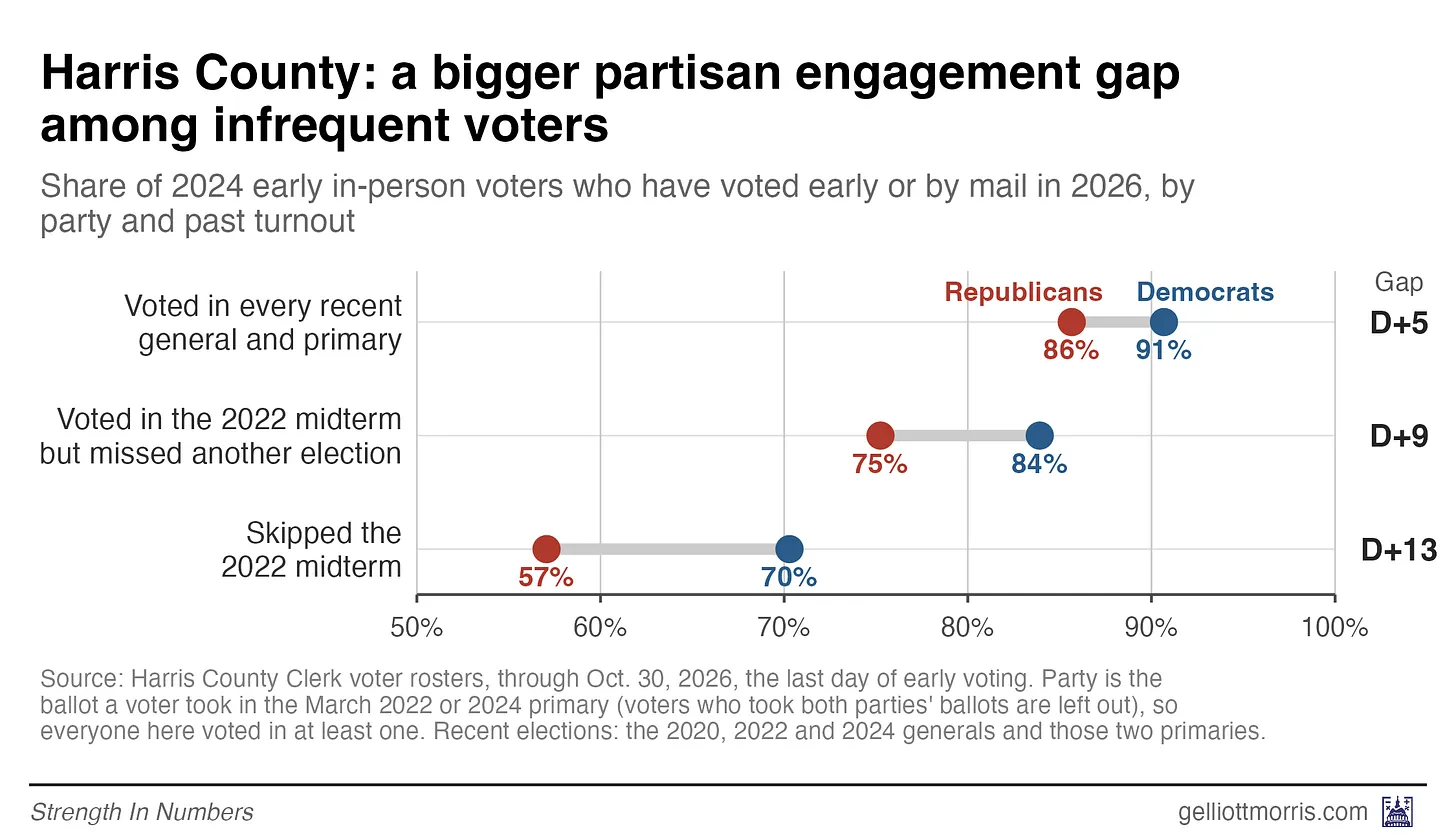
The upshot from that post can essentially be summarized in the chart below, which shows the share of Democratic and Republican voters in Harris County (Houston) who (a) voted early in 2024 and (b) have voted early or by mail this year. Each row shows the turnout rate for prior Democratic and Republican early voters by their level of past engagement, such as (in the first row) Houstonians who voted in the 2020, 2022 and 2024 general elections and the 2022 and 2024 primaries.
There is a larger “engagement gap” between Democrats and Republicans among the lowest-engagement group of voters. Among Houstonians who regularly turn out for elections, Democrats (91% turnout) are out-voting Republicans (86%) by a modest but still sizable 5 points. But among irregular voters (bottom row: those who skipped the 2022 midterm but voted early in 2024), Republicans (57%) have fallen 13 points behind Democrats (70%).
New voters skew even more Democratic. Among those who voted in the primary this March, Democrats outnumber Republicans more than 5 to 1. In 2022, they were split about evenly.
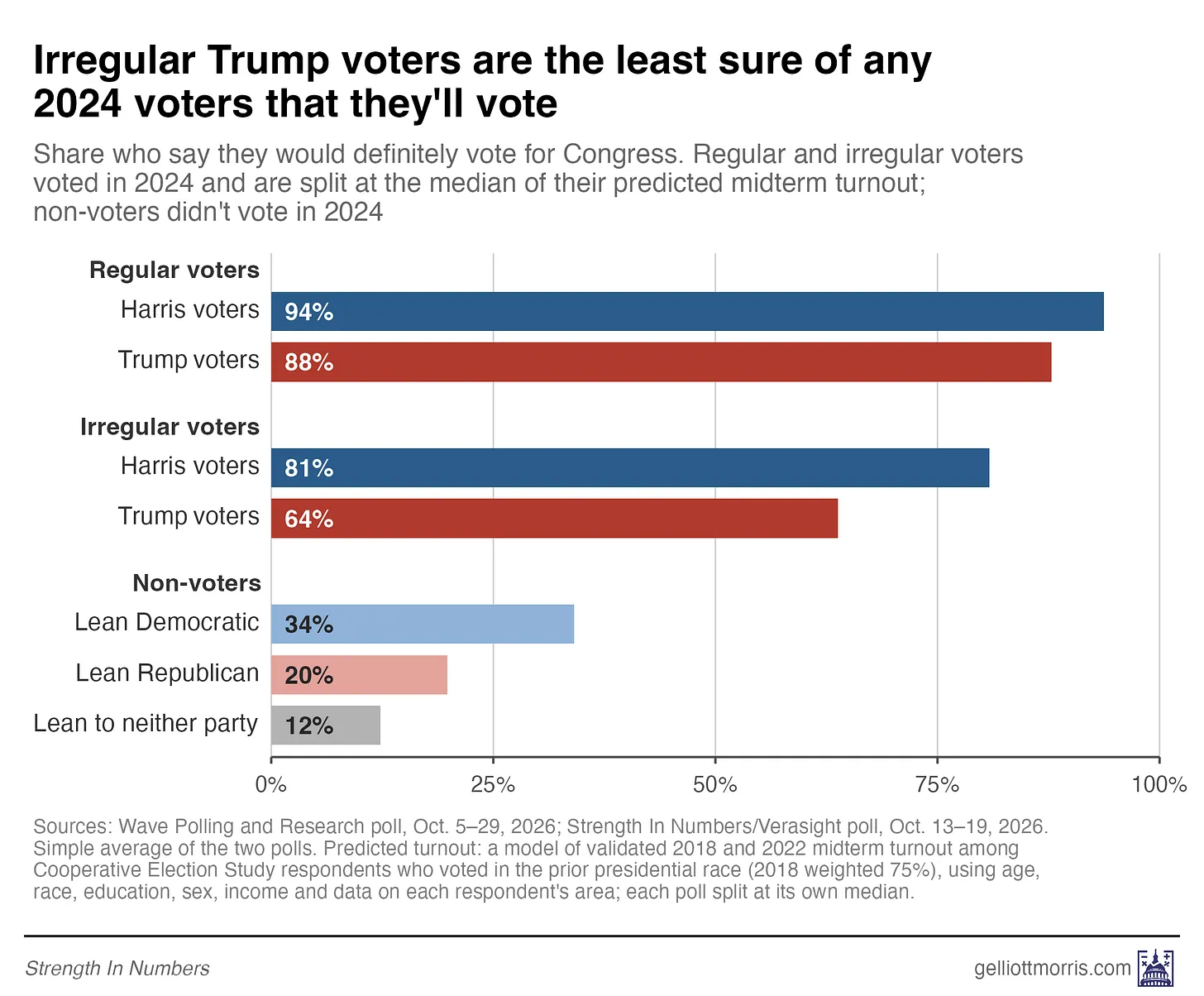
These results look a lot like the polls. For months, Republicans have been telling pollsters they’re less likely to vote this year than Democrats — by about 10 percentage points across firms. But that gap is concentrated among the least reliable Trump voters.
In two recent surveys — one from Wave Polling and Research, the polling firm I run, and the other from our Strength In Numbers/Verasight poll — 94% of regular voters who backed Kamala Harris in 2024 said they’d definitely vote for Congress, compared to 88% of regular Trump voters, a modest 6-point gap.
But among irregular voters, the people who turned out in 2024 but are less likely to vote in a typical midterm, the gap nearly triples: 81% of irregular Harris voters say they’ll definitely vote, vs just 64% of irregular Trump voters. Irregular Trump voters are the least sure of any 2024 voters that they’ll turn out.
Emphasis in original. I don’t have a point to make about any of these, I’m just presenting them.
And finally, from the San Antonio Report:
Bexar County voters have already cast more than half of a million ballots in the Nov. 3 election — breaking a local record for most early votes in a midterm election.
High voter interest comes as money has been pouring into San Antonio for an expensive U.S. Senate race, Texas governor’s race, and nationally targeted congressional contests in this area.
Early voting ended Friday evening with 527,641 total votes cast so far, or about 39% of the county’s 1.3 million registered voters.
That’s nearly as many people as participated in the entire 2022 election in Bexar County, but shy of the 576,639 early ballots cast in the 2024 presidential election.
Last week Elections Administrator Michele Carew said she thought Bexar County might surpass its 2024 presidential turnout — something that would be highly unusual, even in a fast-growing county.
Midterm elections typically draw about 50-55% voter participation, while presidential years draw more like 65-70%, said San Antonio political strategist Kelton Morgan.
The 2024 election was something of an outlier, however, in which only about 59% of the Bexar County voters participated, casting roughly 763,000 total votes.
Polls will be open once more from 7 a.m. to 7 p.m. for Election Day on Tuesday, Nov. 3.
That’s when about 25-30% of the total votes are typically cast, said San Antonio political data analyst Bert Santibañez.
In 2018, Bexar County cast 551,896 votes, so the early vote this year almost matched the entire total from 2018 as well. (There were 543,164 votes cast in 2022.) Bexar went to Beto O’Rourke 59-39 in 2018, so one would hope that the even stronger turnout this year will bode well for the Dem ticket. (The turnout rate was just shy of 50% in 2018, and just over 44% in 2022.) It’s probably not a coincidence that both Gina Hinojosa and Greg Abbott made their closing pitches here. Ken Paxton was supposed to as well, but when was the last time he told the truth about anything?