If the GOP is the party that doesn't "get" the internet, are they also the party that doesn't "get" Hispanic voters? When only John McCain committed to attending a Spanish language debate in Miami, it was indefinitely postponed:
Univisión planned to air the first presidential debates in Spanish on Sept. 9 and 16, one for Democrats, the other for Republicans, trumpeting a national coming-out party for Hispanic voters.Except Republican candidates aren't coming. Only Ariz. Sen. John McCain agreed to participate in the event at the University of Miami.
So much for Sept. 16.
''That date is off the table,'' university spokeswoman Bárbara Gutiérrez said Wednesday.
She said a GOP debate hasn't been ruled out for later in the fall.
''We're thinking that everyone wants to see how the Democratic one goes before they commit,'' she said.
All eight Democratic candidates are slated to show up Sept. 9, and party leaders plan to highlight the contrast. The New Democratic Network, a nationwide political group, is planning news conferences and inviting Hispanic leaders, including Sen. Bob Menendez of New Jersey, former Cabinet member Henry Cisneros and U.S. Rep. Luís Gutiérrez of Illinois.
Most of the Republican field also ignored invitations to attend Hispanic-oriented conferences in Florida organized by the National Association of Latin Elected Officials and the National Council of La Raza.
That doesn't mean they're not courting Hispanic votes. Former New York City Mayor Rudy Giuliani campaigned in Hialeah in June and July.
On Wednesday, former Massachusetts Gov. Mitt Romney announced endorsements from Hispanic leaders around the country.
''This is all part of a continuous effort to reach out to the Hispanic community,'' said Romney spokesman Alex Burgos. ``We had a conflict with the debate, but we continue to be in contact with them about potential opportunities in the future.''
So, the message the Republicans are sending: we want Hispanic votes but aren't willing to put in the legwork to get them. It's such an unbelievably bad decision to decline to attend this debate. I just can't imagine what these campaigns think they're doing. I'm sure they declined due to scheduling conflicts, but that's not exactly the same thing as wanting to see how the Democrats do before they commit, which is the only reason this article mentions. I hope the Dems really let them have it over this.
I want to commend Governor Perry for abiding by the 6-1 recommendation from the Texas Board of Pardons and Paroles and commuting the sentence of Kenneth Foster Jr. yesterday. From the Chron:
For only the third time since he's been in office, Gov. Rick Perry on Thursday commuted the death sentence of a Texas inmate to life imprisonment following a recommendation from the Texas Board of Pardons and Paroles.The move by the governor came about an hour after the equally rare recommendation, on the same day that Kenneth Foster Jr., 30, was scheduled to die for the 1996 slaying of Michael LaHood Jr., 25, the son of a San Antonio attorney.
Invoking a statute known as the law of parties, prosecutors had argued that Foster -- the getaway driver during an August 1996 robbery spree -- conspired with his friend, Mauriceo Brown, to rob LaHood and therefore was culpable for his murder, even if he did not intend to kill the victim. A jury agreed and sentenced Foster to death, finding he actually anticipated the murder.
The jury also found that Foster, a gang member, was a future threat to society.
The case had drawn international attention in recent weeks, inspiring protests and letters urging the U.S. Supreme Court, the governor and the parole board to spare Foster's life because he did not participate in the killing.
The story did get a lot of press, as the Chron mentioned, and I think Gov. Perry made the right decision. The death penalty isn't usually a hot campaign issue since a majority of Americans favor it, but it does rile up the large minority that opposes it. From the Death Penalty Information Center, I got the statistics on who supports the death penalty. For all of these demographics, except African-Americans, the only difference is how strong the support is. But with only 58% of Democrats and 44% of African-Americans in favor, I think there's room for a serious candidate who takes a strong anti-death penalty stance.
But here's what our frontrunners sound like. Barack Obama in 2002:
We certainly don't think that we should be... have this laundry list that does not make any distinctions between the run-of-the-mill armed robbery that results in death, and systematic killings by a terrorist organization. And I think essentially what the reduction of aggravating factors does is it says, "Here's a narrower set of crimes that we think potentially at least could deserve the death penalty."
But here's Dennis Kucinich in 2004:
The imposition of the death penalty is both racially and economically biased. African American defendants are more likely to receive death sentences than others who committed similar crimes. Ninety-eight percent of all defendants sentenced to death could not afford their own attorney.
It's too bad that the only candidate for 2008 who really does take an anti-death penalty stance is mostly just fodder for late night talk show jokes. Maybe Kucinich hanging around or the press that Perry got will help to move this debate back into the mainstream and cause people to rethink their positions while I'm still young and idealistic.
One of the unfortunate side effects of my recent pneumonia experience was that I was forced to cancel a trip Olivia and I had planned to take to New York to visit family and attend a few minor league baseball games. These trips have become a semi-annual family tradition, and I'd really been excited about taking Olivia to participate, especially since we'd be meeting up with some cousins I hadn't seen in awhile. Life had other plans for me, sadly.
One of my uncles spoke to a writer at the hometown paper about the experience. Here it is, so you can see what we missed out on.
STATEN ISLAND, N.Y. -- They call it the Wanderers tour -- a journey that began in 1994, when the children of Charlie and Jessie (McLaren) Kuffner met in Chittenango State Park near Syracuse, went camping, played Scrabble and cheered at six minor-league baseball games, including one played in Cooperstown. And it was at Cooperstown that Charlie, Ken, Jim, Dan and Bill -- and their sister, Judy -- who was not with them on the tour -- decided to call themselves the Wanderers Minor League Baseball Touring Company in honor of their father and his brothers, who grew up in Stapleton during the 1920s and '30s and played semipro baseball, basketball and football as the Stapleton Wanderers.According to Bill Kuffner, since 1994 there have been eight Wanderers Tours that covered Indiana, Illinois, Western New York, North Carolina, Texas, Oregon and Montana. Along the way, participation in the tours grew to include Judy, their children, grandchildren and several Kuffner cousins.
This year, we hear, the tour focused on the New York City area and ran from July 8 to 14 -- including stops at Brooklyn Cyclones, Staten Island Yankees and Newark Bears games -- so kinfolk decided to get the entire family involved and gather on Staten Island with Kuffner cousins and their families and McLaren cousins and their families. The host for the event was the Rev. Pat Kuffner, who was gracious enough to extend the use of his parish hall and gym over in Metuchen, N.J., to the out-of-state tour members, to be used as their campsite.
Karen Kuffner Benson and her husband, Kevin, were hosts for the Kuffner family reunion on July 11 -- and Ann McLaren Lutkenhouse hosted the McLaren family reunion on July 12 -- after the Staten Island Yankee game. In all, the get-together comprised about 50 people.
"We had an absolutely wonderful time at the reunions," says Bill, as well as at the baseball games. "We sang the national anthem at both the S.I. Yankees and the Newark Bears" and went swimming at Hillside Swim Club -- courtesy of cousin Karen Kuffner Benson and her husband, Kevin. Also, they got to swim at the South Shore Swim Club, courtesy of cousin Ann McLaren Lutkenhouse.
Cousin Hap Kuffner and his wife, Karen, hosted a picnic at their house -- where revelers played stickball, took a ferry ride and visited the firehouse of Engine Co. 157/Ladder Co. 80 in Port Richmond, where their dad worked for 22 years (an alarm came in while they were there) and where one of the firemen produced a ledger from 1944 showing their dad reporting in for duty! Quite a thrill, says Bill.
"We visited our homesite at 226 Oakland Ave. and marveled at the beauty of the neighborhood. We visited St. Peter's, from which we all graduated, in '54, '59, '61 and '64. We visited the cemetery and laughed and cried with our parents and Kuffner and McLaren aunts and uncles who are buried there," Bill adds.
They further reminisced when indulging in pizza at Denino's and Italian ices at Ralph's over in Port Richmond.
All in all, Bill says it was just a spectacular event and experience.
The future of the city's ambitious wi-fi plan is questionable right now. From a Chron story by Carrie Feibel:
Following months of delay, an ambitious plan to blanket Houston with wireless Internet signals now is in serious jeopardy.The city's partner in the project, EarthLink, will pay a $5 million penalty to the city for not meeting its deadlines, Mayor Bill White said Wednesday.
"They're either going to do a graceful exit," White said, "or they're really going to figure out whether they can get other industry participants."
The payment will give EarthLink an additional nine months to find investment partners for the Houston project, White said. The company also could decline to do the project altogether without paying additional penalties, he said.
EarthLink announced Tuesday it was laying off 900 employees, nearly half its work force in a company restructuring. A spokesman declined to comment on its agreement with Houston.
I think the "in serious jeopardy" bit might be a little dramatic on Feibel's part. We're already looking at a delay, but I think that either EarthLink will exorcise their internal demons and take care of this, or the city will find someone else to do it. Dwight Silverman had a nice blog post in which he says he expects EarthLink to follow through in Houston. If they want to stay in the city wi-fi business, I don't think they really have another option. I'd just really like to see more commitment from the company though. Like Dwight has pointed out before, citywide wi-fi networks are notoriously spotty, and this isn't going to be successful unless it's done well. So reading this is a little frustrating:
City officials expected installation of the wireless equipment to begin this summer, but EarthLink never completed the first step: signing an agreement with CenterPoint to place equipment on its utility poles.EarthLink is reconsidering its business model for building municipal wireless networks. Rolla P. Huff, EarthLink's President and CEO, spoke to investors during a Wednesday morning conference call on the company's restructuring.
''We will not devote any new capital to the old municipal Wi-Fi model that has us taking all of the risk by fronting all the capital, then paying to buy our customers one by one," Huff said.
EarthLink already has the kind of deal they're looking for with the city, one in which the municipal government is the primary customer: the city's going to be paying $2.5 million over 5 years to use the network. This is an exciting project and I really want to see it work out, but I guess for now we just have a nine-month waiting game to see if they can get it off the ground.
City Council yesterday amended the red light camera ordinances to comply with new state laws. The more interesting action was about the new cameras that were quietly installed at intersections that were already enabled.
The department added the new cameras without consulting council members, including the chairman of the public safety committee.The council was not asked to amend the current contract with the vendor who installs and monitors the cameras, even though the payment terms only call for up to 50 approaches during the deal's five-year term.
[Mayor] White said he does not need a council vote to increase the number of cameras, and that the contract allows the department to expand at will, though he acknowledged the payment structure needs clarification.
Asked whether council members would need to approve any effort to expand the program to 100 intersections, White said: "We'd probably consult with council, but I don't think there'll be any need for a vote."
Councilwoman Anne Clutterbuck, a lawyer, said she did not know the panel's approval last year of the vendor contract meant the department could install multiple cameras at each intersection.
"The contract specifies 50 approaches," she said. "That, to me, is a lot different than 50 intersections."
I would prefer that Council have input on future expansions of the camera program. I don't think they need to approve every new location, but they should have some say in the overall direction it's going. And, um, we are going to do those engineering studies as required by that new state law before we go installing more cameras, right? Seems to me that the report on those proposed locations would be a good thing to bring up at a Council meeting, in case there's any questions.
The question of what the contract with the vendor specifies is an interesting one. I agree with Council Member Clutterbuck - "intersections" and "approaches" sure sound like two different things to me. It would be nice to know what the vendor thinks about this, wouldn't it?
Councilwoman Melissa Noriega, however, said she wasn't concerned about HPD's move. "If you have a philosophical problem with them, then you have a problem with them," she said of the cameras. "If you think it's reasonable to monitor that way, then does it matter if you have them on every corner or just one corner?"Clutterbuck was one of four members to vote against the ordinance change required by the state law.
"I feel very strongly that we need to create our own ordinances with regard to our streets," she said.
Council members Ada Edwards, Jarvis Johnson and Toni Lawrence also voted against the proposal. Council members Michael Berry and Addie Wiseman were absent for the vote.
Council Member Noriega emailed me the following after this article was published:
I voted against the cameras when I was in Austin--I have real concern about the whole idea of cameras everywhere from a civil liberties view, and unlike a fair number of D's, voted 'no' on this one. The question of having a camera on every corner is a serious matter, and I think it should be one where a whole community has a conversation, like in a referendum or town hall meetings or something.
Having said that, I was shocked at the level of violations, and so taken aback by the huge number of violators--thousands and thousands--and the unbelievable public safety hazard it represented, that I have had to rethink this. Clearly something needed to be done, and I have been quite conflicted ever since.
They passed this law last session, and I continue to think it over, and we discuss it at dinner quite a bit because, to me, this rises to the level of a profound philosophical question--liberty or safety, safety or liberty? In the face of that argument, adding a few cameras here or there doesn't seem like the issue.
I don't want anyone to think I don't see this as an important issue--Council Member Clutterbuck's comment that we need to control our own streets is well taken--when I have very serious concerns, indeed. They just aren't so much how many and where, but rather why? and with what implication? for our freedoms in this country.
The other item of interest from this story concerns the Kubosh lawsuit.
The council unanimously approved spending up to $175,000 to defend a lawsuit filed by Paul Kubosh, a lawyer representing his brother, Michael, who intentionally ran a red light to challenge the camera system."They want to save their red-light camera scheme," Michael Kubosh said. "If their case wasn't weak, they wouldn't need a high-dollar lawyer."
Would you have preferred they get a pro bono lawyer, like your brother? They've done pretty well with those, you may recall. I'll let the actual attorneys in my audience comment on this, but it seems to me that given the amount of time and effort needed to defend a lawsuit like this, $175K isn't a particularly extravagant sum.
One can, of course, criticize the city for paying any amount to defend itself from a suit if the actions that led to the suit were unwise or the defense is clearly untenable. But here, I have to wonder what point Kubosh is trying to prove by his continued pursuit of this suit. Recall what he said at the time:
Michael Kubosh said Sunday that he will argue the city cannot impose a civil penalty on drivers who run red lights."The city has gone outside their legislative authority," said Kubosh, who will be represented in court by his brother, lawyer Paul Kubosh. "We just can't let this go because accidents increase at intersections where these things are put up."
Well, SB1119 explicitly gave that authority to cities, so as I've said before, this action seems to have been rendered moot by that. Kubosh certainly could have amended his suit to challenge the constitutionality of the state law, but if he did I'd assume it would be the state defending itself, not the city. Maybe he just wants his own citation voided, I don't know. I can't tell what he's aiming for by pursuing this at this point.
The future of The Woodlands will be determined by the voters this November.
The Town Center Improvement District board voted today to call for a Nov. 6 election that will move the community closer to becoming a city in 2014.Two of the propositions are the result of two bills passed during this year's legislative session. The bills, SB 2022 and SB 4109, enable The Woodlands to enter into a regional partnership agreement with Houston, protecting the community from annexation, and gives the district the authority to expand its boundaries and carry out the agreement.
The first proposition seeks to expand the special taxing district's territory to include all The Woodlands and the second proposition would change the district's board, making it smaller with all elected members.
The third proposition would give the district authority to collect property taxes in addition to the sales taxes it already collects.
The district board voted today to add the third proposition to the ballot, saying property taxes combined with the additional sales tax revenue would provide greater savings to residents in terms of reducing their property assessment fees, which are not tax deductible.
[...]
The first two propositions must be approved for either to be carried out, said Mike Page, the district's attorney. If approved, the district would be renamed The Woodlands Township and would eventually evolve into the single governing body of The Woodlands, replacing the three community associations.
The transfer of power would be another step toward future incorporation, said Joel Deretchin, a member of the community's transition committee, which is working on a plan for how the transition will work.
Community leaders are still waiting for the Houston City Council to approve the regional participation agreement brokered last December by Mayor Bill White and Woodlands Sen. Tommy Williams.
Gotta figure that'll be on the Council agenda pretty soon, and one would expect it to pass. We'll see what the voters think.
Lee Vela, the president of the Outdoor Advertising Association of Texas, has responded to the digital billboards story with the following letter to the editor in the Chron.
Regarding the Chronicle's Aug. 22 editorial ("Visual blight / Texas' policy should be to reduce distracting, ugly billboards, not make them more garish, profitable") and its Aug. 24 article ("Digital billboard plan stirs debate"): This media coverage on the issue of electronic billboards has brought to light an often repeated misconception about using these billboards in Texas.The off-premise advertising use of electronic billboards that was proposed by the Texas Department of Transportation rules would allow one message change every eight seconds.
This use is static, as compared to on-premise casinos, whose displays are allowed to flash, blink and display motion.
The use of motion in electronic billboards in Texas would be prohibited.
Static electronic displays are highway safe.
The Virginia Tech Transportation Institute has conducted a study on static displays, and has found them "safety-neutral."
The institute is nationally renowned for its transportation studies and is often used by the federal government.
Additionally, another traffic study conducted by Tantala & Associates found that static displays had no statistical relationship to the occurrence of highway accidents.
Another critical component of the proposed rules is that the billboards would adjust their brightness for natural ambient light conditions.
A board that is found to be too bright would have to reduce its intensity to an acceptable level.
Finally, the rules allow cities to decide if, and under what conditions, off-premise electronic billboards could be erected.
We are doing everything possible to ensure their responsible use.
LEE VELA
president, Outdoor Advertising Association of Texas, Houston
Thank you for the feedback. I'm glad to know that there's no degradation in highway safety due to these things. I still hate the idea and still think they'll be an extra level of ugly, no matter how much they're downplayed. And I still hope we never see them in Texas.
Let me register my disagreement with Tory Gattis over the question of closing the "condo loophole" for minimum lot size restrictions in neighborhoods that have them.
The new ordinance will only allow a single-family home on the lot (which sounds dangerously close to zoning to me). In general, the city seems intent on reigning in the amazing townhome development happening inside the loop. But one man pointed out that townhomes make housing more affordable, which received a negative reaction from the crowd.People seem to believe it will preserve the character of their neighborhood to require only one single-family home on a minimal size lot. But does it really? These restrictions already apply in West U and Bellaire. The result? Waves of gigantic McMansions. I think they're perfectly nice, but they certainly don't match the character of the older single-story ranch houses in these cities.
But it's not just the physical character that changes. If a developer can't build three $200K+ townhomes on a lot, he'll be forced by economics to build a single $600K+ McMansion. The demographic that can afford that house are in a completely different income bracket from those who can afford the townhomes. Does that really preserve the neighborhood's true character better than the townhomes? A middle class neighborhood ends up rapidly gentrifying, when townhomes could have let it stay middle class.
Right now Houston is attracting a wonderful demographic mix - racially, economically, and age wise - to the townhomes inside the loop. That's part of why the inner loop feels so vibrant today. Do we really want to replace that with only wealthy older couples and families? That's what's happened in Bellaire with the single-family housing restrictions, and that seems to be the direction Houston's headed.
I have three points to make here.
1. Why shouldn't a neighborhood that has done the arduous and time-consuming process of getting minimum lot size petitions filed not be able to fully enjoy the protections that they've signed up for? What exactly is the purpose of having this process if it can be so easily subverted by a developer?
2. The McMansions argument seems specious to me, given that the Planning Commission is also working on a height and width ordinance similar to the lot size and setback ordinance. That won't be effective everywhere, but I think it will mostly neutralize that threat.
3. Given how cumbersome the lot size petition process is, there's really only a small number of neighborhoods that will be affected by the closing of the condo loophole. I seriously doubt that will put much of a crimp in the condo developers' plans, as there will still be plenty of places to put them, most of which will be more appropriate for them anyway. Drive down Washington Avenue between Studemont and the Westcott traffic circle, for instance.
I don't have a problem with townhouse development. I agree, it's been a boon for the inner Loop overall. But it seems to me that we have these rules, which neighborhoods and many City Council members understood in good faith to mean one thing, only to be told another. The purpose of this proposed ordinance is to make the rules mean what people thought they said. I don't think there's anything particularly radical or harmful about that.
The worst-kept secret in local politics officially became a non-secret today, as District Clerk Charles Bacarisse resigned his position to run for the GOP nomination for County Judge.
Bacarisse, who has served as district clerk since 1994, effectively resigned his position to run.By state law, county officials are required to resign to run for another office. A notice of vacancy and request for applications was sent out via e-mail shortly after Bacarisse made his announement.
The duties of district clerk are largely ministerial, including summoning prospective jurors for state and county courts, maintaining certain court files and collecting child support payments.
In contrast, the county judge is the titular head of county government and its ceremonial face. The office, however, carries little real executive authority except as head of emergency management.
If elected, Bacarisse said he would address the costs associated with illegal immigration, which are "stretching taxpayers and county resources to the breaking point."
He also said he would ask Commissioners Court to adopt a taxpayer bill of rights to cap the county's annual budget at level equal to the growth of population, plus the rate of inflation. And he promised to forge a "public-private-faith partnership" to reach out to troubled juveniles.
Yes, that's definitely a platform for a Republican primary. I'm curious - did he say nothing about transportation and toll roads, or emergency preparedness, or was that just not mentioned in the story?
Bacarisse has waited in the wings more than 10 years for the county judge position to open. But he was passed over by Commissioners Court earlier this year. It appointed Ed Emmett when Robert Eckels resigned.
Well, as GW Plunkitt might have said, he saw an opportunity and he took it. We'll see how it goes. Fight fiercely, boys.
He's not resigning, as was previously rumored, but State Rep. Mike O'Day has now announced that he will not run for re-election.
"Seeking elective office is something I never intended to do," Mike O'Day, R-Pearland, said in his announcement. O'Day won a special election runoff in January to replace Rep. Glenda Dawson in the district covering all of Matagorda County and northern Brazoria County.
Well, I can't say for sure he'd be the shortest-serving legislator ever, but he'll still clock in with less than two full years of tenure, and that ought to put him in the top ten at least. The dynamic of this doesn't change much from a special election to a regular open-seat election. The Republicans will be heavily favored, but the right Democrat could make a race out of it. We'll see who steps up to run.
Vince had this reported last evening. He also has news of primary challenges in El Paso and Waco. Check 'em out.
It's often said that Christmas season seems to start earlier every year. Maybe that's because Halloween season is starting earlier, too.

(Another view is here.) This will please Olivia, who loved pointing out the Big Pumpkin every time we drove past the Party Boy costume/novelty shop at I-10 and Studewood last year. When the calendar rolled over to November and the Big Pumpkin went back into storage, she was upset about it and kept asking where it was. We told her it was asleep - it's amazing what kind of BS you can get away with telling a 2-year-old. Anyway, even as Labor Day still looms in the future, the Big Pumpkin is back for another long and glorious Halloween season. She'll be so happy.
Since the general consensus around Houston seems to be that the Tim Purpura firing was justified, I thought it might be a good idea to present an alternate view, that of Joe Sheehan from the Baseball Prospectus.
Firing Purpura, as McLane did yesterday, is an act of incompetence. Not only was it Purpura's work--he ran the Astros' player-development operations for seven years prior to becoming GM--that built the pennant winner, but with the expensive problems he inherited and the meddling of McLane, it was impossible for him to move the Astros in the direction they needed to go. He was essentially a caretaker, needing to preside over a rebuilding process and never being allowed to do so, and he's now out of a job largely because his employer has returned to being completely irrational about what his team is.Purpura's performance as a GM was a mixed bag. He made his share of missteps, such as the [Willy] Taveras trade and the Woody Williams contract. However, he showed a terrific ability for making the smaller moves that add value at very little cost. In three seasons, Purpura made something-for-nothing pickups such as Mike Lamb, Aubrey Huff, and Mark Loretta. The player-development program he built continues to generate contributors such as Luke Scott, Wandy Rodriguez (check out his peripherals this year), Chad Qualls, and Troy Patton. If left to his own devices, I have no doubt that Purpura would have limited the Astros' rebuilding process to a few short seasons, and come out on the other side with a team prepared for a long run of success.
Instead, he's out of a job. Tim Purpura isn't to blame for the Astros' disappointing 2007 season, and that he's being fired for it is ridiculous. Drayton McLane set these events in motion by abandoning what had worked for close to a decade--staying out of the baseball staff's way--and instead making his own bad decisions about what the Astros needed. McLane wanted a year-long coronation of Craig Biggio, and he got it. He couldn't have that and a contending baseball team, however, and his refusal to see that--and his subsequent dismissal of Purpura and Phil Garner as scapegoats for his own mistakes--ranks as one of the game's great embarrassments of 2007.
Much the same sentiment is expressed by Tom Kirkendall, though he is more understanding of the move. So there you have it.
UPDATE: And Sheehan's colleague Nate Silver makes the case against Purpura.
I think we can break the general manager's job into three broad compartments, those being (i) scouting and development; (ii) transactionally-based talent evaluation and analysis, and (iii) interpersonal and intraorganizational skills. And I think Purpura comes up short in each of those departments.In the scouting realm, the Astros ranked 22nd of 30 teams in PECOTA's analysis of minor league talent, 28th in Kevin Goldstein's ranking of the same, and dead last in PECOTA's rankings of the overall 25-and-under talent stock. The Astros have had a handful of player development successes, but their system is poor enough to be past that tipping point where the option of a quick-turnaround rebuilding effort is largely off the table.
In the talent evaluation realm, Purpura's highest-stakes transactions - the nine-figure signing of Carlos Lee, and the Jason Jennings deal - grade out badly (indeed, this is not merely perfect hindsight; they were viewed skeptically at the time). The Astros can also be blamed for their inaction in a number of areas, whether it's failing to offer Roger Clemens arbitration, or allowing run vacuum Brad Ausmus to retain his hold on the catching position.
The intrapersonal skills category is the hardest to evaluate without inside knowledge, and the one where Purpura deserves the most sympathy. Meddling owners like Drayton McLane are almost always counterproductive. It isn't uncommon to see owners block trades, or to be willing to open up the purse strings for some free agents but not for others, but it's extremely unusual to see the owner essentially jump two levels down and interfere with the job of the field manager, as McLane looks to have done by mandating that Craig Biggio play every day until he reached 3,000 hits. This is terrible from an organizational culture standpoint; Purpura's ability to manage Phil Garner was undermined by McLane's insistence on doing the same.
At the same time, the general manager's job is not just about managing one's subordinates, but also managing one's superiors. If we make the favorable assumption toward Purpura, which is that he was not on board with the decision to play Craig Biggio every day, we also have to assume that he was unable to persuade McLane of his case. Certainly, we cannot know how many general managers would have fared differently, but we nevertheless have to regard this as sort of a "tough love" indictment of Purpura. I happen to think that the battle might have been unwinnable, but the war was not: if Purpura had been able to articulate (literally and figuratively) a better long-term vision for the franchise, then the downside to playing Biggio would have seemed more tangible.
I think that's about all I've got on this subject. Moving on...
Some intersections that currently have them in Houston now have more of them.
Houston police quietly have moved to install new red-light cameras at 20 intersections already monitored by the system, allowing citations for motorists traveling in the opposite direction, officials confirmed Tuesday.The 20 new cameras are expected to start working Friday. Motorists caught by the new cameras would be issued warnings during a month-long grace period ending in October, police said.
The move to add more cameras, which had not been publicly disclosed, appears to conflict with the terms of a contract the City Council approved in 2006 with American Traffic Solutions Inc., the private company that installs and monitors the cameras.
That agreement includes payment arrangements with the company for a total of 50 intersection "approaches," or cameras monitoring specific directions at a location.
But department officials said Tuesday that they long had planned to increase the number of cameras at some locations, and they denied the contract limited that total to 50 intersections.
"These are different approaches at those same intersections," said Executive Assistant Chief Martha Montavlo, who supervises the program.
Montavlo said the decision to add the new cameras had nothing to do with a new state law, which takes effect Saturday, that could require some cities to do engineering studies at new locations.
[...]
The department has said for more than a year that its initial plan was to install cameras at 50 intersections.
Montalvo said late Tuesday that she was not aware of any briefings to council members about the new cameras. But she said Police Chief Harold Hurtt had planned to make an announcement later this week.
Randall Kallinen, a lawyer who complained about the cameras before the council Tuesday, said he doubts safety motivated the department to increase the number of cameras at the intersections.
"The idea for the red-light cameras is to pick the problem areas," he said. "Is it a problem in one direction, or both directions?"
Montalvo has in the past said expanding to more sites was possible, but only after the department hired someone to study the effectiveness of the current cameras at reducing crashes.
Montalvo said Tuesday she had not arranged for such a study, but that one was still planned.
Okay, on the one hand, it seems reasonable that if you're already monitoring traffic going one way at a certain intersection that you'd want to monitor the other way, too. I realized as I was reading this story that I'd mistakenly thought that was already the case at these intersections. Assuming that the contract with the vendor is understood to mean "intersections" and not "approaches", I don't think there's anything out of line about the concept.
But geez, what's up with the secrecy? Installations at new locations were publicly announced in advance. Surely announcing this wouldn't have caused any more fuss. Given that today is Wednesday and the work was to start Friday, how much "later in the week" was it going to be before Chief Hurtt mentioned this to City Council? And yes, the timing with the new state law is convenient, at the least, though if there's work to be done after Friday, one presumes that an engineering study would still be required. Or was the plan all along to say that since these intersections already had cameras, no such study was called for to add them in other directions?
This does not look good. It gives people who aren't already suspicious of the cameras a reason to think there's something funny going on with them. I don't know why this wasn't done the same way as before, but I do know that it should have been.
Back in June, Montgomery County Commissioners Court approved the installation of two red light cameras in The Woodlands, though just for "informational" purposes at the time, as the levying of fines was not part of that. Well, now it is, or will be as of October 1.
Motorists caught running a red light in The Woodlands will be slapped with a $75 citation under a new ordinance adopted Monday by Montgomery County Commissioners Court.The ordinance enables county enforcement of red-light cameras that have been installed at two busy intersections in the master-planned community.
The action is part of a new state law, Senate Bill 1119, that gives counties the same power as cities to operate red-light cameras and issue tickets.
The Montgomery County Sheriff's Office and Precinct 3 Constable's Office will review the red-light video and photographs and decide whether a violation has occurred.
The constable's office will administer the enforcement program. Precinct 3 Constable Tim Holifield said there will be a 30-day period in which violators will receive a warning from Redflex Traffic Systems of Arizona, the contractor hired to operate the cameras.
Law enforcement will begin issuing $75 citations beginning Oct. 1, Holifield said. Violators will be hit with an additional $25 if they pay late, he said.
[...]
The cameras are on Woodlands Parkway at Woodloch Forest and East Panther Creek. Woodlands Parkway is a major east-west thoroughfare that connects to Interstate 45.
Precinct 3 Commissioner Ed Chance, whose precinct includes most of The Woodlands, said additional cameras might be installed in community but no decision has been made yet.
Like 'em or hate 'em, more and more you can't escape the red light cameras. Be aware of where they are and drive accordingly.
A little video goodness for you this evening:
That was from Monday's press conference at the GRB. Here's the man himself:
Text of Noriega's remarks are here. As always, if you like what you see and hear, you know what to do.
When I wrote that District Clerk Charles Bacarisse was rumored to be resigning on Friday to make official the run for County Judge that everyone knows he plans to make, I figured if that if the rumor were off it'd be by being too early. Turns out, it may have been off by being a little late.
Harris County District Clerk Charles Bacarisse is expected to announce his candidacy for county judge on Wednesday, ending months of speculation about whether he would seek the job after being passed over for it earlier this year.Bacarisse told the Houston Chronicle last week that he had no plans to declare his intentions before Labor Day. But a close political adviser, Jim McGrath, indicated Monday that Bacarisse would make it official this week.
Asked if that was true, the district clerk hedged.
"I want to wait until I speak at the press conference to say anything, for obvious reasons," Bacarisse said. "I don't want to trigger the 'resign to run' provision until I trigger it."
Well whaddya know? I suppose that makes sense, since announcing such a thing right before Labor Day weekend isn't exactly a great way to get noticed. And he's gotten an extra day in the news cycle out of it, too. Nicely done.
This comes as a surprise to me:
By state law, the county's 59 district court judges are tasked with appointing a replacement to fill the remainder of Bacarisse's term.He was elected to a four-year term last November. If the judges fail to reach a unanimous decision, Gov. Rick Perry must order a special election to fill the vacancy.
The latest Perry can call a special election for the November ballot is Oct. 7, according to the secretary of state's office.
If the judges do not agree before then, the earliest an election can be held is on the next uniform election, May 10.
"The district judges have been aware that this was coming along and they have a committee in place," County Attorney Mike Stafford said.
"I don't think it will take them long to meet. I'd be pleasantly surprised if they came to a unanimous decision, though."
It was my impression from reading this statute about county elected offices that a District Clerk vacancy would be filled in a similar manner as that of County Judge, which is to say that the next election would be in November of 2008. Apparently, that's not the case, though I can't personally confirm that as my attempts to search for a more on-point statute were unsuccessful. If anyone can do better than I at this search, please leave a comment.
Given this, it would seem that Robert Eckels' resignation earlier this year will have the extra bonus effect of making the county spend money on a special election. How nice for us. At least we can reasonably expect it to be this November, when the city of Houston and various Harris County independent school districts would be voting anyway. Of course, if the turnout for this special election is skewed more heavily towards the city of Houston and less towards the rest of Harris County, that might very well provide a leg up for Loren Jackson. That would be a nice and somewhat ironic coda to the whole saga, I think. We'll see what happens.
Yesterday Metro held the only public hearing on the Draft Environmental Impact Statement for the proposed University Line alignments. The DEIS is a pretty thick volume - two volumes, actually - and I want to thank Christof for summarizing it so well here and here. I don't think we would have had the volume of comments that we heard yesterday if the DEIS hadn't been made so accessible.
The hearing lasted something like three hours, with maybe 70 speakers total. I kept score between the pro-rail and anti-rail folks for a while, and my estimate would be that the rail on Richmond supporters outnumbered the opponents 2 to 1. There were a few people who liked the so-called Culberson option that runs from Richmond to Montrose to 59 to Kirby to Westpark, but most of the people who want rail support the Richmond-Cummins alignment.
Not surprisingly, a lot of the anti-rail comments were a little ridiculous. There was a lot of bait-and-switch talk concerning the ballot language and the Westpark and BRT controversies. I think Burt Ballanfant handled those comments pretty deftly, but I'll get to that later. A couple people talked about how dangerous the rail would be for children who play outside along Richmond, which confused me, because I don't think that Richmond in its current state is an especially safe playground. And there was a bit of "You say people are going to ride the rail, but I don't think they will. I wouldn't ride the rail" talk too. A lot of commenters raised genuine concerns about problems they saw in the DEIS - some with trees, congestion, property takings, etc. and I'm sure they'll be reflected in the FEIS.
The most important comment, I think, came from Griff Griffin and was echoed by Metro board membr Burt Ballanfant. Griffin talked about organizing the first anti-Richmond rail rally fifteen years ago, but now it's clear that the public support is behind rail on Richmond. He's learned to deal with that, and he's concerned about implementing this responsibly. Ballanfant said much the same thing, and he discouraged the opposing factions from wasting time fighting with each other and slowing down this process (i.e. lawsuits that he believes will probably be ruled in Metro's favor anyways). I think they're both totally right: from the DEIS, there's a pretty clear winning alignment. Now we have other things to think about - station locations, minimizing the negative impact on neighborhoods and businesses as we build, and preserving trees and yards and property as much as possible. It was refreshing to hear this from these two and from several other speakers as well. I'm sure we'll hear lots more about implementation as the process continues. I'm excited about it, because I know there are people on both sides of the alignment debate that are very passionate about preserving neighborhoods and being socially responsible, so I'm confident that we'll end up with a very attractive University Line.
I managed to get my two cents in at the hearing too. There was only one other student that I recall speaking, and she didn't specify where she goes to school. Her parents own El Pueblito on Richmond and she spoke pretty briefly against rail. So I was glad to skip class to go to the hearing and make sure that the students' perspective will be considered. I copied my comments after the jump, if anyone's interested. Metro blogger Mary Sit and Lydia from the HGAC asked me for copies of my statement, so you might see this floating around elsewhere too.
I live in Montrose a few blocks north of Richmond, and am a student at the University of Houston. Over 90% of UH's 30,000+ students live off-campus, and parking is notoriously difficult. We have the greatest space deficit of any university in the state, but we have a great master plan in the works to use the space we do have strategically. For the university's continued growth and success, I'd much rather see that space fill up with academic and residential facilities, not more parking garages. Not only do we need light rail to serve the university as a whole, one of the most vital entities in the city, we also need it to serve students as individuals. I know people who have hour-long commutes from places as foreign as Clear Lake. Time spent riding transit can be used for homework, reading, or anything else - anything besides the frustration of sitting in rush hour traffic. Not to mention the problem buying gas creates for students who are usually living on a tight budget. That being said, having reviewed the information in the Draft Environmental Impact Statement, I am here to state that I support the Wheeler/Elgin alignment on the east and the Richmond/Cummins alignment on the west. The Wheeler/Elgin alignment serves the UH campus the best: it puts everything in the academic core of campus within ½ mile of a rail station. Not only that, according to the Draft Environmental Impact Statement, it has the highest ridership for the lowest cost per mile and is the only option that includes a connection to the Eastwood Transit Center. The Wheeler/Elgin alignment has minimal negative impact on the surrounding areas, with the least noise and vibration impacts and arguably the most responsible property-taking. On the west end, the Richmond-Cummins alignment will best connect students to the places they want to go: homes in places like Montrose or Gulfton, jobs in Greenway Plaza and Upper Kirby, shopping in the Galleria, or leisure destinations like the Menil Collection. Not only that, but if we pair the Wheeler/Elgin and Richmond/Cummins alignments together, we end up with the highest ridership for the lowest cost and minimal traffic and noise impacts.
By the time these lines are completed, I will have graduated, but those of us who support rail have more in mind than how this will affect us. We need to be conscious of what building rail means for us now and for future Houstonians. Like it says on the "Water Screen" in Main Street Square, "As we build our city let us think that we are building forever." Parking garages and widening streets can fix some of our problems for now, but light rail is a long-term solution that will continue to serve our wonderful city for years to come.
We know that the Draft Environmental Impact Statement (DEIS) for the Universities line says that nearly 200 trees may be affected by the construction and location of the line. Christof listed mitigation of this as a wish list item for Metro. If this Q&A with Metro chairman David Wolff is any indication, someone is listening.
Q: Some who live or work along Richmond fear that the actual number of trees lost will be much larger than 197 when you add trees on each side of the street to those in the median. What's the real total?A: I don't know the actual number, but it will be less than the one in the DEIS report because we're very much committed to transplanting and replacing trees.
Q: A lot of people will see the loss of mature oaks as a huge negative. Two sets of tracks and boarding platforms take up space, and the trains need room overhead for the power line. How can you avoid taking out a lot of trees?
A: Some will have to be removed, but with others you may be able to go in and have professional pruning done so the wires can go underneath them. A lot of trees may need to be picked up and moved 10 or 20 feet, but they will stay in the corridor to keep the feeling of greenery and shade and beauty.
Q: We're talking about live oaks, with deep roots and massive trunks. How can you transplant those?
A: Some may be too big to move, but trees larger than you might think can be transplanted. I have two live oaks in front of my house that came from the parking lot in front of Saks Fifth Avenue, and they're probably 12 inches (in diameter).
[...]
Q: Were you surprised at such large numbers?
A: I was surprised, but what happens with these environmental impact statements is that they make you define the maximum number that can be impacted and then you work that down.
Q: Are you hamstrung by not having a definite route until next year?
A: Not really because all the alternatives have some overlap, and we have an idea from the DEIS what the probabilities are.
Q: Is Metro planning to do this alone? That's a lot of trees, and moving them isn't easy or cheap.
A: I've asked [board member Burt] Ballanfant to meet with Trees for Houston, meet with the Greenway Plaza people, the Neartown people -- anybody in the neighborhood who wants to have input.
That all sounds good. As with many things associated with this project, the result ought to be measurable, so we'll see if the actions are as good as the words.
In related news, look for an in-person report from yesterday's public meeting by Alex Ragsdale later today.
Baby domain names. I keep thinking I've heard it all, and I keep discovering that I haven't.
A small but growing number of parents are getting domain names for their young kids, long before they can do more than peck aimlessly at a keyboard.It's not known exactly how many, but the practice is no longer limited to parents in Web design or information technology.
They worry that the name of choice might not be available by the time their babies become teens or adults, just as someone claimed the ".com" for Britney Spears' 11-month-old son before she could.
The trend hints at the potential importance of domain names in establishing one's future digital identity.
Think of how much a typical teen's online life now revolves around Facebook or News Corp.'s MySpace. Imagine if one day the domain could take you directly to those social-networking profiles, blogs, photo albums and more.
"It is the starting point for your online identity," said Warren Adelman, president of registration company GoDaddy.com Inc., which sells basic domain name packages for about $9 a year. "We do believe the domain name is the foundation upon which all the other Internet services are based."
It should be noted that the phrase "A small but growing number" usually means "A few people this reporter is acquainted with or has heard about here in New York", which is to say it is more likely to be a phony trend than a real one. I suppose it's at least a plausible one, as far as these things go. But you know, I think I'll let my daughters make their own decisions about this sort of thing when they're ready for it. Who can say what the Internet will be like by then anyway? For all I know, I could be tying them to something that'll be obsolete in a decade's time.
I for one certainly hope that the current efforts to turn Buffalo Bayou into a useful recreational resource are a smashing success. This appeals to me as a preservationist, as an environmentalist, and just as someone who wants to see a vital urban core in Houston. I can't help but feel a little dubious about the whole thing, though, since Lord knows this isn't the first time this sort of thing has been tried.
Anne Olson has a different view of Buffalo Bayou. She envisions the bayou at Allen's Landing as a downtown playground for kayakers, as a background for walkers and joggers, as a green and historic gathering place for strollers, picnickers and tourists."Our goal is to activate the bayou with more boating, with hiking and biking, with food, with events," says Olson, president of Buffalo Bayou Partnership.
"It's Houston's greatest natural amenity. It's where the city was founded. I'm always amazed that people don't know where Allen's Landing is."
She smiles. "It's our birthplace, darn it. It needs to be more than it is today."
Turning Allen's Landing on Buffalo Bayou, where Houston began 171 years ago this week, into an active water and lawn amenity has long been a dream of city boosters. Noble efforts have been made, but attracting Houstonians to the downtown waterway has been sidetracked by, at different times, pollution, floods, lack of funds, apathy, area blight, wrong approaches, homeless campers -- you name it.
Buffalo Bayou Partnership is confident the dream will soon become reality. In the spring, it will launch a $3 million rehabilitation of the 97-year-old International Coffee Company Building adjacent to Allen's Landing, turning it into a site bike, canoe and kayak rentals, dining and other activities. The partnership hired the prestigious San Antonio firm Lake/Flato architects to design the space. Olson estimates completion of the project by fall 2009.
The park could become either a starting place for excursions by foot, wheel or water, or a destination for paddlers to share food and drink. It's all part of Buffalo Bayou Partnership's master plan, Buffalo Bayou and Beyond, a 20-year vision now in its fifth year.
Is there, like, a Gantt chart or something somewhere showing the progress and current status of this 20-year project? I don't mean to be snarky, but maybe seeing a few "Where we were then" and "Where we are now" pictures might help me feel more confident about this endeavor.
"Downtown has been transformed in the last 10 years with light rail and Discovery Park and major efforts by Buffalo Bayou Coalition (now Partnership) and landscaping of the roads," says Stephen Klineberg, Rice sociology professor and director of the annual Houston Area Survey. "Four-and-a-half-billion dollars have been spent over the last 10 years of public and private investment in downtown."
No doubt, downtown is a different place now, more of a destination than before. Perhaps that was a necessary first step for real success at turning Buffalo Bayou into something better. Check back with me in 2009 when that International Coffee Company Building renovation is complete and we'll see how I feel then.
Now this sounds cool.
A new security thread has been approved for the $100 bill, the Associated Press has learned, and the change will cause double-takes.The new look is part of an effort to thwart counterfeiters who are armed with ever-more sophisticated computers, scanners and color copiers. The C-note, with features the likeness of Benjamin Franklin, is the most frequent target of counterfeiters operating outside the United States.
The operation of the new security thread looks like something straight out of the Hogwarts School of Witchcraft and Wizardry. This magic, however, relies on innovations produced from decades of development.
It combines micro-printing with tiny lenses -- 650,000 for a single $100 bill. The lenses magnify the micro-printing in a truly remarkable way.
Move the bill side to side and the image appears to move up and down. Move the bill up and down and the image appears to move from side to side.
"It is a really complex optical structure on a microscopic scale. It makes for a very compelling high security device," said Douglas Crane, a vice president at Crane & Co. The Dalton, Mass-based company has a $46 million contract to produce the new security threads.
The redesign of the $100 is about one-third of the way complete. The bill is expected to go into circulation late next year.
Awesome. I can't wait to see what that will look like.
No shock here, that's for sure. I might have thought they'd have waited till the end of the season, and doing a twofer is slightly more unexpected than just giving the manager the heave-ho, but surely there's no one in Houston who's actually surprised that Astros GM Tim Purpura and manager Phil Garner are now unemployed.
I have no strong feelings about this. Garner is what he's always been, a retread who had some decent people skills, and didn't screw up the magic in '04 and '05. Purpura was a bit unlucky, but more than a bit unimpressive. It's a shame for him that he didn't get more of a chance, but I won't go so far as to defend him.
I will, however, note that whatever ails the franchise today, it hasn't been swept away with the two ex-employees. New/interim manager Cecil Cooper shows part of the problem here:
Cooper, 57, is in his third year as bench coach and has experience a minor league manager and major league bench coach following a stellar 17-year playing career with the Boston Red Sox and Milwaukee Brewers."We have the talent," Cooper said. "It's just a matter of us going out and playing like we're supposed to, and believe me we will."
Actually, the Stros don't have the talent, as anyone who's been watching the comic stylings of Brad Ausmus and the entity formerly known as Craig Biggio can attest. To be blunt, this team is playing like it's supposed to. That's the issue in a nutshell.
Now, I don't expect Cecil Cooper to step in and slag the roster as part of his first press conference. Never mind his future job prospects, that's just bad people management. But if he gets a contract to stick around, and he doesn't have a frank talk with the new GM about what the talent here is really like, then he'll be where Garner is soon enough.
Then there's Richard Justice, whiffing on an evaluation of Purpura's roster construction skills.
Somewhere along the way, the Astros lost sight of the things that made them so successful over the years.We might not be having this discussion if Woody Williams and [Jason] Jennings had been what they were supposed to be, but the lack of major league prospects at the upper level of the minor leagues was going to take a toll on the big league record at some point.
I'll stipulate that the Stros got unlucky with Jennings. There was risk in taking him on, but it didn't have to turn out this badly. Williams, on the other hand...well, read what Baseball Prospectus said before the season began:
Williams is not a good choice for the front half of a rotation--he`s fragile, and he needs a big park and/or a great lineup to succeed. Signed to a two-year, $12.5-million deal by the Astros, he`s a fly ball pitcher going to the Non-Carbonated Fruit Beverage House of Pain for Pitchers, and, outside of PETCO, hitters pasted him at a .295/.341/.476 clip. Still, he wanted to pitch at home, and, let`s face it, the guy`s a former 28th-round pick who didn`t become a rotation regular until he was 30, he`s 40 now, and he has 120 career wins--it isn`t like he just threw away his shot at the Hall of Fame by heading to Texas. What he might cost the Astros is a different story.
Indeed. BP's complex player projection system, called PECOTA, put Williams' median forecast at 6-7 in 27 games (18 starts), 113 innings, with a 4.96 ERA. Given that he's actually at 8-12 with a 4.84 ERA in 165 innings (27 starts), he's actually done better than that. But please, let's be clear: Woody Williams was exactly what he was supposed to be. To think otherwise is just crazy.
So I'd say we've now officially closed the books on the 2005 pennant winners. Time to hope that the next one comes quicker than that. My best wishes to the new crew in achieving that.
Score another win for the city in court.
After a daylong hearing in which the bar owners sought a preliminary injunction against the ordinance, U.S. District Judge Gray Miller found that the city can regulate alcohol-selling businesses to protect the public health and welfare.Miller said the plaintiffs, Crazy Frogs Saloon and the Houston Association of Alcoholic Beverage Permit Holders, did not meet the high burden required for an injunction.
In doing so, he rejected claims that the city's ordinance improperly or unfairly regulated the businesses, or that it was unconstitutionally vague.
"The city of Houston's smoking ordinance, in my view, does not conflict with the state law that regulates the sale of alcohol," Miller said. "The mere fact that Texas has enacted laws that regulate the sale of alcohol does not preclude the city from passing ordinances regarding establishments that serve alcohol. Otherwise the city could not impose regulations, such as a health code or noise ordinances."
Matt Stiles liveblogged the proceedings. I know there was a kerfuffle after the story about Mayor White putting the arm on some prominent law firms to do pro bono work for the city. All I can say at this point is that between this, the Hotze lawsuit, and the tail end of the SOB saga (I'm presuming that recent legislation will moot the Kubosh lawsuit), the Mayor has certainly gotten good results from this. The bars are apparently going to appeal, but it doesn't look good for them right now.
Now that this has been settled, I hope that all the confusion over applying for exemptions can be cleared up. At least there's now an application available.
This isn't a surprise, right?
Of the 111,000 people caught by red-light cameras in the city of Houston since September, only about 360 have challenged their citations, and only 78 were successful, court records show.Court and police officials say several possible factors explain the reluctance to appeal and the low success rate. The key, they say, is that the images and video captured by the cameras, which drivers can watch online beforehand, can be precise and compelling in proving violations.
"Once the person sees the tape, they seem to be convinced," said the Municipal Courts' presiding judge, Berta Mejia.
I have not been caught by the red light cameras (my daily routines almost never take me through a camera-enabled intersection), but the parking lot where I work has cameras, and a year or so ago I got an email from our security department warning me that I had run a stop sign in the lot. I didn't think I'd done that, so I asked to see the tape. Sure enough, there it was, some very compelling video evidence of me roll-stopping through the sign. There really isn't much you can say other than "Sorry about that, won't do it again."
So I figure most people don't bother challenging the citation because they know good and well that they ran the light, as I think most of us do when it happens to us, and most of the rest of them see the evidence and realize they haven't a leg to stand on. Again, what are you going to say?
At least one critic, Houston lawyer Randall Kallinen, said most drivers probably choose to pay the civil penalty, which doesn't hurt their driving records, rather than hassle with a trip to the crowded and busy courts building at 1400 Lubbock."It's only $75, so how much trouble will a person go through?" said Kallinen, who has criticized the cameras before City Council.
"A lot of people won't go through the bother."
I'm sure that's true, too. I just figure that most of them, had they bothered, would have realized that they had wasted their time.
The most common appeal, a "general denial" of guilt, was the least successful. At least 170 motorists made this claim, and all but four were forced to pay the $75 fine. The most common reason for overturning a citation came when drivers proved that someone had stolen their vehicle. That happened at least 11 times, the records show.Some succeeded by claiming the time of the yellow light was too short, or that their license plates had been stolen. Others convinced hearing officers that emergencies or other circumstances excused their actions.
"If they don't have the sufficient evidence, then they're probably not going to be found not liable," said Bonita Tolbert, an assistant director at Municipal Courts.
In a few cases, they succeeded by noting that glitches caused the wrong vehicle to be cited. And in at least one instance, someone who ran a light to keep pace with a funeral procession had a citation tossed.
There's one category of excuse here that I'd have expected to see but don't, which is "I got the ticket, but it was my spouse/my kid/my friend/my mechanic/someone else driving the car" excuse. My friend Dan got a ticket some months ago for an infraction committed by his mechanic, for instance. I suppose one reason why this isn't accounted for here is that in many cases, it's still a member of the same household who's responsible, and protesting that it should be your spouse or kid getting the ticket instead of you seems silly. Though I'm sure someone will do it if they haven't already.
Missed this from Friday.
Almost five years after the Texas Association of Business secretly rounded up $1.7 million from corporations to influence the 2002 elections, a judge ruled Friday that the group and three officials must face a civil suit for possibly violating state election laws, while the companies that gave the money were dismissed from the lawsuit.At issue is whether the association and its officials -- President Bill Hammond, board member Mike Toomey and staff lobbyist Jack Campbell -- acted as a political committee and are subject to state election laws, which prohibit the spending of corporate money in connection with campaigns.
But state District Judge Joe Hart ruled that the companies, including telecommunications giant AT&T and several insurance companies, were not part of a political action committee. Also, though Hart wrote that the state election law and court decisions on campaign finance are ambiguous, he concluded that the corporate-financed ads did not expressly advocate the election or defeat of any candidate.
[...]
Hart's three-page decision is a setback for the Democratic plaintiffs. The ruling effectively removes much of the potential monetary damages from the lawsuit by releasing the corporations as defendants.
Both sides, however, could take something positive from Hart's ruling.
On one hand, Hart said it is a question for a judge or jury to decide whether the business group was acting as a political action committee, a key element of the indictment against the business association pending before state District Judge Mike Lynch.
On the other hand, Hart wrote that he must assume an ad does not expressly advocate the election or defeat of a candidate unless it uses words such as "vote for" or "vote against," an argument that has been a cornerstone of the defense in both criminal cases and civil litigation.
Lynch reached a similar conclusion about express advocacy last year when he dismissed an indictment against the business association. But Earle was successful in securing another indictment against the group, adopting the civil litigation's legal theory that the group violated the law by operating as a political committee that should have disclosed its activities to state election officials.
Austin lawyer Joe Crews, who represents the Democratic candidates, said he was disappointed that the corporations were let out of the lawsuit.
"The law is so scrambled and bad that even a good, bright judge -- presented with compelling facts -- couldn't really find a way to hold the corporations responsible," Crews said.
But Austin lawyer Larry York, who represents Connecticut General Life Insurance Co., disagreed.
Corporations "gave money to be used in an issue ad campaign," he said. "They basically relied on TAB for what was permissible."
Austin lawyer Buck Wood, who has a similar lawsuit against some of the same defendants in front of a different judge, said Hart should have left the corporations in the lawsuit until it was determined at trial whether the business association was acting as a political committee.
"The corporations can't argue that they didn't know what they were doing," Wood said.
Hammond sent copies of the ads to some donors as they were being mailed to voters.
The previous update I had on this story was from last September, when Toomey was added as a defendant. Burka wasn't kidding when he talked about how slow this process has been.
I don't really have anything to add to this, I'm just trying to keep track of it. Maybe we'll get a resolution before everyone involved has retired from politics. Judge Hart's ruling is here (PDF). Be sure also to check out these two sidebars that give a more visual explanation of where we are and what just happened.
The word I'm hearing through the local grapevine is that District Clerk Charles Bacarisse will resign his position as soon as this Friday to make formal his run for the GOP nomination for County Judge next year. Now, we all know that not every rumor you hear on the Intertubes will turn out to be true, so don't go running off to your bookie to bet on this just yet. After all, Bacarisse has already been asked about this rumor and has denied it. But hey, who are you going to believe, the man himself or some guy with a website? Obviously, the latter is way more fun. And for what it's worth, the rumor is persisting beyond his denial anyway. So make of that what you will.
Now, what everybody and his brother does know is that Bacarisse wants to be County Judge, and that he and his friends have been gearing up for the campaign. He's taken steps to prepare financially for the run. He's got to resign sooner or later if he's going to do this at all, since he can't raise money till he resigns, and he's starting out well behind Ed Emmett in that department. So if he's still the District Clerk at the close of business this Friday, then just scratch out that date in the rumor and add in a new one. The date may not be certain, but unless he's overestimated his support within the GOP, the fact of Bacarisse's resignation is. As certain as anything can ever be in politics, anyway.
And when Bacarisse does resign, we'll have situation similar to that of the County Judge when Robert Eckels took a powder, which is to say that a replacement will be selected (in this case by the district court judges), and there will be an election to fill the remainder of his four-year term next November. I do know that Democrat Loren Jackson, who had been prepping for a run for the Justice of the Peace seat that was left open by Betty Brock Bell's resignation in District 7 before Hilary Green was appointed to fill it, has set his sights on the District Clerk's office instead. I'm also pretty sure that there will be some jockeying on the GOP side for the right to be selected as Bacarisse's replacement, and that there will be a contested primary in that slot as well. All of which means that 2008 just keeps on getting more and more interesting. Stay tuned.
Previously, I noted that the Texas Youth Commission had a secret (okay, underpublicized) plan to outsource care and custody of 10- to 13-year-old offenders to a private company. Now here's an update to that story:
Upheaval at the Texas Youth Commission could mean a new revenue source for Kerr County from the leasing of vacant beds at its juvenile detention center.Two companies vying for state contracts to house offenders want to use the 48-bed facility that was mothballed by the county last year amid a fiscal crisis at the center that saw half its staff let go.
[...]
County Judge Pat Tinley is optimistic about leasing the larger building, which the county took over in 1997 after the private company that opened it in 1994 declared bankruptcy.
"There are only a limited number of secure long-term juvenile facilities available in the state," he said.
The state's juvenile corrections agency sought bids from detention companies last month. But it withdrew the "requests for proposals" so it could assess the impact of laws and operational changes sparked by troubling revelations about abuses of inmates at TYC facilities.
"There's still a lot of change going on with everything from our treatment programming to our population needs," said Tim Savoy, TYC spokesman.
But, he said, the agency plans to seek bids Sept. 15 for secure sites to house boys between 10 and 13, and pregnant girls.
I'll let Grits for Breakfast, who was the first to notice this scheme, take it from there:
The agency issued its last press release in June. There's no release on the decision to re-issue the RFP for 10-13 year olds in September, just as the decision to cancel the last RFP was ultimately confirmed to the press but never announced. For an agency whose leaders promised a new "transparency," the decisionmaking process has been utterly opaque, without even public hearings as part of agency rulemaking. While there's no "stakeholders" list for notification about key decisions, some folks apparently know some things before the rest of us.This story bubbled up in the media, not from a reporter covering TYC, but from a journalist focused on local politics in Kerr County, where vendors and local officials knew the RFP would be re-released before the public had been told.
So, an RFP was issued, then retracted, then plans formed to re-issue it again without any formal announcement to the public. Privatization of care for 10-13 year olds is not a requirement of SB 103 or the Legislature, it's just something Ed Owens and Dimitria Pope apparently want to do. Why?
Good question. Sure would be nice to hear some answers, wouldn't it?
Eye on Williamson brings word that Diana Maldonado, currently a trustee with the Round Rock ISD, will challenge State Rep. Mike Krusee in HD52. This is a top-tier pickup opportunity for Democrats, as Krusee, who has made himself a target by being the biggest booster of the Trans Texas Corridor in the Lege, barely achieved a majority of the vote in 2006 against the good but underfunded candidate Karen Felthauser. But it isn't just Krusee's personal charms that make HD52 attractive. As you can see from the election returns, the district is becoming quite purple, and with Krusee running five or more points behind most other Republicans there, this one is well within reach. Keep an eye on how Maldonado does in fundraising - if she has a good report in January, this race will be on everyone's radar.
Mark Evanier has been busy digging up old videos of Tom Lehrer performing his wonderful (and, sadly, often still timely) songs. Here is one of my favorites, "National Brotherhood Week".
As they say, it's funny 'cause it's true. Other recent finds include "Werner von Braun" (which as I recall nearly got Lehrer sued for defamation), "So Long, Mom (A Song For World War III)", and "Pollution". Enjoy!
As of this Friday, the Warren Chisum Marriage Tax, along with many other new laws, goes into effect. That means that if you haven't yet made an honest man or woman out of your current sweetheart, better get cracking while it's still a bargain. The rest of you, well, I'd hope for something like this to become available in the near future so the experience can at least be memorable.
Fundraising is of course an important aspect of running a campaign. As we know, Rick Noriega has done pretty well in that department so far (and as we also know, you are powerless to resist clicking on that link whenever I post it), but you also have to show support among the establishment and the electorate. Noriega will demonstrate some of the latter at a press conference tomorrow:
U.S. Senate candidate Rick Noriega will announce his support from current and former Texas leaders spanning more than three decades. Governor Dolph Briscoe, Lt. Gov. Bill Hobby and State Senator Rodney Ellis, who briefly served as Lt. Governor, will join Houston's Paul Hobby in calling for Rick Noriega's leadership in the United States Senate.Who: Rick Noriega for U.S. Senate Exploratory Committee
What: Over three decades of Texas leadership will be on-hand to announce their support for Rick Noriega's US Senate Exploratory bid - including Gov. Dolph Briscoe, Lt. Gov. Bill Hobby, State Senator Rodney Ellis and Exploratory Committee Chair Paul Hobby.
When: Monday, August 27th, 2007 at 11:00 AM
Where: George R. Brown Convention Center
3rd Level, Meeting Room 370A
1001 Avenida de las Americas
Houston, TX 77010
Noriega was also reportedly a big hit at last night's SDEC meeting in Austin. Expect there to be more like this as we go along.
How can you tell when it's a slow news day? When stuff like this is considered newsworthy.
A recent survey of 1,000 Americans who are at least age 50 shows that 29 percent would choose talk show host Oprah Winfrey over real estate mogul Donald Trump as their "celebrity" real estate agent.
The remaining 71 percent were too busy having sex to state a preference.
What's the over/under on how many votes this guy gets in next March's GOP Senate primary?
[Larry] Kilgore, of Mansfield, doesn't say what state he plans to run in (he has endorsements from a legislator in Montana and a congressional candidate in South Carolina) but one can presume he plans to run in the Texas Republican primary against incumbent John Cornyn.Kilgore got about 50,000 votes in the 2006 GOP primary against Gov. Rick Perry, snaring almost 8 percent of the primary turnout.
His issues are mostly grounded in the Bible and are centered on ending abortion. Here are some of Kilgore's positions:
Judges shall carry out the death penalty against murderers, including those who abort a fetus, within 24 hours of conviction. Crimes of other bodily injury would result literally in an eye for an eye.
Adultery with a married woman would carry the death sentence.
Public use of vulgar sexual language would result in flogging.
"Judges will flog more severely those convicted of transvestism..."
The state should stop spending money on the "government indoctrination of children" also known as public schools.
Last, but not least, "Texas should secede because the U.S. has sealed its doom."
Well, at least you know where you stand with him - most likely, in the stocks, awaiting a date with the flogger. Just one question: Would it be a crime for a judge to enjoy flogging a transvestite? And if so, would it be punishable by flogging? We could have an infinite loop problem here.
Add State Rep. Sylvester Turner to the list of people who aren't happy with the HISD bond package.
Construction delays at an Acres Homes school have prompted state Rep. Sylvester Turner to pull his support of the $805 million bond issue that HISD is putting on the Nov. 6 ballot.The roughly $11 million renovation of Williams Middle School, funded by the Houston school district's 2002 bond issue, won't be complete by the start of school Monday. Work remains to be done on the library, gymnasium, auditorium and restrooms, Turner said.
"We're not ready for school," said Turner, D-Houston. "That concerns me and disturbs me."
He said he's afraid the unfinished campus will prompt parents to send their children to better-looking and higher-performing schools in the Aldine and Klein districts.
While conceding that work at Williams is about two months behind, HISD officials said students won't be affected by the construction. They blamed the wet summer for some delays.
"It's a renovation, a major renovation, but the school is ready now," spokesman Terry Abbott said. "The school's in really good shape."
That follows some strong skepticism expressed by Turner's colleague Harold Dutton. Even if you think that Turner wasn't a supporter of the bonds to begin with, this doesn't look good for HISD.
And then there's this press release from the local AFL-CIO:
The Harris County AFL-CIO Council has put its decision "on hold" whether to support the Houston ISD's $805 million bond election set for this November. The AFL-CIO Council did, however, vote to support the Port of Houston's $250 million bond proposal and the Cypress-Fair ISD's $806.9 million bond proposal at the same Council monthly meeting, Wednesday, August 22, 2007."Our first concern," stated Richard Shaw, Secretary-Treasurer, "is that no one from HISD has contacted us to explain the proposal and to ask for our support." We want to hear from Superintendent Abe Saavedra. It was a total surprise and, frankly, a shock that they had called for an election so late in the political season for this November. We had supported their last two bond proposals based upon their promises of prevailing wages that included health benefits and apprenticeship job training.
All public entities, including school districts, are requited to adopt "prevailing wages" that reflect the current construction market wage rates for the crafts. Douglas McGee, President of the Houston Gulf Coast Building and Construction Trades Council had an article published by the Houston Chronicle that detailed the opportunity for the Houston ISD to recruit and train members of the community through the apprenticeship programs of the Houston Community College System (HCCS) to build the schools. The current wage rates adopted by the district are 7 years out of date and do not include apprenticeship classifications. McGee cited a similar community training program in the Los Angeles United School District.
"The HISD Superintendent and the Board have refused to take action on our proposal for current wage rates that include apprenticeship training," continued Shaw. We badly need skilled construction workers and about 42% of HISD student are not completing high school. What's wrong with this picture? Their "college bound culture" is leaving too many students behind and they do not want to train the community for good jobs. Now they are asking for community support with nothing in return for them - like good jobs.
The City of Houston and Harris County both have current wage rates that provide for apprenticeship training and health insurance for the workers. The last three stadiums and the city hotel were constructed with current market wage rates and trained apprentices. The AFL-CIO Council and the Building Trades have met with the Superintendent and some Trustees on many occasions and have submitted numerous written requests and explanations concerning the wage rates and how the apprenticeship programs work through the HCCS.
"Why must the City and the County be the only ones doing any training through apprenticeship programs?," asks Shaw. The HISD is an educational/training institution and our community ought to have a chance to get trained for a good job on their construction sites. HISD's own graduates could enter the HCCS apprenticeship programs and build their neighborhood schools. Such training will fill gaps in the present workforce for skilled craftpersons and for future construction projects on the books now. Let's use these precious bond dollars twice - once to build needed schools and again to train," concluded Shaw.
I was at an event for Rep. Ana Hernandez last night, and the subject of the HISD bond package came up in conversation. One person was wondering if the Harris County GOP would mount an opposition campaign to the proposal. From the look of things right now, it's not clear to me that they have to. I'm not seeing much in the way of organized support for it. HISD has its work cut out for it, that's for sure.
NFL Commissioner Roger Goodell didn't wait long to take action on Michal Vick.
Commissioner Roger Goodell suspended the Atlanta Falcons quarterback indefinitely without pay, just hours after Vick filed a plea agreement that portrayed him as less involved than three co-defendants and guilty mainly of poor judgment for associating with them.Vick acknowledged bankrolling gambling on the dogfights, but denied placing bets himself or taking any of the winnings. He admitted that dogs not worthy of the pit were killed "as a result of the collective efforts" of himself and two co-defendants.
Goodell wasn't moved and didn't bother to wait until Monday, when U.S. District Judge Henry E. Hudson will formally accept the plea and set a sentencing date likely to land Vick in prison for one to five years.
The commissioner said Vick's admitted conduct was "not only illegal but also cruel and reprehensible." Even if he didn't personally place bets, Goodell said, "your actions in funding the betting and your association with illegal gambling both violate the terms of your NFL player contract and expose you to corrupting influences in derogation of one of the most fundamental responsibilities of an NFL player."
Goodell freed the Falcons to "assert any claims or remedies" to recover $22 million of Vick's signing bonus from the 10-year, $130 million contract he signed in 2004.
We won't know till Monday how much time Vick may have to spend in jail. As far as ever setting foot on a gridiron again, it may not matter.
Vick might be out of jail in time for the 2008 or 2009 seasons. But the NFL commissioner made it clear that Vick's involvement in a dogfighting ring and bankrolling that operation were far too reprehensible for a simple post-prison "you've served your time, you can go back on the field now."So Vick misses 2007 and likely will spend at least a portion of 2008 incarcerated. He is expected to get at least a year and perhaps more from U.S. District Judge Henry E. Hudson when he is sentenced.
Next season? Forget it. Goodell won't allow it.
[...]
To the NFL, Vick's acknowledgment that he bankrolled gambling on the dogfights is even more serious. If anything terrifies the folks who run sports, it's gambling. Witness the problems for the NBA with the admission by a rogue referee that he bet on games.
"Even if you personally did not place bets, as you contend, your actions in funding the betting and your association with illegal gambling both violate the terms of your NFL player contract and expose you to corrupting influences in derogation of one of the most fundamental responsibilities of an NFL player," Goodell wrote Vick.
You can argue that some of this is rhetoric, but most of it isn't.
[...]
What will aggravate Vick's situation when and if Goodell clears him to play is that the public clamor will remain -- centered on any team that even thinks of signing Vick, who clearly has seen his last game in Atlanta.
Beyond that, he will be 30 years old, his skills eroded by three years of inactivity. Yes, he will try to keep himself in shape. But few players come back in the NFL after missing three years, especially players who depend on speed and quickness.
Maybe someone will take a chance (Oakland?). And maybe Vick will return with some of his skills intact.
But it's a big maybe.
I still think it's possible for Vick to redeem himself in the eyes of the public, but it won't be easy. It'll take real penance, including some form of restitution, and a strong commitment to helping others stay off the path he went down. It'll also take the realization that a nontrivial number of people will never forgive him no matter what he does, but that he still needs to work towards being forgivable anyway. And finally, it has to be about becoming a good person, not about aiming for an NFL comeback, whatever the odds of that may be. The minute people sniff a financial motive for Vick's actions, they'll file him under "scum" again.
One other thing he can and apparently will do is work with the feds to bust other dogfighting rings. Whether or not that will help in his redemption I couldn't say, but it can't hurt.
I can't say I care about whether or not we've seen the end of Vick's football life. I hope for his sake he can repair the rest of his life, and that ten or twenty years down the line, we can look back at this and say that something good did eventually come out of it. That's all up to him now.
All things considered, I'd have to say that this counts as pretty good news. For now, anyway.
Should "intelligent design" - the cousin of creationism - be taught in science classes in Texas alongside evolution?A solid majority of the State Board of Education, which will rewrite the science curriculum for public schools next year, is against the idea, even though several members say they are creationists and have serious doubts about Charles Darwin's theory that humans evolved from lower life forms.
Interviews with 11 of the 15 members of the board - including seven Republicans and four Democrats - found little support for requiring that intelligent design be taught in biology and other science classes. Only one board member said she was open to the idea of placing the theory into the curriculum standards.
"Creationism and intelligent design don't belong in our science classes," said Board of Education Chairman Don McLeroy, who described himself as a creationist. "Anything taught in science has to have consensus in the science community - and intelligent design does not."
Mr. McLeroy, R-College Station, noted that the current curriculum requires that evolution be taught in high school biology classes, and he has no desire to change that standard.
"When it comes to evolution, I am totally content with the current standard," he said, adding that his dissatisfaction with current biology textbooks is that they don't cover the weaknesses of the theory of evolution.
While I'd certainly prefer to have SBOE members who had actual knowledge of scientific matters - it's clear that the member from Beaumont, who spoke about humans and monkeys, hasn't the first clue of what evolution is all about - at least the ones we have seem to understand the distinction between what they believe, and what is appropriate for a classroom. That's good to hear.
Not everyone is sanguine about this, of course:
Kathy Miller of the Texas Freedom Network, which advocates strict separation of church and state, said she doubted board members had given up their advocacy of intelligent design."Don McLeroy and the other ideologues who now control the state board have said repeatedly in the past that they want public school science classes to teach creationism and other religion-based concepts," Ms. Miller said. "So we have no doubt that they'll find a way to try, either by playing politics with the curriculum standards or censoring new science textbooks later on."
Which gets back to what I said before - it would be vastly preferable to have SBOE members who had genuine knowledge in these matters, rather than having to depend on their goodwill. But again, we could be in worse shape than this, so let's be glad for that. It's in 2011, when the textbooks come up for review again, that we'll really have to be on the watch for attempts to weaken the curricula.
I should note that it would also be nice if we had more reporters who understood what evolution is all about. Consider this paragraph:
The theory of intelligent design holds that certain features of the universe and living things are best explained by an unknown "intelligent cause" rather than by undirected processes like natural selection and random mutation - key components of the theory of evolution.
Evolution is both a fact and a theory. Calling "intelligent design" a "theory" is inaccurate, since in scientific terms the word "theory" has specific properties, such as predictive value and falsifiability, neither of which are true for ID. Unfortunately, you wouldn't know that from reading this story. Quite the reverse, in fact - after all, if both evolution and ID are "theories", why shouldn't they both be taught? Balancing that out with a "Some critics say" paragraph isn't good enough. We need better understanding all around.
I'll spare you all the tedious "Back to the Future" jokes and simply note that the DeLorean will be back in 2008, and what's more they'll be manufactured locally.
We sat down with James Espey, veep of the DeLorean Motor Company, one of a large corporate contingent in Detroit on Saturday for the Woodward Dream Cruise. They were there to cater to the large number of DeLorean enthusiasts in town to cruise their classic flux-capacitor-carrying time machines. The burning question we had was whether the AP story was correct in hinting that DMC would again be building DeLoreans. His response was absolutely clear:"Job one will begin the third quarter of this year, with delivery by Q1 of 2008. We're aiming for $57,500 as the sale price."
And yes, we're also told it will look like a DeLorean -- square nose, gull-wings and all. This time, instead of attempting to mass produce the cars, the DeLorean folks will be building them by hand at their assembly plant in the li'l town of Humble, Texas. No word yet on issues regarding EPA testing or production numbers (we didn't think to ask), but the Detroit News is claiming it'll be one or two a month.
Pretty cool. There's pictures to ooh and aah over if you're excited by this. Link via Gizmodo and O-Dub.
Now here's a question, since I brought up the movie. If "Back to the Future" were a 2005 release instead of a 1985 release, what kind of car do you think Doc Brown would have put the time machine in to give it the requisite coolness factor? DeLoreans would have been in pretty short supply, so what would have stood in for them? Leave your substitutions in the comments.
Is there anything about the phrase digital billboards that sounds like a good idea to you?
The prospect of digital billboards proliferating along highways pitted outdoor advertisers against scenery defenders Thursday at the Texas Transportation Commission, which proposed rules for public comment that would allow the technology.The proposal, which can be commented on until Dec. 6 and would require another commission vote before it could take effect, would allow the electronic, changeable billboards on highways -- with numerous restrictions.
The billboards would be allowed only within municipalities or their surrounding areas. Cities would have to approve each billboard.
The signs would be subject to restrictions including a requirement for each message to be displayed at least eight seconds. A change of message would have to happen within two seconds. Only static messages would be allowed, with no movement of images or flashing lights.
Backers of the technology, including the Outdoor Advertising Association of Texas and outdoor advertising giant Clear Channel Outdoor, said it would give businesses a fresh way to sell themselves through a long-used avenue.
"This new technology is just another way for them to present their business services to the traveling public. That stimulates the local economy, and that's good for Texas overall," said Lee Vela, president of the Outdoor Advertising Association of Texas.
Is it too early to start saying "Lady Bird Johnson must be rolling over in her grave"? Because I'm pretty sure that she is.
I mean seriously. Houston drivers are distracted enough. Nothing good can come of this.
I do thank the pushers of this scheme for giving me a good laugh, however:
Blake Custer, president of the San Antonio division of Clear Channel Outdoor, told the commission that his company is "ecstatic" about the opportunity to use LED displays but, if allowed, would move forward "on a sensitive and balanced basis."
HA HA HA HA HA HA HA HA HA! "Sensitive and balanced." You're killing me.
In Houston, a longstanding ordinance has prevented new signs off of business premises since 1980, said senior assistant city attorney Larry Schenk. He said he doesn't anticipate that changing in the near future.Houston officials, in a position statement, said they're satisfied with the current law that prohibits such signs "and we frankly see no reason for the change," Schenk said.
Thank goodness for that. The rest of you, I hope your cities see it the same way.
Did anyone catch this article in yesterday's Chron?
The Metropolitan Transit Authority board today will consider the purchase of a former rail bed between downtown and the 610 North Loop, as well as sites for new Park & Ride lots in Katy and Pearland.Metro plans a commuter rail line from near U.S. 290 and Hempstead Highway to a future terminal for trains and buses north of downtown, although an exact route has not been announced.
My reaction upon seeing it was "I hope Christof blogs about this, because I've got a lot of questions." Thankfully, he came through.
To get a 290 commuter rail line Downtown, there are only a few options. The existing freight rail line -- the Terminal Subdivision, which splits into two parts near Downtown -- is congested, with no spare capacity for commuter rail. HGAC's Commuter Rail Connectivity Study includes an elevated commuter rail line along the edge of I-10, but that would be expensive. The Eureka Corridor, by contrast, seems simple: it connects to the 290 line at Eureka Junction, and commuter trains wouldn't need to cross the busy Terminal Subdivision to reach it. At the other end, it passes right by the Intermodal Center, with lots of room to build a connection. And there are no freight trains in between.In other words, the Eureka Corridor would be perfect for commuter rail -- if it didn't happen to run right through two residential neighborhoods, the First Ward and the Heights. It's unlikely those places would look kindly on the idea of new, large, diesel-powered trains through their neighborhoods (especially since the First Ward already has two freight rail line). And this would be suburban service, which means it likely wouldn't stop between Northwest Mall and Downtown. These neighborhoods would get the impacts but none of the benefits. In fact, using the corridor for commuter rail would prevent its use for light rail or streetcar service that actually would benefit these neighborhoods.
There is a possibility here for a bigger, more beneficial solution, one that combines urban transit, suburban trains, bikes, and freight rail in a way that not only adds not modes of transportation but reduces the impacts of what is already there. METRO and the city and Union Pacific and the Gulf Coast Freight Rail District could work together and consider the corridor as a whole, and the neighborhoods could end up better off.
As Christof notes, this item wound up being removed from the agenda before the meeting, but according to Robin in the forum discussion, it's almost certain to be back. I think that commuter rail line is going to happen one way or another, so it's vital that it be done in a least-harmful, most-beneficial way for the inner Loop neighborhoods it will pass through. Time to start talking to Metro about what we do and don't want.
UPDATE: Here's today's Chron story with more about this.
The Metropolitan Transit Authority shelved a planned vote Thursday to buy a former freight rail bed for commuter rail, after learning -- to board members' surprise -- that the city plans a bike trail there.Board member Rafael Ortega said news that Metro is interested in the route had "created some concern in the community." He suggested that Metro should "communicate our regret to the city of Houston and TxDOT for jumping the gun."
Chairman David Wolff said that was not necessary, but agreed that the agenda item had been premature. Metro staff will discuss the proposal with Houston officials before a vote is rescheduled, he said.
[...]
The MKT route runs along Hempstead Highway to the former Eureka freight yard, then east along Seventh Street, angling toward downtown after crossing Heights Boulevard.
The city's planned MKT-SP Rails to Trails Bikeway would follow generally the same route out of downtown, but would turn north at Nicholson and continue to 26th Street.
Andy Icken, a deputy director of the city's Public Works and Engineering Department, said the bikeway plans have been "long developing" and that construction could begin and be completed in 2008.
Icken said the city plans to buy the right of way from TxDOT, which would obtain federal funds to build the trail the city would maintain. The land price is being negotiated, he said.
Icken said he does not know if the right of way is wide enough to be shared safely with commuter rail. Metro has not spoken to the city about its plans, he said.
Robin's update in the CTC forum seems to indicate it would be wide enough for both. We'll see.
This article about one of the border fences we already have was sent to me last night, and I think it pretty much speaks for itself.
Every day, Eddie Lujan and fellow members of his Border Patrol welding team go out and fix holes cut in a 12-mile border fence the night before by illegal immigrants sneaking across from Mexico.Then he and the others get up the next day and do it all over again.
"It's disheartening," said Lujan, a Border Patrol agent. "It's frustrating."
Given the never-ending task faced by Lujan and other like him, some wonder how the U.S. government will ever manage to maintain the fence it wants to build along a large portion of the 2,100-mile border.
"There isn't going to be anything that is cut-proof," said El Paso Sector Chief Patrol Agent Victor M. Manjarrez Jr.
Congress has authorized $1.2 billion for about 700 miles of fencing, including about 330 miles of a so-called virtual fence - a network of cameras, high-tech sensors, radar and other technology. The remaining 370 miles, primarily in more urban areas, are expected to have an actual, two-layer fence.
Salvador Zamora, assistant Border Patrol agent in charge of the El Paso station, said no amount of vigilance - including constantly wandering patrol agents, pole-mounted cameras trained on the border and underground sensors - is going to prevent someone from taking a pair of bolt cutters to the fence.
"If it's made by man, it's going to be tampered and overcome by man," he said.
In fact, Manjarrez said the proposed border fence would not reduce the number of agents needed - it would increase it. Agents will have to watch for the people who almost certainly will try to climb or squeeze over, under, through or around it, and someone will have to repair the damage, he said.
"A fence in itself, we can't walk away and just say, 'Well, that's it,'" Manjarrez said.
So it's ineffective, labor-intensive, and a money sink. What more could you want?
Mike Flynt was drinking beer and swapping stories with some old football buddies a few months ago when he brought up the biggest regret of his life: Getting kicked off the college team before his senior year.So, one of his pals said, why not do something about it?
Most 59-year-olds would have laughed. Flynt's only concern was if he was eligible.
Finding out he was, Flynt returned to Sul Ross State this month, 37 years after he left and six years before he goes on Medicare. His comeback peaked Wednesday with the coach saying he's made the Division III team's roster. He could be in action as soon as Sept. 1.
[...]
Flynt's position is still being determined, but he used to play linebacker. Wherever he lines up, he'll likely become the oldest player in college football history. Neither the NCAA or NAIA keeps such a statistic, but research hasn't turned up anyone older than their mid-40s. And even those are rare, for obvious reasons.
"I told him he's an idiot," said Jerry Larned, who coached Flynt at Sul Ross in 1969 and counseled him at the start of his comeback. "I said, `Gosh, dang, Mike, you're not 20 years old any more. You're liable to cripple yourself.' He understands all of that. But he has a burning desire to play. ... He is in great physical condition. He still runs a 5-flat 40 and bench presses I-don't-know-what. He's a specimen for 59 years old."
Before anyone asks, the rules of eligibility are different for Division III than Division I. Basically, in Div III, you have eight semesters of eligibility, and you can use them any time. So, someone who's been out of school for awhile and had participated in fewer than eight semesters' worth of intercollegiate athletics during that time can come back and rejoin a team.
At least, that was my understanding while I was at (Division III) Trinity. We had a similar situation there one year, where a 40-something dude made the football roster. To the best of my recollection, he never played a down - the one time I remember seeing him on the sideline, he wasn't in pads. It's still a good story, even if all he did was play tackling dummy. Here's hoping that Mike Flynt actually gets his name in a game recap or two. Link via State of Mine, who's already envisioning the film treatment.
Nice piece by Stephen King on the Harry Potter series, the generally uninteresting reviews of those books, and the future of reading. Check it out. Link via dghall.
When was the last time a 110-year-old record was broken in major league baseball?
The Texas Rangers rounded the bases at a dizzying pace and became the first team in 110 years to score 30 runs in a game, setting an American League record Wednesday in a 30-3 rout of the Baltimore Orioles."This is something freaky. You won't see anything like this again for a long, long time. I am glad I was on this end of it," said Marlon Byrd, who hit one of two Texas grand slams.
Trailing 3-0 in the opener of a doubleheader, Texas couldn't be stopped. At last, the last-place Rangers did something right.
"We set a record for something on the good side of baseball," manager Ron Washington said.
It was the ninth time a major league team scored 30 runs, the first since the Chicago Colts set the major league mark in a 36-7 rout of Louisville in a National League game on June 29, 1897, according to the Elias Sports Bureau.
As the geeky, sports-obsessed boy that I was growing up, I knew that no team in either league had scored more than 29 runs in a game since there were two leagues, going back to 1901. I don't think it ever occurred to me that 30 runs in a game was possible. It was just too wild to contemplate.
Best tidbit about the score:
Anyone got the Ravens' number?: The Baltimore Ravens, who play across the parking lot from the Orioles, haven't allowed 30 points since Week 12 in 2005.
Ouch.
For more mindless fun about this, see the Top 100 beatdowns list. Now I need to figure out what other realistically reachable 19th century records still stand.
In the end, it wasn't nearly as bad as it could have been.
As of Wednesday night, the system was downgraded to a tropical depression. There were no deaths reported in Mexico nor known damage to its vital oil infrastructure, but a threat of inland floods and mudslides still loomed."There was a lot of preparation, a lot of planning, so we avoided human losses," said Juan Manuel Orozco, the state's police chief, after surveying the region.
Dean, whose impressive girth swirled clouds into the Pacific Ocean by afternoon, was a tropical storm before dusk and was expected to begin breaking apart over the central Mexican mountains overnight.
It was a much tamer storm than many had expected, and the farmers, villagers and fishermen here took it in stride. Even at the height of the hurricane, people walked the streets in Martinez de la Torre, a market town 25 miles inland where shops selling everything from tortillas to clothing remained open.
Within a few hours of the storm center's passing, electricity was on in many of the bigger towns and crews from the federal power company were working on lines.
"Despite the fury of this hurricane, up till now we've got off easy, and we've got off easy because we were prepared," Mexican President Felipe Calderon said while surveying the Yucatán Peninsula, where Dean first struck the country Tuesday with 165 mph winds.
We should all be thankful for that. As we know from recent history, it doesn't have to be like this.
Speaking of which, here's one for the Nobody's Ever Satisfied chronicles.
One Bexar County commissioner is saying the state went way overboard with preparations, and wasted some serious money on a storm that didn't impact Texas.County Commissioner Lyle Larson says the state wasted millions of dollars despite knowing Hurricane Dean was not headed our way.
"We had aircraft sitting at the tune of $10,000 a day out at Kelly AFB, just in the event they needed to be deployed," Larson said.
[...]
[W]ith millions of dollars spent on mobilizing aircraft, buses, ambulances and the Texas National Guard, did Texas overreact?
"The problem is, you do this two or three times, then people are gonna say, 'Do you really need us?' There's gonna be ... complacency's gonna take place," Larson said.
Throughout the preparations, San Antonio officials said it was better to be safe than sorry.
"If we just said, 'It's not going to hit us,' and turned around, and dropped our arms, and sent people home, we wouldn't be as prepared if it does take a turn," said Nim Kidd, the city's emergency management coordinator.
"There'll never be another opportunity like this. Because, even if this one doesn't hit us, the next one might," Mayor Phil Hardberger said.
Still, Larson said we continued to bring in resources late in the game, knowing Dean wasn't going to have an impact on Texas, and that the lesson to be learned here is efficiency.
"We just need to have a schedule, a time schedule, of how long it will take to them get here, a commitment of the resource, and then have a virtual exercise. You don't have to actually bring them down and physically have them in place, and send them to South Texas, knowing they're not gonna be needed," Larson said.
In the abstract, Commissioner Larson has a valid point. In the here and now, I suspect this is mostly a matter of risk assessment and where one chooses to draw the line between "we could still get hit" and "we're probably not going to get hit". I don't think it's a big surprise to anyone that less than two years after Rita, a Cat 5 storm in the Gulf is going to have just about everyone leaning towards doing too much rather than too little. I won't condemn anyone for that.
Can't say I'm surprised by this.
Not that they're worried or anything. But the White House evidently leaves little to chance when it comes to protests within eyesight of the president. As in, it doesn't want any.A White House manual that came to light recently gives presidential advance staffers extensive instructions in the art of "deterring potential protestors" from President Bush's public appearances around the country.
Among other things, any event must be open only to those with tickets tightly controlled by organizers. Those entering must be screened in case they are hiding secret signs. Any anti-Bush demonstrators who manage to get in anyway should be shouted down by "rally squads" stationed in strategic locations. And if that does not work, they should be thrown out.
But that does not mean the White House is against dissent -- just so long as the president does not see it. In fact, the manual outlines a specific system for those who disagree with the president to voice their views. It directs the White House advance staff to ask local police "to designate a protest area where demonstrators can be placed, preferably not in the view of the event site or motorcade route."
The "Presidential Advance Manual," dated October 2002 with the stamp "Sensitive -- Do Not Copy," was released under subpoena to the American Civil Liberties Union as part of a lawsuit filed on behalf of two people arrested for refusing to cover their anti-Bush T-shirts at a Fourth of July speech at the West Virginia State Capitol in 2004. The techniques described have become familiar over the 6 1/2 years of Bush's presidency, but the manual makes it clear how organized the anti-protest policy really is.
I'm reminded of a joke Ronald Reagan used to tell:
An American and a (Soviet) Russian were arguing over whose country had more freedom. "In my country," the American said, "I can carry a sign that says I HATE THE PRESIDENT right in front of the White House, and no one will stop me.""Big deal," said the Russian. "I can carry a sign that says I HATE THE PRESIDENT right in front of the Kremlin, and no one will stop me, either."
Boy were those the days, huh? Link via Tapped.
The HISD bond package might be a tough sell in one of the communities most directly affected by it.
Fifth Ward community leaders said Monday that they won't support any bond that consolidates several schools in their area.They fear the $805 million bond that HISD will ask voters to approve Nov. 6 unfairly targets schools in the predominantly black community. It was poorly planned and doesn't take into account anticipated growth in the inner city, they said.
"If a school closes on this side, somebody's going to have to pay for that," said Rep. Harold Dutton, D-Houston, who hosted a standing-room crowd of more than 120 in the first community meeting held to discuss the bond.
[...]
"Brand new state-of-the-art schools will help revitalize the community," [Superintendent Abelardo Saavedra] said.
But leaders said the Fifth Ward needs better teachers and stronger magnet programs, not new buildings.
They said they fear HISD is trying to make money off their community by selling the property to developers.
"It's going to be hard to convince us to vote for $1 billion," Dutton said.
He added that nearly 40 percent of elementary-school children in the Fifth Ward transfer to other schools, mainly magnet programs. "We'd rather have an old school than no school."
Some background on the affected schools is here. Keep an eye on this, because it feels like trouble for HISD to me.
Remember the case of Elizabeth Reyes, the attorney with the Secretary of State's office who was fired after she was quoted in a Washington Post story about the possibility that Karl Rove had committed a civil offense by improperly registering to vote in Texas? Well, she's filed a lawsuit over her termination.
Elizabeth Reyes was dismissed in September 2005 after Mr. Rove called Secretary of State Roger Williams about her quotes in a newspaper story.In the suit filed in state district court, Ms. Reyes says she was fired "because of the political embarrassment and pressure" after she answered a reporter's questions about Mr. Rove's voting eligibility in Texas.
Mr. Williams, who resigned in June to head the state Republican Party's 2008 campaign effort, said Monday that he had not seen the lawsuit.
"I don't know what it says. So I can't say anything about it," he said.
Mr. Williams has previously said that Ms. Reyes was terminated because she violated agency policy. He said she was not authorized to discuss controversial issues with the media.
In Texas, state employees can be fired at will. Her attorney claims the firing violated her constitutional right of free speech.
[...]
The lawsuit seeks lost wages and unspecified punitive damages. In addition, Ms. Reyes asks that references to her termination be eliminated from her state employment file.
Okay, we all know I'm not a lawyer. And I'd certainly enjoy seeing Rove and Williams get skewered by this. But honestly, I can't see how Ms. Reyes wins this suit. I'm not even sure how she survives a motion to dismiss. Maybe she can produce an email from Rove to Williams saying something like "do me a favor and can her sorry @$$", I don't know. Seems to me all the defense has to do is say she violated department policy by speaking to a reporter instead of deferring to the press officer, and that'll be that. I feel bad for her - I think firing was an overreaction to what she did - but I don't see how she wins.
More downtown construction activity coming soon.
Hines, the Houston-based firm that develops real estate across the globe, is planning its newest building in the heart of its hometown.The new project, to be called MainPlace, will be a 46-story, 1 million-square-foot office building at 811 Main St. between Walker and Rusk, the company said Tuesday.
The modern glass tower will replace a series of worn-out structures, including the Montagu Hotel, situated on "one of the most blighted blocks in downtown," the company said.
"We believe there will be a tremendous outpouring of improvement on adjacent blocks," said Mark Cover, an executive vice president with Hines.
Yeah, that block could stand a little improvement. There's others as well - feel free to name names in the comments. The Press had an interesting but ultimately frustrating story about eyesore buildings, mostly downtown, that still stand after years of neglect and tax delinquency; I say frustrating because it was hard to tell where some of these buildings were. Maybe someday I'll get to read an article about those blighted blocks getting a facelift.
As the company begins to prepare its site this week for construction, at least three other developers are moving forward with plans for their own top-class office towers.While none of the firms has secured a main tenant for any of the buildings -- once considered a prerequisite to breaking ground -- each has expressed confidence in its abilities to do so.
"There's certainly enough demand to fill more than one building," said Matt Khourie, president of the U.S. central region for Trammell Crow Co., which said it will break ground early next year on a 30-story tower near Discovery Green, downtown's new park. "Whether there's enough to fill all four buildings, the market's going to have to dictate that."
We heard about some of these projects back in March. It's still a little weird to see such things built on spec - it's like the office space bust of the late 80s never happened - but I'll take it as a positive sign of things to come. We'll see.
Get ready for another red light camera modification.
Motorists making illegal turns at the 50 intersections monitored by Houston's red-light cameras so far have avoided citations because of a loophole in the city's ordinance.City Council could close that loophole today when members consider an updated red-light camera ordinance that reflects several new laws passed by the Legislature earlier this year.
Among many changes that affect how the Houston Police Department spends revenue and monitors crashes, the new ordinance authorizes officers to issue camera citations to motorists who turn without stopping at a red light, a violation of state law.
"In the past, there has been no violation for that," said Joseph Fenninger, the Houston Police Department's chief financial officer. "There will be from this point forward."
[...]
The loophole was intended to avoid ambiguity about whether motorists actually stopped. The new ordinance cuts a section that defined violations as incidents that did not involve turns, and defers to the Texas Transportation Code on definitions, said Kuruvilla Oommen, an assistant city attorney who worked on the changes.
The Texas Transportation Code states that a motorist can turn at a red light only after "stopping, standing until the intersection may be entered safely, and yielding right-of-way to pedestrians lawfully in an adjacent crosswalk and other traffic lawfully using the intersection."
The code was amended in the last session under a bill sponsored by Sen. Tommy Williams, R-The Woodlands.
That bill requires revisions to Houston's ordinance. In addition to requiring the definition of a violation come from the state code, Williams' law requires cities to send half their red-light camera profits, after maintenance and operations, to a state trauma fund.
This change is a long time in coming - it was first discussed last September. The story notes that had the ordinance been written originally to allow for the ticketing of "California-stop" right turners, the city would have made a lot more money in tickets. Now, with the new state law that limits and redistributes revenue from red light cameras, that's pretty much moot. Which won't stop anyone from claiming that it's all a money grab, of course.
Councilman Adrian Garcia, a former police officer who chairs City Council's public safety committee, said turns were not included in the original ordinance to "err on the side of caution" and avoid innocent motorists getting citations.He is more confident now.
"The technology allows us to track the frames to see how fast the vehicles are going," he said.
While he said he trusts the cameras, Garcia said he still is not sure whether the system has served its purpose.
"My jury's still out," he said, adding in jest: "It is making sure to keep my behavior in check."
With all due respect, if the data about collisions and injuries at the camera-enabled intersections were ever made public as we were led to believe it would someday be, we could all come to better conclusions about the program's effectiveness. It's been a year now. What are we waiting for?
UPDATE: Tagged for a week.
And another local icon leaves the scene.
Billy Burge, who played a major role in building Houston's three professional sports venues, will not be reappointed to the Harris County-Houston Sports Authority.Burge said he had served long enough on the authority -- 10 years -- and Mayor Bill White said he wanted to inject new blood into the authority.
[...]
"Last week, I visited with (Burge), and he said he wanted to move on," White said. "I think it's good for boards and chairs to turn over from time to time."
I'm going to borrow a page from Norbizness and simply note that Billy Burge:Harris County-Houston Sports Authority::Jordy Tollett:Greater Houston Convention and Visitors Bureau. Now I'm wondering - if these things come in threes, who's next to go? Leave any speculation you might have in the comments.
Left unsaid in the story is, um, just what exactly it is the Sports Authority does these days, given that we're (mostly) not in the stadium-building business any more.
White said he would like the authority to better coordinate with the Greater Houston Convention and Visitors Bureau and the Harris County Sports and Convention Corp. to attract sporting events.Commissioner Steve Radack said he would like the sports authority to cede marketing responsibilities to the convention and visitors bureau. The authority should scale back and focus solely on paying off the bonds issued to pay for construction of the sports venues, he said.
I've got to agree with Commissioner Radack here. You could maybe convince me that a subset of the Sports Authority might be usefully merged into the GHCVB for the purposes of attracting sporting events to Houston, but I don't see the need for a separate, autonomous entity for that. Beyond that, pay off the bonds and be done with it.
I've been driving by the River Oaks Shopping Center on my way to and from work lately, to see when the demolition work would begin. Nothing happened last week, which I attributed in part to the heavy rains from TS Erin and the potential threat of Hurricane Dean. Turns out there was a more prosaic reason - Weingarten had not yet gotten the permit from the city to do demolition. They already had a sewer disconnect permit, but either the weather was holding them off or they were waiting to have both birds in hand before commencing. Whatever the case, Matt Stiles reports that they now have the demolition permit, so there's nothing left to hold them back. We'll see how long it takes now.
By the way, the comments on that Stiles post are pretty amusing. I especially like the one from Cory, who seems to think there's this vast cyber-nexus of River Oaks Shopping Center/Rick Noriega for Senate supporters out there who are just waiting for the word from me to lend their names and dollars to these causes I deem worthy. Why, just the mere presence of the all-powerful hyperlinks in my posts are enough to get them to do my nefarious bidding. Pardon me for a minute while I rub my hands together and cackle with glee. Oh, the power! I love the power. Thankfully, I choose to use it for good, and not for evil.
Anyway. I'll try to get some pix of the demolition once it starts. Then we'll see if this construction project gets started any faster than some of the others around town that haven't happened yet.
In thirty-plus years of attending live sporting events, I've seen my share of public wedding proposals done via Jumbotron, airplane banner, and the like. One of my best friends proposed to his wife by putting a message on the scoreboard during a Rangers game at Madison Square Garden. She said Yes, and I figure any groom-to-be with half a brain has a pretty solid idea that his beloved will say Yes when he tries a stunt like this, but as some Astros fans saw on Monday night, that doesn't always happen.
The biggest excitement happened in the stands [after the fifth inning] when a fan failed in his public attempt at popping the question.With the couple highlighted on the big screen, the mood soured after the man took a knee to offer an engagement ring. Wearing a brick-red replica Astros jersey, the woman appeared to angrily dump a bag of popcorn on the man before rushing up the stairs amid a chorus of boos.
After the top of the sixth, the man left amid cheers from the sympathetic crowd.
"If it was an act, she put on a good one," Garner said. "She looked totally surprised and then totally mad. We couldn't even get a proposal right down here tonight.
"We lead the league in marriage proposals, and we couldn't get that one right tonight."
Ouch. I suppose the only way for this to be worse for that guy is if that footage finds its way to YouTube. Though I suppose in the long run, he may end up better off. Not that that's likely to be a consolation for him right now.
UPDATE: Missed this features story about the proposal:
The Astros fan whose marriage proposal was rebuffed in front of 30,000 fans actually struck out twice Monday night.He didn't get the girl.
And now he's stuck with the $300 bill from the Astros, which is the tab for two tickets, the proposal shown on the centerfield scoreboard and a souvenir video of the proceedings.
"We did what we said we were going to do," said Pam Gardner, president of business operations. "We hope these proposals will be serious and special, so people have to think before they do it."
Gardner said she wasn't sure what to do with the video of the first rejected marriage proposal in the history of Minute Maid Park. Certainly it belongs to the gentleman if he wants it, she said. Otherwise, the staff will dispose of it discreetly.
Uploading to YouTube would not be discreet, would it? A small blessing for the poor fellow.
Have you seen an ad for the Trans Texas Corridor lately? They're out there, and you're paying for them.
The Texas Department of Transportation, which complains about chronic underfunding, has launched a multimillion-dollar campaign that promotes the divisive Trans-Texas Corridor plan and toll roads.The campaign is anticipated to cost $7 million to $9 million, according to a memo titled "Keep Texas Moving: Tolling and Trans-Texas Corridor Outreach" sent to transportation officials by Coby Chase, director of the agency's government and public affairs division.
Such use of state highway-fund dollars is drawing questions, but the department says it's an important effort to educate and engage Texans.
"It's a waste of money," said Rep. Warren Chisum, chairman of the budget-writing House Appropriations Committee, "and they have no business out there trying to get public opinion to be in their favor."
The money would be better spent fixing roads, said Chisum, R-Pampa.
[...]
The new campaign, as outlined in the memo obtained by the Houston Chronicle, started June 1 with TV, radio, print, billboard and Internet advertising meant to push people to the Keep Texas Moving site (www.keeptexasmoving.com).
Rep. Lois Kolkhorst, R-Brenham, who fought for a moratorium on privately run toll roads, said the initiative needs a hard look.
"TxDOT is consistently telling us we have no money to build highways, yet they seem to be spending a lot of money on internal audits and also ad campaigns. That's something that the Legislature needs to look at," she said. "I don't know that we would approve any other agency to do a $7 (million) to $9 million campaign on an initiative as controversial as the Trans-Texas Corridor and tolled roads."
She added that the cost "is a lot of money, and I would hope since it's taxpayer dollars they would approach it with a balanced approach to tell the pros and the cons of toll roads and the Trans-Texas Corridor."
TxDOT spokesman Chris Lippincott defended the campaign. "The clearest and most-often repeated criticism of the department during the legislative session was that we needed to do a better job of engaging the public," he said. "We heard that message loud and clear, and we're acting on it."
So, what do the small-government, fiscal-conservative types think about this? Is this how you want your tax dollars spent?
The obvious problem with TxDOT's claims that this is just about engaging with the public is that billboards and radio ads don't exactly sound like engagement. That's more like advocacy, which seems questionable at best, given the controversy and politics surrounding the TTC. If you think you need to engage the public, what's wrong with holding public meetings? Well, besides the fact that the public will tell you a lot of things you don't want to hear and aren't interested in doing anything about. Much easier to just do the one-way communications thing and not worry about the other aspect of engagement. Eye on Williamson has more.
Vince has been checking into the documents related to the highly unusual resignation and replacement of House Parliamentarian Denise Davis and Deputy Parliamentarian Chris Griesel, and he's found some interesting stuff.
Among the documents is a memorandum written by new House Parliamentarian Terry Keel, a former Republican legislator, three days before his appointment as interim parliamentarian (and before Davis' resignation) which set forth the claims Craddick continues to use to justify his refusal to allow members to raise a motion to vacate the chair.In addition, the documents also reveal that both Davis and Griesel have taken serious issue with House Speaker Tom Craddick's characterization of their employment as being governed by the tenets of attorney-client privilege. Though both are themselves attorneys, documents released to Capitol Annex show that now are both represented by Austin attorney Charles Herring, Jr., and that Herring sent Speaker Craddick a letter challenging the claims he made upon their departure from their positions.
So Craddick got an opinion he didn't like, found someone who'd give him an opinion he did like, forced out the people who gave him the opinion he didn't like, and installed the person who gave him the opinion he did like. Neat. Oh, and then he told the people he forced out that they'd better keep their mouths shut about this, or he'd claim they violated attorney-client privilege.
Vince has more, including a timeline of events, and an explanation for why the Keel memorandum is a smoking gun. One wonders what AG Greg Abbott might think about that. Anyway, check it out.
They are going to name the Harris County Department of Education building on Irvington after RONALD REAGAN? This falls under the "I thought I'd seen it all" category.
Reagan was NOT the education president, contrary to what the misinformed Republican woman quoted in the Chronicle story believes.
It looks like Jessica Farrar and Sylvia Garcia tried to make the argument against the name change to no avail. This is just a damn shame. We have a county with huge percentages of minority kids, kids with inadequate to no health and dental care and kids below the poverty line.
In case anyone doesn't remember, Reagan was continually slamming on people on welfare, acting as if all families on welfare were piling in their Cadillacs to go use their food stamps.
I was a high school teacher during Reagan's presidency and those were dire times for education. Reagan started that ridiculous drumbeat of "let's abolish the Dept. of Education". He cut federal education dollars because, hey, that's what you do when you are a Ronald Reagan - cut funding and decrease services! At the low income, racially diverse school where I taught, all I saw were kids on free and reduced lunch, and on food stamps, who really needed help to survive and keep their focus on learning.
Seriously, is this a done deal? Read the Chron article for an explanation of what in the heck HCDE is, and to see the photo of the HCDE board member holding up the photo of Reagan that he keeps in his wallet. A must see.
UPDATE (from Kuff): For an interesting Republican view of this, see Houston Consigliere.
Former Rockets forward Eddie Griffin was killed today in an auto accident.
The Harris County Medical Examiner's office has identified former Rockets power forward Eddie Griffin as the man who died when the SUV he was driving plowed into a moving train in southeast Houston last week.Officials said Griffin, 25, drove his SUV through a railroad crossing barrier and into a moving train about 1:30 a.m. on Aug. 17. The vehicle burst into flames on impact, damaging Griffin's body so badly that investigators had to use his dental records to verify his identity Tuesday.
Griffin, whom the Rockets acquired for three first-round draft picks in 2000, faced off-court troubles throughout his NBA career. A power forward, he was released by the Rockets in 2003 after several run-ins with the law.
"If this is true, then Eddie is free now,'' said former Rockets guard and NBA coach John Lucas, who worked with Griffin in Lucas' Houston-based substance rehabilitation program. "I'm just sad. Just so sad.''
What a tragic waste. Griffin was never able to capitalize on his talents, and was always battling his own demons off the court. Whatever circumstances led to this, it should never have happened this way. Rest in peace, Eddie Griffin.
I'm not sure else how to say it when I read stories like this.
The Bush administration, engaged in a battle with Congress over whether a popular children's health insurance program should be expanded, has announced new policies that will make it harder for states to insure all but the lowest-income children.New administrative hurdles, which state health officials were told about late last week, are aimed at preventing parents with private insurance for their children from availing of the government-subsidized State Children's Health Insurance Program. But Democrats and children's advocates said that the announcement will jeopardize coverage for children whose parents work at jobs that do not provide employer-paid insurance.
Under the new policy, a state seeking to enroll a child whose family earns more than 250 percent of the poverty level -- or $51,625 for a family of four -- must first ensure that the child is uninsured for at least one year. The state must also demonstrate that at least 95 percent of children from families making less than 200 percent of the poverty level have been enrolled in the children's health insurance program or Medicaid -- a sign-up rate that no state has yet managed.
What possible interest could there be in making sure a kid is uninsured for a year before making this worthwhile program available to him? And why would you insist on a hurdle that's too high for anyone to clear?
Cindy Mann, executive director of the Center for Children and Families at Georgetown University, said they "would effectively foreclose the opportunity for states to cover children in families with incomes of about $40,000 to $50,000 a year, depending on the size of family."The District and 18 states, including Maryland, either cover children in families making more than 250 percent of the poverty level or have recently passed laws to do so, Mann said.
The administrative move, announced while lawmakers are out of town during the August recess, comes after the White House has wrangled with Congress for months over the future of the $5 billion-a-year program.
The Senate and the House have passed legislation that would dramatically increase funding and make it possible to sign up millions of new children for coverage. But President Bush wants to keep the program largely unchanged and has promised to veto either bill, saying they would inappropriately increase the federal role in health care.
The "inappropriate" thing to the President is that this actually works really well, and at a lower cost than what the private insurance industry can provide. Needless to say, that just won't do.
What else is there to say? The President's actions speak for themselves. Click on for a response from State Rep. Garnet Coleman, who's been one of the biggest CHIP supporters in the Lege.
Last month both houses of Congress passed a reauthorization and expansion of the State Children's Health Insurance Program (SCHIP), the joint state-federal program that provides health insurance for millions of children whose parents make too much to qualify for Medicaid but can't afford private insurance.Congress comes back from its August recess September 4 to meet in a conference committee to iron out the differences between the House and Senate versions of the bill. (For an excellent elaboration on the differences between the two bills and what makes a good SCHIP reauthorization bill, click here to read a thorough policy paper from the Center for Public Policy Priorities).
Yet Congress' progress is imperiled by a veto threat from President Bush, and today the New York Times reports that the Bush administration is implementing new rules that will stifle efforts to ensure more children in this country ( click here to read the article from the New York Times). Those rules include:
- Imposing waiting periods for enrollment (like the 90-day waiting period the Texas Legislature eliminated this past session)
- Requiring states to cover 95% of children at or below 200% of the poverty level before allowing them to enroll children above 250% of the poverty level
- Charging co-payments and premiums that approximate the cost of private health insurance coverage
You can read the letter from the Center for Medicaid and State Operations outlining the new rules by clicking here.No state has met the standard of covering 95% of children at or below 200% of the poverty level, so that rule effectively bars states (including Texas) from ever expanding their CHIP programs to cover children above 250% of the poverty level. Additionally, Texas has had such a terrible experience with its 90 day waiting period that it eliminated it in HB 109 this past session. Why would we impose on the nation something that clearly hasn't worked in Texas?
It's important to stay in touch with your member of Congress on this issue. Click here to find your member of Congress, and tell him/her that nothing should stand in the way between our children and the health coverage they deserve.
It could have been much worse.
Hurricane Dean slammed into the Caribbean coast of Mexico today as a roaring Category 5 hurricane, the most intense Atlantic storm to make landfall in two decades. It lashed ancient Mayan ruins and headed for the modern oil installations of the Yucatan Peninsula.Dean's path was a stroke of luck for Mexico: It made landfall in a sparsely populated coastline that had already been evacuated, skirting most of the major tourist resorts. It weakened within hours to a Category 3 storm, with maximum sustained winds of 125 mph.
Sure feels weird to see "stroke of luck" used in conjunction with "Category 5 hurricane", doesn't it?
In the largely Mayan town of Felipe Carrillo Puerto, at one point about 30 miles from the center of the storm, people stared from their porches at broken tree limbs and electrical cables crisscrossing the streets, some of which were flooded with ankle-deep water.Tin roofing ripped from houses clunked hollowly as it bounced in the wind whistling through town.
"We began to feel the strong winds about 2 in the morning and you could hear that the trees were breaking and some tin roofs were coming off," said Miguel Colli, a 36-year-old store employee. "Everyone holed up in their houses. Thank God that the worst is over."
With the storm still screaming, there were no immediate reports of deaths, injuries or major damage, Quintana Roo Gov. Felix Gonzalez told Mexico's Televisa network, though officials had not been able to survey the area. In the Quintana Roo state capital, Chetumal, the storm downed trees and sent sheets of metal flying through the air.
Let's hope those immediate reports prove to be accurate. The storm caused multiple deaths in the Caribbean, and it will still hit the Mexican mainland as at least a Category 1 hurricane, so there's still plenty of potential for catastrophe. But hopefully, the worst is over.
SciGuy says Dean is notable in many ways.
Hurricane Dean moved inland near Costa Maya this morning as an historic, 165-mph storm with a central pressure of 906 millibars. This figure places Dean as the third-most intense landfalling hurricane ever in the Atlantic, behind only the Labor Day Hurricane of 1935 and Hurricane Gilbert in 1988.Among Dean's other notables:
- First Category 5 Atlantic hurricane at landfall since Andrew, in 1992
- Dean is the ninth-most intense Atlantic hurricane ever to form
- Five of the ten most intense Atlantic hurricanes have now formed since 2004
Let's hope that list doesn't change much in the near future.
If this isn't the death blow, I don't know what is.
A federal appeals court today upheld a city ordinance restricting where topless clubs and sexually oriented businesses can operate.The ruling by a three-judge panel from the 5th Circuit Court of Appeals in New Orleans is a significant victory for the city, which has spent more than $1 million defending the ordinance in the decade since its adoption.
In a short written opinion, the court affirmed a finding earlier this year by a federal judge in Houston that the city had properly imposed rules prohibiting such businesses from operating within 1,500 feet of schools, churches, parks and licensed day-care centers.
The court agreed that the city demonstrated enough alternative sites where the topless clubs, adult book and video stores and nude modeling studios could relocate.
The ruling means the Houston Police Department's vice officers can begin enforcing the ordinance, arresting owners and employees working in businesses that violate the ordinance.
There's a longer version of this story in the print edition, which for some reason I can't find online. It indicates that the clubs will pursue a Supreme Court appeal, though honestly I can't see it changing the result. The only question that remains is which clubs will try to relocate, and which ones will go the pasties-and-bikini-bottoms route to circumvent the "sexually oriented business" designation. A copy of the ruling is here (PDF), via the City Hall blog.
UPDATE: Matt Stiles emails to send me the URL for the longer story. Thanks, Matt!
I finally had a chance to catch up with David Baldwin, the president of the Foundation for the Retarded, which is the fundraising arm of the Center Serving Persons with Mental Retardation, and ask him a few questions about the deal to buy the land the Center sits on that was formally approved by City Council last week. Since there are still tasks to be completed before the actual closing, which should take place on or about September 1, he didn't want to discuss that other than to reiterate what he's said before, that the deal is a "fair one" for the City and the Center, and that the Center is "thrilled" to have gotten it done. So with that, we had instead a nice conversation about the current and future plans of the Center, and how it hopes to bring them about.
The first thing we talked about was fundraising. The Center has actively fundraised for years, since among other things they need to provide scholarships for their residents, which is to say they need to cover the difference between what residents and their families can pay for their care, and what their care costs. The Center had been raising on the order of $1 million annually to provide for these scholarships, and more recently had gotten into the $1.5 million range, with a goal of $2 million for 2008.
But the challenge has gotten significantly greater for the Center, which has become in a way a victim of its own success. Over the past half century or so, the life expectancy of a resident at the Center has nearly doubled, from mid-thirties to mid-sixties. That presents several issues, since residents are now likely to outlive their parents, who are usually their main means of support, and they now have to deal with the normal effects of aging, which tends to make one's daily upkeep more expensive. Baldwin compared this challenge to riding a bicycle that keep accelerating, and you have to pedal faster just to keep up.
To meet these ever-increasing demands, the Foundation's board has ramped up its fundraising efforts. In particular, they have taken the following steps:
1. They have brought on board a professional fundraiser who has broad experience in the Houston philanthropic community.
2. They have formed a committee on the board to identify and prioritize their short term needs, which include scholarships, deferred maintenance, and the expansion of existing services.
3. They are studying their long term needs, in order to continue providing what Baldwin termed "state of the art" services to their residents.
Despite the uncertainty of the past two years as the process with the city worked its way to a conclusion, which gave some donors pause since they were unsure what would become of the money they'd give, the Center has been successful at meeting their fundraising goals. Baldwin said that the deal that's now in place gives the Center the flexibility it needs to keep meeting those goals going forward. One unexpected benefit of the Center's public plight has been a boost in its profile, which has brought forth more people willing to help them. Baldwin called that a "godsend" and said they hoped to build on their raised stature.
That about covers our conversation. There will be some kind of public "ribbon-cutting" ceremony to celebrate the completion of the sale of the land, which should take place some time between the September closing date and Novemberfest, which is the Center's annual fundraiser. I hope to attend that and perhaps to ask a few more questions about how things are going. In the meantime, congratulations again to the Center, and best of luck to them going forward.
There's much to be said about this article regarding our statewide prison overcrowding epidemic and the muleheadedly stubborn refusal by some DAs and sheriffs to think constructively about the problem. Grits has already done most of the heavy lifting, but there are a couple of points I'd like to make.
Beginning Sept. 1, local communities will have the option of ticketing, rather than sending to jail, most nonviolent Class B misdemeanor offenders.[...]
Texas counties are coming dangerously close to running out of jail beds, a little more than a decade after the last major jail construction boom, which occurred as the state was embarking on a prison buildup.
Some 29,000 county jail beds were added between 1990 and 1995, bringing the total to 64,000 in 1995.
But tougher laws and a growing population have filled those local jails, which now house about 73,000 offenders statewide, from shoplifters who may be awaiting trial or serving short sentences to accused killers. The total number of beds stands at 84,000.
Fifty-two new jails are being constructed or are in the planning stages.
But in the meantime, 39 percent of the 246 county jails across Texas are overcrowded, which the state defines as being at 85 percent capacity or higher. (Jails must have more beds than inmates because of the need to separate violent felons from nonviolent offenders, and women from men).
Almost 27 percent of jails are at least 90 percent full (Bexar County stands at 98 percent capacity; Harris County at 97 percent).
[...]
Harris County District Attorney Chuck Rosenthal doesn't support the new law and has warned local law enforcement chiefs that his office won't prosecute anyone who's been ticketed for a Class B misdemeanor.
I seem to recall that Rosenthal's predecessor and mentor, Johnny Holmes, used to say that it's the Legislature's job to write laws, and his job to enforce them. At least, that was the rationale he gave for prosecuting the sodomy case that eventually became the Lawrence v. Texas ruling instead of simply choosing to ignore a law that he didn't like or didn't agree with. Apparently, Rosenthal does not subscribe to that point of view. Who needs a Legislature when we have Chuck Rosenthal telling us what the law should be?
And then there's this:
Fort Bend County Sheriff Milton Wright left it at this: "I think a crook's ass ought to be in jail."
Translation: "I have no regard for cost. I want to lock people up because that's what I've always done, and if that means you have to raise taxes or incur debt to accommodate me and my inflexibility, that's your problem. I'm the only budget priority that matters." Well, at least now we know where we all stand. Thanks for that.
For the most part, this article about life in Farmers Branch a year after the anti-immigrant movement took hold there just makes me sad. What a colossal waste of energy (and money, too, given the cost of defending the losing lawsuit against them), and for what? But one part of this story just has me puzzled:
[City Council member Tim] O'Hare said he doesn't remember exactly what caused him to propose anti-illegal-immigrant measures that put the city of 28,000 in the national spotlight."I can't point to just one thing," he said.
But he said there was increasing resentment over the growing number of Hispanic students in Farmers Branch schools who didn't speak English, and over an influx of businesses catering to Spanish-speaking customers in the Four Corners shopping center in the heart of town.
Emphasis mine. This is something I've noted before, and it still makes no sense to me. What possible reason could there be to resent a business that caters to Spanish-speaking folks? Every day of my life I drive past businesses that don't cater to me - Christian booksellers, gay bars, vegetarian restaurants, Curves, big-and-tall clothing stores, etc etc etc. It's never occurred to me to be resentful of these places. What's it to me? What's it to the resenters in Farmers Branch? Unless you have reason to believe that the newcomers are somehow muscling out the oldtimers, why wouldn't you just keep patronizing the places you've always gone to and not care about the rest of it? Isn't that what capitalism is all about? Someone help me out here, because I just don't get it.
Time again for the weekly texas blog roundup, as conducted once again by Vince. Click on for this week's highlights.
Krazypuppy at Texas Kaos keeps track of What You Will Not Find at Laura Bush's Library.
TXSharon at BlueDaze asks, "Would you make Osama Bin Ladin director of Homeland Security?" If the answer is no, read about who wants to protect our water in Barnett Shale: Devon wants to conserve our water? Like hell!
Hal at Half Empty sees vultures flocking to pick over the bones of Tom DeLay's old seat.
Texas Toad at North Texas Liberal exposes the hypocrisy of chickenhawk Republicans taking shots at Rick Noriega.
Vince at Capitol Annex tells us about the coming storm surrounding implementation of religious viewpoint "anti-discrimination" policies in Texas schools to comply with a bill recently passed by the Texas Legislature.
WcNews at Eye On Williamson points out the hypocrisy in sentencing in recent child molestation cases in Williamson County.
PDidde at Brains and Eggs fries up a double order of e-Slate voting woes: an advance of the meeting over security issues with Houston Mayor Bill White and the Harris County (Republican) clerk; and the disappointing results of that meeting, including the news that the TDP lawsuit over "emphasis voting" was dismissed.
Captain Kroc at McBlogger suggests the incumbent in the Travis County Tax Assessor-Collector race is using a page or two from Turd Blossom's playbook.
Boadicea at StopCornyn tells us about John Cornyn's Badge Of Fiscal Irresponsibility.
CouldBeTrue at South Texas Chisme exposes another Republican minority district suppression scam - using immigration raids to minimize population counts for the 2010 census.
Kuffat Off the Kuff asks "How many felonies could you commit with an oyster?"
Glenn Smith at Burnt Orange Report gives a "political type's" perspective on the media's fascination with Karl Rove.
It's tough to pick the most wrong thing from John Cornyn's Q&A with the Statesman, but it's easy enough to pick the most poignant:
Q. Will you ask the president to appear with you on the campaign trail?A. I will probably ask the president to help me do some fundraising, but probably not on the campaign trail. ... We've talked about his poll numbers. And the fact of the matter is he's not going to be on the ballot anymore.
Could you have imagined that there would come a time when a Texas Republican, facing a strong challenge for re-election, would not want to grab hold of George W. Bush with both hands and cling to him for dear life on the campaign trail? To say "How the mighty have fallen" almost seems inadequate. Bush has been the foundation of just about every Republican campaign in this state since he won election as Governor in 1994. (On this count, I strongly agree with Burka regarding Karl Rove's legacy in Texas.) I'm not sure if some of these guys are going to know how to run for office without leaning on Bush.
Well, okay, we do know from the rest of the piece that if they're like Cornyn they're still going to agree with Bush on every matter of substance that comes up. They're just not going to be seen with him in public. And they'll still take his money, again as long as it's done out of sight of the public. Good luck with that.
There's a four-word cure for this sort of silliness: Rick Noriega for Senate. Noriega just had himself a pretty good week on ActBlue. Let's see if we can make this week as good as that one was.
No surprise, given all the ammunition that the prosecutors had at their disposal.
Michael Vick's lawyer said Monday the NFL star will plead guilty to federal dogfighting conspiracy charges, putting the Atlanta Falcons quarterback's career in jeopardy and leaving him subject to a possible prison term.The offense is punishable by up to five years in prison and a $250,000 fine, although federal sentencing guidelines most likely would call for less. Vick's plea hearing is Aug. 27.
Lead defense attorney Billy Martin said Vick reached an agreement with federal prosecutors after consulting with his family over the weekend.
"Mr. Vick has agreed to enter a plea of guilty to those charges and to accept full responsibility for his actions and the mistakes he has made," Martin said in a statement. "Michael wishes to apologize again to everyone who has been hurt by this matter."
Martin later told The Associated Press he could not divulge any specifics of the plea agreement or how much time Vick can expect to serve in prison.
[...]
Martin said salvaging Vick's NFL career was never part of the discussions.
"Football is not the most important thing in Michael Vick's life," he said. "He wants to get his life back on track."
You have to wonder, though, when or even if Vick will ever step onto a playing field again. Pat Forde thinks Vick will have a second act some day, though John Clayton thinks his chances of a comeback are poor. This sounds about right to me:
What is Vick's best public relations strategy?Vick would need to fall on the mercy of the courts and seek forgiveness from fans. He must be apologetic and remorseful. He must do public service announcements to stop people from fighting dogs. If he embraced dogfighting in the past, he must be the leader against dogfighting in the future. Time does create opportunities for forgiveness. To set a different tone for his reputation, Vick must demonstrate that he is remorseful in interviews and commercials. Along with a good attorney, he needs a good public relations expert.
The most effective spokesperson for a cause is someone who has come to that cause after suffering the consequences of his own actions. Think Yul Brynner and his anti-smoking commercial, for example. To my mind, the way Michael Vick can begin to regain what he's lost will be by being honest about the cost of what he did to himself and to others. Put that in a 30-second promo, and he could do some real good. Whatever follows from that, he'll have earned.
When Michael Bromwich released his final report on the HPD Crime Lab, he urged there be a special master appointed to oversee what cases involving potentially tainted serology reports needed to be reviewed. His recommendation was opposed by Mayor White, Chief Hurtt, and DA Rosenthal. Bromwich has now repeated his call, in testimony before the House Urban Affairs Committee.
"The appointment of a special master may not be the exclusive remedy," said former U.S. Justice Department Inspector General Michael Bromwich. "However, after extensive discussion with our team of investigators, it was the best solution we could offer."Bromwich's statement came during hearings by a joint session of the House's urban affairs and general investigating and ethics committees concerning the recommendations Bromwich and his team issued in June at the conclusion of a $5.3 million investigation into widespread problems at the lab.
[...]
Hurtt said today the police department is attempting to go through Bromwich's recommendations and see which ones fit.
"We understand the urgency of getting this done," Hurtt said. "We're committed to getting it done.''
Hurtt and Rosenthal again rejected the idea of appointing a special master.
Rosenthal said his office has already contacted the judges in almost 200 cases where problems with evidence analysis may have affected the outcome.
He said those judges will appoint attorneys for defendants who want one, and they will go through the evidence.
Patrick McCann, president of the Harris County Criminal Lawyers Association, suggested to the legislators that the city, the district attorney and the council of judges in the region should consult each other and decide on the appointment of a special master.
"Right now, HPD gives its information to the DA. The DA gives its information to the judges and the judges only know the cases they have,'' said McCann. "I think the committee today has discovered that there is no central tracking.''
McCann wrote an op-ed to that effect back in June; more on the final report is here. I thought this was a good idea then, and I still think it's a good idea now. It just makes more sense to have an independent agent, whose sole purpose is to see this through to the end, be responsible for it. I think an adequate job can be done without a special master, but I think the people who were directly affected by this deserve better than a merely adequate job. We owe them that much.
The National Hurricane Center in Miami said the first hurricane of the Atlantic season was a powerful Category 4 storm, and could reach the highest level -- Category 5, with maximum winds greater than 155 mph -- later today.As of 7 a.m. CDT today, Dean was about 440 miles east of Belize City, traveling west at about 21 mph, the National Hurricane Center said.
Dean killed at least eight people as it moved across the Caribbean but Jamaica avoided a direct hit when the storm wound up passing to the south Sunday night.
There were no deaths reported in Jamaica, but the storm uprooted trees, flooded streets and tore the roofs off many homes, businesses and a prison block.
The storm is expected to cut across the southern Yucatan Peninsula, cross the Bay of Campeche and make landfall again in south-central Veracruz state, possibly entering the Mexico City area by Wednesday. With the mountains in the region already sodden with heavy seasonal rains, government officials fear severe flooding and mudslides.
[...]
In Texas, state officials cautiously shifted their response to Hurricane Dean as they watched the storm make its way toward Mexico.
Harris County Judge Ed Emmett, who also directs the county's homeland security and emergency management office, notified area responders to stand down from a rescue and evacuation mission and reposition themselves as support for South Texas.
"The department will continue to monitor Hurricane Dean and is prepared to assist areas that may be impacted," a news release from Emmett's office stated. In Galveston, the emergency operations center closed its doors by midafternoon.
Officials in Texas, mindful of the lack of preparation that came with Hurricane Rita in 2005, continued to push vehicles and gas into the Rio Grande Valley, just in case.
Gov. Rick Perry on Sunday deployed 600 buses to the Alamodome in San Antonio. Another 700 were heading to the Rio Grande Valley, where they would remain on standby until local officials determined whether to use them.
[...]
In Brownsville, there were no plans for a mandatory evacuation, but those residents who wanted to leave were urged to do so if they could.
"We caution people not to underestimate this situation," Brownsville Mayor Pat Ahumada said. "This storm could turn our way very quickly."
One of the concerns they have in South Texas is how well the levees will hold.
With many of the forecast models predicting Hurricane Dean will hit Veracruz, Mexico, Rio Grande Valley leaders are turning their attention to the region's suspect levee system."The levees are our Achilles heel," La Joya Mayor Billy Leo told the Guardian, after speaking at a news conference Sunday to give an update on emergency preparedness in Hidalgo County.
"If Hurricane Dean hits northern Mexico, we could still be in danger because the Rio Grande will fill. We all know our levees are very weak and you might still have to evacuate because you are going to get flooded."
Hidalgo County Judge J.D. Salinas, who also spoke at the news conference, agreed.
"Our focus is now changing from Hurricane Dean to the IBWC," Salinas said, referring to the International Boundary and Water Commission. "As Hurricane Dean goes south, we will have to consider what indirect situations might occur - rain, flooding, possible dams overflowing. It may be beautiful today but we may be talking in a week about the low-lying areas, such as Sharyland, having to evacuate because we have a river overtopping."
SciGuy has more on the likely effect Dean will have on Texas.
With a final landfall now forecast for 300 miles south of the Texas border on Wednesday, Dean's effects on this state should be minimal. Even if Dean re-strengthens into a powerful Category 3 storm it may only bring tropical depression-force winds to extreme south Texas for a few hours.Dean's presence in the Bay of Campeche may increase moisture along the coast, possibly bringing showers a little later this week. After that temperatures will warm as a strong ridge of high pressure returns us to normal August temperatures.
We'll see. All we can do at this point is hope for the best, and respond to calls for help afterwards.
I have three things to say about this article concerning Latino population growth versus Latino political power in Harris County and elsewhere.
1. I think one reason why Latino voter registration and turnout lags its population and is so poor in comparison to whites is that there's a sizable number of Latinos who are not being directly engaged by political campaigns. Latino GOTV efforts tend to focus on the traditional Latino areas - Denver Harbor, the East End, etc - but there's a lot of Latinos who don't live in those areas. My understanding of current demographic data in Harris County suggests that maybe 2/3 of Latinos in the county live outside the "traditional" Latino neighborhoods, with about half of those folks living in the reddest parts of the county, the north and northwest. An example that's been cited to me, one where the vast majority of new homes being built have been bought by people with Hispanic surnames, is Precinct 599, up in Spring. It was carried by Jim Sharp last year by a 446-422 count (30.7% turnout), despite being in the 70% Republican HD150 (and SD07). You think Debbie Riddle or Dan Patrick expended any effort talking to these folks? All I can say is that if they didn't, the odds are that nobody did. Why should people who aren't being engaged get involved?
2. There are never enough opportunities to go around. Waiting for them is a guarantee that you'll never make more than incremental gains.
[County Commissioner Sylvia] Garcia said the lack of candidates is not because Latino politicians aren't motivated to run, but that they're waiting for the right opportunity."The reality of politics is that incumbency has a lot of power and that is difficult to overcome," Garcia said.
Problem with that is that the right opportunity may never present itself, and when it does you may not be in the best position to take advantage of it. It's going to take Latinos knocking off a few Anglo incumbents (keep an eye on the Democratic primary in HD140, and maybe the general election races in HDs 138 or 144) and winning city- or county-wide races for stories like this to go away. There's one serious Latino candidate for an At Large Council seat this November: former HISD Area Superintendent for the Southeast and Central Districts and Austin High School Principal Jose Trevino, running in the crowded At Large #5 race; looking ahead to next year, there's Council Member Adrian Garcia's potential run for Sheriff. That's what I'm talking about. We'll see what happens.
3. I'm always amused to see Orlando Sanchez, the hardest working man in county government, get quoted in a story like this. Whatever else he may be doing to keep busy as County Treasurer, it's nice to know that he'll still take the time to return a reporter's phone call.
Say what you will about JK Rowling, she hasn't been sitting on her laurels since she finished the last Harry Potter book.
J.K. Rowling has been spotted at cafes in Scotland working on a detective novel, a British newspaper reported Saturday.The Sunday Times newspaper quoted Ian Rankin, a fellow author and neighbor of Rowling's, as saying the creator of the Harry Potter books is turning to crime fiction.
"My wife spotted her writing her Edinburgh criminal detective novel," the newspaper, which was available late Saturday, quoted Rankin as telling a reporter at an Edinburgh literary festival.
"It is great that she has not abandoned writing or Edinburgh cafes," said Rankin, who is known for his own police novels set in the historic Scottish city.
[...]
In an interview with The Associated Press last month, Rowling said she believed she was unlikely to repeat the success of the Potter series, but confirmed she had plans to work on new books.
"I'll do exactly what I did with Harry -- I'll write what I really want to write," Rowling said.
As a fan of the Potter series as well as of British crime fiction, let me say that I'm looking forward to this book. I rather doubt she'll make an appearance at Murder by the Book for a signing, but I'll be sure to take a look at it when it debuts anyway.
Now here's a question for you. Which do you think is more likely: The book will receive undeserved praise from critics who are giving her credit for all things Harry Potter, or the book will receive unjust derision from critics who are mad that she isn't writing any more Harry Potter? I lean towards the latter, but could be persuaded otherwise.
Patrick Leahy: Senator by day, scourge of the underworld by night.
Holy Beltway, Batman! Sen. Patrick Leahy has a part in the next Batman movie."I don't wear tights," the Vermont Democrat said.
Leahy's scene was filmed this summer for The Dark Knight and involves Batman, played by Christian Bale, The Joker, played by Heath Ledger, and Alfred Pennyworth, played by Michael Caine.
The longtime Batman fan would reveal little about his role other than he is called the "distinguished gentleman."
"It's a pretty tense scene," said Leahy, chairman of the Senate Judiciary Committee. "It's going to be a very interesting one."
He's done voice-overs on Batman cartoons, written the preface for a Batman book and had small roles in the last two Batman features.
He said he will donate his earnings from the film to the Kellogg-Hubbard children's library in Montpelier, where the senator got his first library card.
I believe we have a frontrunner in the Coolest Senator competition.
People sometimes ask me who Olivia takes after more, me or Tiffany. The truth is that in most ways she's very much her own person, but every now and then, you see an indelible glimpse of one of us on her character. Her nascent musical taste is one such place, but I got an even better illustration yesterday afternoon as we were planning to head out to the Children's Museum. The following conversation took place as Olivia and I were walking down the stairs in our house:
Olivia: Daddy! I did what you told me to do.Me: That's very good, Olivia, doing what Daddy told you to do. (pause) What did I tell you to do?
Olivia: I don't remember.
That's my girl.
Once again, good news from my perspective, horrible news from many other people's. Here's the late night update from SciGuy:
Today the models have fallen in line with a final landfall for Dean in Mexico. The official forecast has caught up, bringing Dean into Mexico about 210 miles south of the Texas border. This forecast remains conservative as a couple of models bring the storm even deeper into Mexico.Here's the distance from the Texas border yielded by the most recent runs of the most important computer models used by the hurricane center:
HWRF 1 p.m. run: 210 miles
GFDL 1 p.m. run: 130 miles
GFS 1 p.m. run: 270 miles
NOGAPS 1 p.m. run: 350 miles
UKMET 1 p.m. run: 320 milesFor a four-day forecast this is a surprisingly good consensus among the models. I believe that by [Sunday] morning we will be able to clear the upper Texas coast from a direct hit by Dean, and possibly any of its effects as well.
South Texas should remain on alert, but if the consensus among the models holds, it's likely the United States could escape serious harm from an extremely powerful and damaging hurricane. We're not there yet, but that's the trend.
Should that come to pass I would hope Texas and the rest of the country would do what it could to help Jamaica and Mexico, as these two nations appear set to bear the brunt of the most intense hurricane to form since 2005's Wilma.
It's hard to feel positive about one's own good fortune when one realizes what it means to someone else. I feel relief for my family, friends, and neighbors, and acute dread for everyone who is now in Dean's path. All I can do now is hope that Dean weakens, but there will be plenty to do later, once we know what damage Dean has done. Let's all be ready for that.
Well, you've got your caffeinated donuts and your caffeinated beer, but you're not sure those are two great tastes that taste great together. So, as an alternate accompaniment to your hi-test brewskie, how about some caffeinated potato chips?
Birmingham-based Golden Enterprises, maker of Golden Flake snacks, said Tuesday it is now shipping to retailers its newest treat: NRG Phoenix Fury Potato Chips, described as an "energy" chip.It took the company 18 months to develop the chips, which a company press release billed as "The New Breed of Energy, one crunch at a time!"
The chips include taurine, caffeine and B-vitamins familiar to drinkers of energy and sports-related beverages.
Golden Flake said it is the first snack company to make an energy chip.
The company described the chips as "hot" and not for kids or pregnant moms.
Okay, I don't actually see the word "potato" in there anywhere, so who knows what's actually in those suckers. Maybe they found a way to turn caffeine directly into a crunchy, edible form. You've got to be willing to take a few things on faith out here in the caffeine frontiers. Thanks to Mac for the link.
I can't believe I've come across an entire thread on favorite movie lines, and nobody has yet quoted from Better Off Dead. That's just wrong.
Lane Myer: Two brothers... One speaks no English, the other learned English from watching "The Wide World of Sports." So you tell me... Which is better, speaking no English at all, or speaking Howard Cosell?
Pretty much anything from that page would work for me. How about you?
Miya has the latest update in the Roy Morales Lawsuit Follies, which at this point is threatening to become a regular feature of every municipal election. I'm thinking the next logical step would be to turn it into a musical, then take it on the road. It can't get much more absurd than it already is.
Looks like EarthLink might be getting some cold feet over the WiFi deal they've inked with the City of Houston.
Months after the City Council approved a contract to allow EarthLink Inc. to blanket Houston with a wireless network, the build-out still has not begun.The delay is prompting concern that the company, which publicly has said it is rethinking its business model, may be having doubts about whether to proceed in Houston as planned.
Mayor Bill White acknowledged Friday that the company is two or three months behind schedule. But he said EarthLink is obligated under contract to build the network within a certain time, so if there are significant delays Houston would receive compensation.
"I would intend to either wrap something up within a fairly short period of time -- probably a matter of weeks, not months -- or proceed with our legal remedies against the company," White said.
He said he has been working with EarthLink officials to find a mutually beneficial solution.
Options include the city paying more, and trying to sell to businesses instead of consumers. We know that EarthLink has been rethinking its business model for city WiFi services. Dwight had a link to a Business Week article on the topic that nonetheless had some good news from Houston's perspective. I think we probably won't end up with what we thought we were going to get originally, but I don't think EarthLink is going to try to get out of this. I still think the idea makes sense, and I hope everything gets ironed out.
The bad news is that Hurricane Dean is on its way to becoming a Category Five storm. The good news, from my perspective, is that the models have nudged enough south, and are now clustered enough together, that Houston is now outside the cone of uncertainty. At the very least, it seems much more likely now that we won't take any real hit from this storm. Great for us, terrible for somebody else.
(And let me agree here with Richard Connelly - my one-stop source for figuring out how much to worry about this thing has been Eric Berger's SciGuy blog. Bookmark it and check it out if you haven't already.)
Meanwhile, the state's new multi-county, multi-agency planning commission for hurricane preparedness has been keeping itself busy.
"In the event that we do have to do evacuations, the timing will be coordinated so that everybody is synchronized," said Dennis Storemski, director of Houston Mayor Bill White's public safety and homeland security office. "They'll also be coordinating the need for resources."The group already is meeting and taking action, readying coastal areas and telling the public during a news conference Friday to prepare for a storm but not to evacuate.
[...]
The first meeting on Hurricane Dean, which took place at the Houston Emergency Center by conference call, came Friday morning, with another in the afternoon.
The group is planning twice daily meetings until the storm, which could strike anywhere from Mexico to the Mississippi River according to early computer models, is no longer a threat.
The committee includes representatives from Austin, Brazoria, Chambers, Colorado, Fort Bend, Galveston, Harris, Liberty, Matagorda, Montgomery, Walker, Waller and Wharton counties, as well as both Galveston and Houston.
The most intense planning, so far, is focused on coastal areas. John Simsen, Galveston County's emergency management coordinator, said buses are being pre-positioned to ensure that evacuation transportation is available for some 6,000 special-needs residents. He said anyone who needs transportation help should call 2-1-1.
Galveston officials also are gearing up their emergency centers and notifying employees that the centers could be staffed around the clock this weekend to make sure preparations are completed, he said.
Simsen said plans call for Galveston to be evacuated first, followed in sequence by other cities, the closest to the coast being evacuated first. Mayors will be urging residents to wait their turn in order to avoid a massive traffic jam like the one that ensued during the Hurricane Rita evacuation.
A regional communication system is in place that will allow Galveston County to inform Houston officials on the pace of any exodus so the city can time its evacuation and keep traffic to a minimum.
"We've been working on this nonstop since Rita," Simsen said. "You will see a lot of things being done differently as a result of these meetings."
The way things appear to be going now, I'd guess any evacuations will occur in South Texas - it's possible Galveston won't have to take action at all. I wouldn't count on that, of course. We ought to have a good idea by Monday morning. Stay tuned.
We are already slated to have one special election to fill a state legislative seat. Now Chris Elam is reporting that we may have another.
Word out of Austin is that Pearland State Representative Mike O'Day will be resigning his HD29 seat by the end of this week. Dogged by rumors and reports of misconduct and inappropriate behavior ("ungentlemanly personal conduct" as reported by Paul Burka on his blog) during the recent legislative session, the buzz is that O'Day will step down from the seat to save face.
I've heard this from another source as well. It's all still rumor until someone holds a press conference, and one of Elam's commenters says O'Day will issue a press release denying this, so don't carve anything in stone just yet. Since O'Day has only held office since late January, I have to ask: What's the record for the shortest time anyone has been a State Rep? I'd have to think that O'Day would be a contender for that if he does step down.
If we do have a special election there, Republicans would be strongly favored to retain the seat (again). HD29 was a bit redder than the state as a whole last year. I don't consider that insurmountable, especially if some details about O'Day's alleged behavior were to come out, but a lot of things would have to go right for this to be a possible pickup. If January runoff loser Randy Webber (also a Republican) takes another shot at this, he should be a lock. We'll see what happens. Vince has more.
Grits for Breakfast has a question I don't hear every day:
Texas' overcriminalization trivializes 'real' crimes, writes Marc Levin of the conservative Texas Public Policy Foundation in the Houston Chronicle. I laughed out loud when he announced that eleven of the 2,324 felonies created by the Texas Legislature related to oysters.Can you think of eleven different felonies you could commit with an oyster?
This being Texas, I feel fairly confident that the phrase "crime against nature" would be involved with at least one of those felonies. Beyond that, I'd prefer not to think about it.
"Between now and the next legislative session," Levin recommends, "Texas lawmakers should identify some of the thousands of criminal laws to repeal or convert to civil infractions." That's certainly needed; let's hope somebody out there is listening.
To put it mildly, that would seem unlikely to me. But hey, at least we can all take comfort in knowing that the $35,000 a year we spend to keep all those oyster molesters off the streets is money well spent. Right?
I think Perry and Greg have already commented on most of the main points regarding this fluffy story about the life and times of our senior Senator. But there is one thing that I need to say:
"Before I retire, I need to have financial stability," said Hutchison, 64, raising the option of leaving public service after being asked about the always-swirling speculation about her political plans. "I could certainly see another career in the private sector. ... I certainly would like to make money. I think I've given up a lot of earning potential being in public service."In an interview with the Houston Chronicle, Hutchison said she loves public service but she also likes business. She has a law degree, was a television reporter, worked in banking and owned a candy company, besides serving in the state House and then state treasurer before the Senate.
Her bond-attorney husband, Ray Hutchison, 71, has done very well, she said, but they have the responsibility of providing for their adopted children, Bailey and Houston, both 6.
If after that career path, plus thirteen years of drawing a Senate salary and the benefits that go along with it, not to mention having a successful bond-attorney husband, if after all that KBH lacks financial stability, then she's got to be the biggest wastrel I've ever encountered. To put it another way, if someone in her position isn't financially stable, and doesn't think she's made any money, then what hope does anyone in a lesser position than her have?
SciGuy gives me some morning agida:
The overnight models have become more tightly clustered, and the news is not favorable for Texas, which now appears the target if Dean makes a U.S. landfall.
Dean may yet not make landfall in the US, and if it does it may strike farther down along the coast. It's still too early to tell. But since one of the existing models has it "bringing a Category 5 hurricane off the central and upper-Texas coast by next Wednesday", let's just say I'm a little nervous. Just a little.
At a public hearing on Tuesday, aides to Governor Perry proposed various crazy schemes to restore the $154 million of community college funding that Perry vetoed in June, for which he's been regularly pilloried ever since.
Although lawmakers left unspent more than $2 billion in the two-year budget that starts Sept. 1, Perry and the Legislative Budget Board have limited options in how to spend money between legislative sessions.To begin with, the senators were surprised to hear that officials would have to take the $154 million from other agencies if they returned the money to the colleges. Unspent money, including the $154 million that was vetoed, is off limits until the Legislature returns in 2009 or Perry calls a special session.
"I've been in some pretty high-level meetings, and that's never been discussed," said Sen. John Whitmire, D-Houston. "We've got a hell of a problem."
Sen. Kyle Janek, R-Houston, suggested that the state could return to the so-called accounting gimmicks it boasted of eliminating this year. Specifically, Janek suggested deferring payments one day into the next fiscal year.
Because the money that Perry vetoed came from the second year of the upcoming 2008-09 budget, officials could juggle the state's money until the Legislature returned in January of 2009 to address the issue.
Ken Armbrister, the governor's legislative liaison and a former state senator, testified Tuesday that the money should come from other items in the budget "without a very vocal constituency." He suggested juggling some state debt payments.
Take from those who won't bitch, and give to those who will. Boy, if that isn't a governing philosophy for the 21st century.
I think it's fair to say that there's enough momentum in favor of undoing this shortsighted veto of Perry's that it will likely happen. I mean hell, even Tom Craddick favors it (sort of). But as we've seen before, it may be too late to offset the damage done by the veto, since the community colleges need to plan their budgets now. And even if everything does go perfectly, there's still an underlying issue to be dealt with:
Austin Community College President Stephen B. Kinslow said the larger issue is being lost: The state pays only for 52 percent of the education costs at community colleges -- not the 100 percent state officials promised when the community college system was created in the 1970s -- and the state's share is shrinking.
Sounds familiar, doesn't it? Well, why should they be any different from the rest of the public education system? PinkDome has more.
I don't know if Weingarten ever got their sewer disconnect permit business straightened out, but as of yesterday afternoon at least, the River Oaks Shopping Center was the same as it was earlier this week. Basically, there's some heavy equipment sitting around, presumably to do the sewer line work, but it's all done nothing but sit. And given the torrential rains of yesterday, I'm not expecting any change in that any time soon.
Meanwhile, the Facebook group I Will Not Shop At The West Gray Barnes & Noble continues to grow, with 341 members as of this morning. Can we hit 500? I don't see why not. Come join, it's not too late to make your feelings known.
Everyone knows about the fight over where the Universities line will be. But where the tracks are is only half the battle. Christof shows why station location matters, too. Check it out.
Christof is also quoted in this This Week story about one of the Metro open houses regarding the Universities DEIS. Somewhat amazingly, the reporter managed to misspell both of his names, in different paragraphs. That sort of thing doesn't happen to just anyone, you know.
Firedoglake guest blogger Marisa Trevino brings news of an interesting upcoming event called Hands Across El Rio.
Spanning 16 days, 1,250 miles, it's a protest that involves Americans and Mexicans forming human chains across the international bridges, daily binational press conferences and the launch of a flotilla of kayaks, canoes and inner tubes that will paddle down the Rio Grande to each international bridge to join the protests in progress.Longtime border residents are saying they've never seen anything like this before in their lives and the consensus, from both sides of the border, is that this is a historic event.
But what is really amazing is that these organizers, for the most part, are average residents who have felt forced to make their voices heard. Because so many have never participated in a protest, the organizers are sending out a plea for assistance.
The itinerary is here. The first event begins next Saturday, August 25, in El Paso. In the interim, they're looking for writers, photographers, and anyone else who can help them chronicle the events. Check it out, and if you're in their area, give them a hand.
Ready or not, here it comes...
After much discussion, which mostly consisted of many plaudits to Council Member Anne Clutterbuck for her work during the decisionmaking process, the Hippie Bohemian Attorney project got the green light.
City council approved the sale of a block of Bolsover Street, between Kelvin and Morningside. The developer plans to build high rise condos, retail, and office spaces. It's a plan not everyone is happy about.[...]
This is the latest project by developer Randall Davis, who has spent months trying to convince elected leaders that selling the street is the right move for Rice Village. Today city council agreed, voting in favor of selling the street for $1.5 million.
"There is a preference right now for many people to live in high rise structures," explained Mayor Bill White. "That's not all bad. That can be good for the city."
Getting the city to sell this block of Bolsover was the last major hurdle for Randall Davis, but even people who are considering buying into the Sonoma dream aren't sure the city should have given in.
Potential homeowner Burt Branstetter said, "I don't know. It could create some problems in the village, but it's going to happen. So the question for us, it's a nice place do we want to live there or not?"
The most interesting comment made during the discussion period was by Council Member/Radio Mogul Michael "Senioritis" Berry, who chided preservationists and transit proponents for complaining when shiny new highrise development is proposed in established neighborhoods. His point, and he used the impending changes to the River Oaks Shopping Center as an example, is that successful transit depends on density, and density often means the kind of development that gets people who should welcome it bent out of shape. While there's merit to what he said, his choice of example was odd, since it's not like a Barnes & Noble bookstore is going to contribute to density in a meaningful way. And for what it's worth, for as much as everybody talked about the parking issues in the Rice Village, which folks who live in the area fear will be exacerbated by the Sonoma project despite their promise to build 40 public parking spaces, nobody said anything about possible non-car alternatives for the area. Oh, well.
KHOU gives a quote to the Council member who was most on the spot over this:
"So you can see why people are very passionate about this because change is coming to the village and none of us really like change," said Anne Clutterbuck with Houston City Council.
Everyone who spoke during the discussion period was effusive in praising Clutterbuck for making the process transparent and open to the stakeholders. It'll be interesting to see if this is a campaign issue for her this fall, since she did ultimately have to pick a side. I can't tell yet how upset the folks who didn't get their desired outcome from this are. We'll see.
The Republicans finally have someone besides Shelley Sekula Gibbs to try to challenge Nick Lampson - State Rep. Robert Talton says he's in for CD22.
State Rep. Robert Talton is giving up his seat to run in the increasingly crowded Republican primary for the 22nd Congressional District, as the GOP sets its sights on reclaiming the seat vacated by former House Majority Leader Tom DeLay.Talton, of Pasadena, sent paperwork Monday to the Federal Election Commission and said he will make a formal announcement after Labor Day.
His declaration pre-empts the official entry of former Houston City Councilwoman Shelley Sekula Gibbs into the District 22 race. She is opening her Clear Lake-area campaign headquarters today and announcing Clymer Wright, Houston term-limits activist and former Texas Finance Chairman for Ronald Reagan, as her campaign chairman.
Practically speaking, Sekula Gibbs has not stopped running after winning last fall's special election to fill the remaining two months of DeLay's term. She fell short, however, in her write-in candidacy against Rep. Nick Lampson, D-Stafford, for the full term.
[...]
Other Republicans eyeing the seat include Pasadena Mayor John Manlove; family court Judge James Squier; Pete Olson, U.S. Sen. John Cornyn's former chief of staff; and former Sugar Land Mayor Dean Hrbacek, who has formed an exploratory committee.
Couple of things to keep in mind here. One is that Talton was on track to be the Chosen One to replace Tom DeLay on the ballot before all that got torpedoed. He's got the conservative creds, he's got support among the insiders, and of course he's got the requisite amount of stone craziness to be a strong contender for the nomination. If it basically comes down to Talton versus Shelley, I say he wins going away. Anything can happen if the field expands, but right now he's the favorite.
How he does against Lampson remains to be seen. I think almost anyone does better than Shelley, but Lampson will not lack for ammunition to use against Talton. And as weird as this may sound, Lampson could choose to attack him from the right on some things, in particular Talton's generally congenial relationship with the trial lawyers (of whom he is one). I can't say I look forward to that, but I also can't say I'll be surprised if it happens.
The biggest impact Talton's announcement will have is for the race to replace him in the State House. As Michael Hurta noted, his district is trending blue - the average countywide Democrat got 43% in HD144 last year, with Jim Sharp topping out at 46%. I've been hearing for some time now that if Talton were to decide against running for re-election, HD144 would be a top target for the Dems. (Given his strong opposition to Tom Craddick last session, Talton would probably have gotten a pass from the Dems had he chosen to stay.) As of today I've not heard of any potential candidates on either side, but I'm sure names will start popping up quickly. Stay tuned.
UPDATE: And here's our first contestant.
Ken Legler, a Pasadena native, is running for House District 144, the seat Robert Talton is giving up to take a stab at Congress.Legler, a Republican, is already closely associating himself with Talton, saying he's proud of the job Talton has done.
"His service to our area, since his election in 1992, will be a model for anyone who hopes to succeed him," Legler said. GOP political consultant Allen Blakemore is running his campaign.
Time for a Democrat to join in.
It's been one month since folks like me who support Rick Noriega for Senate first launched a drive to get 800 donors to Rick's campaign by the end of the quarter on September 30. As of this one-month anniversary, some 477 people have made contributions to Rick via ActBlue, with a sum of over $27,000 being given. A lot of things have gone into that total, including Rick's rock star appearance at Yearly Kos, a big boost from the folks at the Blue America 08 PAC, and even the untriumphant return of Karl Rove to Texas. However you slice it, it was a pretty impressive month for Team Noriega, and we've still got half of the quarter to go.
So, on behalf of Rep. Noriega and his team, let me say Thank You to everyone who's signed up to be a part of this effort. You can't claim to be "people powered" without a lot of people, and it's been truly heartwarming to see such a response from so many people. If you haven't gotten on board yet, have no fear. It's always the right time to make a donation and help elect a Senator for Texas we can all be proud of.
As noted yesterday, I had the chance to ask Frank Michel, the Director of Communications for Mayor White, a few questions about sale of land to the Center Serving Persons with Mental Retardation. Here are the questions and his responses:
1. What prompted the review of the Center's lease with the city?We have been reviewing all city property, not just the Center property, to determine its status and to ensure the best stewardship of properties based on a transparent, fair set of principles and responsible, businesslike management. Those principles are outlined in the mayor's statement below, as are some examples of how that has already benefitted the community. As the mayor's statement reflects, discussion with the Center took place over the course of about three years. We apply the same set of rules to ALL parties seeking to use public property.
2. The neighboring Center for Hearing and Speech also has a 99-year lease with the city. What action is the city pursuing with them?
We are honoring the terms of the lease.
3. I thought part of the issue with the Center's lease was that City Attorney Arturo Michel had issued an opinion saying that 99-year leases violated the city charter. How is this different?
The Legal Dept. advises me they are under a 99-year lease that originated in 1965. MHMR shares that lease with them. As I stated before, we are honoring the terms of the lease and evaluating what if anything to do. No further action is planned at this time.
One additional point: The City Attorney's office advises that the action was taken on the Center Serving Persons with Mental Retardation in part because they were pressing the City for a new lease.Note: The Center Serving Persons with Mental Retardation had multiple leases, as noted in the Mayor's statement, for different pieces of its property. This was due in part to past expansions of the Center. One of its leases, a 30-year lease signed in 1972, had expired in 2002. The Center had been leasing that piece of land on a month-by-month basis since then.
4. Is the city generally trying to get out of the landlord business, in particular its leases with nonprofits?
No, not at all . There are, for example, neighborhood clinics where people or organizations using public properties are helping to provide a critical and important public function or service and we want to continue partnering with them under a transparent, fair set of rules with accountability to the taxpayers for the use of their asset. Again the mayor's statement below outlines the policy.
5. Some people have characterized the city's actions in regard to the Center - the declaration that the 99-year lease was invalid, along with the potential that the land could be sold from underneath them - as a "shakedown" to get more money from a tenant that had been paying a dollar a year. How do you respond to that?
Everyone is entitled to their opinion but we all have to share the same set of facts, and the facts just do not support that assertion. The deal worked out with the Center is fair and equitable and helps remove doubt about the Center's future. The City has been fair to the Center and to the taxpayers. To state otherwise is not factual.
So there you have it. I've got some questions ready for David Baldwin, the president of the Center's Foundation for the Retarded, when I get to speak to him. Click on for the Mayor's statement that Michel referred to in his responses.
Wise Management of City Assets
By Bill White
Mayor
I and other City officials greatly respect the work of the Center for Retarded and desire a reasonable agreement which allows the Center to preserve and expand its important mission in caring for our citizens with special needs. We will be willing to work with them in considering any location, including the current one. But the leases of City property must have policies which apply in a non-discriminatory manner to all those who seek to use public property.
The City of Houston manages money and other assets, such as land, equipment, and buildings, which belong to the public. In this Administration, we have sought to be good stewards of all those assets based on (1) clear principles, (2) accountability for results per dollar invested, and (3) open, public decision-making.
Decisions on resource allocation begin with the focus on those essential functions of government which are the primary responsibilities of local government - public safety, parks and libraries, garbage collection, aviation, certain public health functions, and the construction and maintenance of critical infrastructure such as water and sewer, and streets. Other levels of government administer other critical and needed services, such as public education, higher education, uninsured healthcare, and care of those with mental health and mental retardation. The City can provide limited support of those activities through actions such as seeking grants and encouraging charitable contributions.
The City is being criticized for asking The Center for the Retarded, to engage in good faith negotiations for a lease of public property using processes and criteria which we are applying on a non-discriminatory basis to a wide variety of non-profit organizations providing services to those with special needs, the homeless, those with chronic illnesses, and other vulnerable populations such as infants and the elderly.
As I have said many times in many places, cities, like people, should be judged by how they treat their most vulnerable citizens. And we have declined offers by private interests to buy valuable real estate so that many essential public services should be at appropriate, often central locations.
During this Administration, we have tried to improve management of our real estate. Historically, Houston maintained surplus real estate with no planned use, or permitted non-profit and occasionally for-profit entities to lease City real estate for little or no value. There are two problems with handling public assets, whether it be cash or real estate, without formal standards: first, we lose the opportunity to maximize the use of our assets in the public interest; and second, we fail to account annually for the value of grants or gifts to various organizations, and to subject them to open annual debate in our budget process.
The public has realized tremendous benefits from business-like management of City real estate. Consider these examples:
- We sold a City-owned downtown parking garage for $8 million, and we were able to reinvest the funds in needed new underground parking for the George R. Brown Convention Center and our new downtown park under construction, Discovery Green.
- We sold a high-value piece of real estate on West Dallas, and used the money realized to invest in more neighborhood drainage projects.
- We leased City land to the Museum of Natural Science for $5 million, allowing that outstanding educational and cultural institution to expand, and used every penny as a match for even more private donations for improvements to Hermann Park.
- Last month we sold an old, unused fire station near the Medical Center for $3.1 million, allowing us to afford other needed public safety facilities.
- We sold a 10-acre site on the east side to the Houston Community College System for $1.2 million with the condition that they build a new educational facility on that property.
We frequently are asked by public and non-profit organizations to use public land for free. We decline, but do consider proposals to pay fair market value, as did the last Administration in the lease to Lakewood Church. We do intend to give priority to non-profit organizations who seek to acquire our underutilized real estate, by purchase or lease, based on its fair market value.
The Center for the Retarded provides critical and important services on 6.72 acres of City land. One acre, with a residential facility, is simply occupied without an existing lease. Five acres are occupied under a lease which legal counsel and those in prior administrations have said violates the City Charter. The remaining 0.72 of an acre is subject to a valid lease. In addition, Center residents use about 2 acres of City park space which has been fenced in as part of the Center's campus.
As I said, I am committed to working with the Center to find a reasonable, fair solution. We are willing to work with them in considering any location, including the current one. In numerous meetings over the course of three years, City employees and volunteers have asked the Center to help us both continue some public support for their organization and do so in a manner which allows us to work within a set of principles applicable to all worthy non-profit organizations which seek to use City funds, buildings, or land.
It is neither fair nor appropriate for the Board of the Center, consisting of outstanding and sincere individuals, to place all of the responsibility on the City for failing to obtain a valid lease on its site. Similarly, I believe that this Administration has some responsibility for the impasse with the Center. I will accept personal responsibility for helping the Center obtain a secure future.
I would ask the public to understand that no dedication of taxpayers' property is "free," and that any choice that the City dedicate limited public funds or real estate for one purpose ultimately comes at the expense of some alternative use. In addition, please understand that the City must make hard choices and have some alternative to protect the value of City assets if any organization simply occupies land owned by taxpayers, without an agreement no matter how worthy the cause.
Finally, there are ways for all of us to support the work of the Center. I urge people to contribute to the care and lives of these vulnerable citizens by contributing to the Center for the Retarded, 3550 West Dallas, Houston, TX 77019. These contributions are tax deductible.
The folks at KPFT had a press conference yesterday to talk about the shooting that took place there on Monday.
A volunteer radio host who was nearly struck by a bullet that crashed through the front window of KPFT's Montrose studio early Monday said the incident will not stop her from sharing her love of zydeco music with listeners."I want to continue doing my show (but) maybe at a different time," Mary Thomas said Wednesday, as other staffers and community leaders gathered around her for support.
Thomas pulled her chair forward about 1 a.m., mere seconds before the high-powered round punched through the double window panes.
"I looked back and saw the big hole. I just fell to the floor and crawled to the next room," Thomas said.
Jay Lee, who hosts Technology Bytes on KPFT, has a picture of the bullet hole, plus some personal thoughts about broadcasting there.
To ensure the safety of the eight paid staffers and more than 200 volunteers at the listener-supported station, KPFT manager Duane Bradley said it may be necessary to move the studio to the rear of the building or cover the window with bricks.The station simply didn't have the $24,000 that it would cost to replace the studio windows with bullet-proof glass, Bradley said.
"We rely on our listeners to pay the bills," Bradley said.
The motive for the drive-by shooting remains unknown, but Bradley and others believe the culprit may have been a disgruntled listener. If so, it wouldn't be the first time KPFT has been targeted by people angry with the station's generally left-of-center positions on controversial topics like immigration or the war in Iraq.
The station's transmitter was blown up twice by the Ku Klux Klan in the early 1970s.
"We are people of passion. There are those who get upset by our passions," said Ray Hill, a KPFT co-founder who also hosts a show about prisoner-rights issues.
"I would not want to live in a society where there was not diverse opinions," Hill said.
I admire the sentiment. I just wish some of those opinions could be expressed a bit more serenely. There's more at the Observer blog and at the KPFT station blog.
Looks like we'll have Roy Morales to kick around for awhile longer.
Two-time City Council candidate Roy Morales is giving it another try.In a news release, the retired Air Force lieutenant colonel announced that he plans to take on Councilwoman Melissa Noriega for her At-Large 3 seat this fall. You'll recall that he lost a runoff election against Noriega in June.
The release goes on about the same issues he lost on last time. Whatever. I've still got the sign, so get ready to see it again in the fall. Miya has more.
So much for our quiet hurricane season.
Rescue workers were activated in southern Texas today in preparation for heavy rain expected to accompany newly formed Tropical Storm Erin moving through the Gulf of Mexico.At 10:30 a.m. CDT, it had maximum sustained winds near 40 mph, up from 30 mph earlier in the day, and was centered about 250 miles east-southeast of Brownsville. It could hit land Thursday, according to the National Hurricane Center.
[...]
Farther out in the tropics, but still a potential threat to Texas, Tropical Storm Dean continued moving west Tuesday. The storm, located about 1,300 miles east of the Lesser Antilles on Tuesday night, attained 50 mph winds.
Forecast models suggested Dean would continue moving west across the Atlantic for several days, tracing the edge of a high-pressure system to its north.
If the system eventually turns north, it will miss land, but equally likely is a continued west-northwest track that could bring it near Haiti or Puerto Rico in about five days.
If Dean ends up in the Gulf of Mexico, the storm would find plenty of warm water to fuel intensification. But forecasters said it's too early to know where the storm will go.
Stock up on the bottled water now, before it all gets sold out. SciGuy has more on Erin and some good news/bad news on Dean:
Given the warmer water and lessening wind shear, the official forecast calls for a 115-mph, category-3 hurricane, but then hastens to add that because of the favorable conditions, Dean could be "notably stronger" than this.The bad news is that the Gulf of Mexico is still warmer (I'll do a full analysis this afternoon), and if Dean reaches the Gulf the United States will likely face a blow from a major hurricane. Although the models remain unreliable forecasting longer than five days, and Dean probably wouldn't reach the Gulf for a week, the storm's trend is clearly in our direction.
Yeesh. There's more of the good news/bad news in this what-if post. At least it's rare for a hurricane like Dean to hit Texas in August. But go buy some water anyway, OK?
Today, City Council unanimously approved the sale of the land on which the Center Serving Persons with Mental Retardation to the Center, thus completing a deal that was struck in April. As I understand it, there are still a few minor details to be worked out, but those are basically formalities. I'm told the closing may be as early as today, with a ceremony at the Center to follow at a later date.
During the discussion of the agenda item, before the vote was taken, Mayor White spoke somewhat cryptically about a piece of direct mail that went out in the early stages of the city's negotiations with the Center that attacked the city's motives and made some statements that the Mayor called untrue. You could tell that he was upset about this - he specifically said that if the senders of that mail had really wanted to do something constructive, they would have given money to the Center instead of spending it on that attack mailer - though he didn't go into any detail about its origins. You could also tell that he hadn't spoken of this before in public, because everyone I asked about it, including folks who were representing the Center, didn't know anything about it.
Anyway. I've sent a few questions to Frank Michel, the Mayor's director of communications, to ask about the deal with the Center. I'll print his answers when I get them. I expect to have a conversation with David Baldwin, the president of the Foundation for the Retarded, in the next few days as well. In the meantime, congratulations to the Center Serving Persons with Mental Retardation and to the city for getting this done.
UPDATE: The following is a press release from the Center:
The Center Serving Persons with Mental Retardation's future at its West Dallas Street location was assured today by the Houston City Council's approval of an agreement to sell the 6.7 acres of underlying land to Foundation for the Retarded."We are extremely grateful to Mayor Bill White and the City staff for negotiating terms that are fair to all parties. This will enable us to establish a fundraising program to pay off our mortgage and improve our facilities and services," said David Baldwin, president of Foundation for the Retarded, The Center's fundraising organization. "We are also grateful for the overwhelming outpouring of ongoing support from Houstonians, including generous donations of professional services that helped us achieve this agreement."
For more than 50 years, The Center has served its clients at the West Dallas location under a 99-year lease signed by the City in 1963. The nonprofit built its primary facilities on the land, including a six-story dormitory that is home to 200 adults and now provides education, vocational training, supported employment, day habilitation, and residential services to approximately 700 people each day.
"As we intended, this is a win-win for all," said Mayor Bill White. "It adds more certainty to the future, and we believe it will put The Center in a stronger position to carry out its important work."
In April, Mayor White and Center officials reached a preliminary agreement allowing The Center to purchase the land. That agreement was approved today by the City Council. The final purchase and sale is subject to agreement on platting, which is expected to occur in the next 1-2 weeks.
"Owning this land opens up great opportunities for us to better serve more people with disabilities," said The Center's executive director, Eva Aguirre. "Our board has appointed a steering committee to identify the improvements most needed to serve our clients, many of whom are advancing in years. We have also hired a fundraising professional to help us seek the financial resources needed to make those plans a reality. Together with our board members, families, volunteers and supporters, we look forward to providing our clients new opportunities for growth."
Today's the day we get to find out if that is going to happen.
Houston City Council is set to decide today whether to sell a block of Bolsover in Rice Village to a developer for $1.5 million, after months of debate among nearby residents.Developer Lamesa Village Ltd. is planning a mixed use, mid-rise condominium and retail development called Sonoma on both sides of Bolsover, between Kelvin and Morningside. If the council approves the sale, Lamesa plans to close the 2400 block of Bolsover to create a pedestrian plaza.
[...]
"There are strong opinions on both sides and I have to make a decision in this," said Councilwoman Anne Clutterbuck, whose district includes Rice Village. "It's a classic case of reasonable people looking at the same facts and coming to different conclusions."
I figure this gets approved without too much dissent. The Chron editorialized against the sale last week, but I think it'll go through. We'll know soon enough.
Lisa Falkenberg discovers discontent and denial within the GOP.
At a Mexican restaurant in the East End, Reggie Gonzales explains all the ways in which the Republican Party irks him these days: the "holier than thou" attitudes of some leaders, the second-class status he says it assigns to Hispanic members, and most of all, the harsh, xenophobic rhetoric frothing from the mouths of some party members discussing immigration.It's the kind of talk you might expect from Democratic spin doctors or liberal columnists, but Gonzales is neither of those.
He is state chairman of the Republican National Hispanic Assembly.
"People around here, they ask me all the time, 'You're an American of Mexican descent. Why do you deal with them fools?' " he says. Lately, he's really beginning to wonder.
[...]
Hispanic disillusionment with the Republican Party appears to be growing, even in the trenches.
Polls suggest Hispanic support George W. Bush built in the past decade has eroded in recent years. Indeed, Karl Rove's parting words Monday as he announced his White House departure advised Republicans not to alienate Hispanic voters.
[...]
"All the building blocks have tumbled now," said Neftali Partida, a political consultant who has worked for Republican and Democratic candidates. "Everything they built in the last eight years has basically gone down the drain with immigration."
GOP leaders failed to understand that many Latinos, although a diverse group, remain connected to culture and community, Partida said.
"They were throwing bombs, rhetoric bombs," Partida said.
Not so, says Texas Republican Party Chairman Tina Benkiser, who is proud of the party's record of reaching out to "non-traditional" voters.
She points out the party's gains in the Valley and the unprecedented number of Hispanics appointed to commissions and boards by Bush and Gov. Rick Perry.
"If you believe like we do, you're welcome, you're wanted, you're needed in this party," Benkiser said.
She called Gonzales' comments about the party's flailing support for Hispanic candidates and dismay over immigration rhetoric "ridiculous."
So establishment Hispanic Republicans like Reggie Gonzales and Massey Villareal are saying "We have a problem here", to which Tina Benkiser sticks her fingers in her ears and says "NO WE DON'T! LA LA LA I CAN'T HEAR YOU!" Can't imagine where Gonzales and Villarreal might have gotten the impression there was something wrong.
Obviously, this is all fine by me. No better teacher than hard, bitter experience, right? Let 'em have a little (or a lot) of that before they figure out they need to change. Marc Campos has more.
This is bad news (or maybe I should say "bad newz") for Michael Vick.
On Monday, the remaining two co-defendants who were indicted with the NFL star in a federal dogfighting conspiracy case set hearings to accept plea deals.The decisions by Purnell A. Peace, 35, of Virginia Beach and Quanis L. Phillips, 28, of Atlanta surprised Vick's legal team, said Collins Spencer III, a spokesman for the Newport News native.
A third co-defendant, Tony Taylor, 34, of Hampton, accepted a deal and pleaded guilty two weeks ago, but he does not appear as close to Vick as Peace and Phillips. A written admission that Taylor submitted with his guilty plea said he left the group that called themselves "Bad Newz Kennels" in 2004 following a disagreement with Phillips and others.
[...]
Assistant U.S. Attorney Michael Gill said at the men's July arraignment that prosecutors planned to present a new indictment by the end of August, which could bring more charges against Vick or name additional defendants.
The conspiracy charge carries a maximum sentence of five years in prison and a $250,000 fine.
New allegations could surface when Peace and Phillips accept plea agreements. When Taylor pleaded guilty, prosecutors released a summary of facts that he agreed were true and that the U.S. government could prove beyond a reasonable doubt.
Among the new details in Taylor's plea agreement was the assertion that Vick "almost exclusively funded" the dogfighting operation and supplied the money the men used to gamble on it.
[...]
From the government's perspective, cooperation from Phillips and Peace could fill in gaps in the government's time line following Taylor's departure, said Carl Tobias, a law professor at the University of Richmond School of Law.
"It just becomes that much harder for Vick," he said.
ESPN's Lester Munroe explains in more detail how much worse things have gotten for Vick. It's bad enough that the word now is that Vick himself is considering a plea.
Michael Vick's attorneys are engaged in plea negotiations with federal prosecutors and the Falcons quarterback could reach an agreement before new dogfighting charges are handed down next week, according to a person with knowledge of the negotiations.The negotiations follow news that two more of Vick's three co-defendants are scheduled to enter guilty pleas later this week as part of a deal with prosecutors.
Collins Spencer, a spokesman for Vick's lawyers, declined to comment Tuesday on any possible negotiations.
He added that Vick did not meet with his attorneys last night but said they will have a conference call with Vick this morning and may have an announcement this afternoon. Spencer did not indicate what the announcement would be.
On Monday Spencer said the legal team was "very surprised" by the pleas from Purnell Peace and Quanis Phillips and said they would not affect plans to move forward toward a Nov. 26 trial.
Doesn't look good, does it? It should be noted that even with all the might of the federal prosecution machine ginned up against you, there may yet be hope, as the Enron Broadband defendants ultimately found. I'm not sure how much hope Michael Vick has at this point, though. His choice may be between a little prison time, and a good chance of a lot of prison time. I know what I'd pick.
Who has responsibility for ensuring that there's enough park space for Houston residents? According to City Council, some of that responsibility needs to be on developers.
The ordinance, which city officials hope to have in place by Oct. 1, would be one of the most significant new regulatory requirements in years for Houston's politically powerful development industry. Leaders of single-family home and apartment development organizations said they supported the measure in principle but were concerned about some details."We feel parks are both a public and a private responsibility. The majority of that burden is being shifted to the private sector" under the proposed ordinance, said Brian P. Austin, a board member of the Houston Apartment Association. The city uses tax dollars mostly for operations and maintenance rather than land for parks.
Edward E. Taravella, chairman of the Greater Houston Builders Association's development council, said the city should consider counting yards attached to single-family homes toward the parks and open space requirements. Otherwise, he said, the measure would discourage development of single-family houses with yards.
I suppose that might make sense if the goal were to ensure a certain amount of unpaved, grass-capable land be preserved, but it isn't. The goal is to ensure that there's a minimal amount of community space per capita. Yards serve a purpose, but not the same one as park space.
Let's do the math here. The formula the city devised is this:
10 acres times number of housing units times 2.6 average household size, divided by 1,000. That means a developer building a project with 100 units would have to set aside 2.6 acres of space.
Putting it another way, for each housing unit built, you need to set aside 0.026 acres of space. That's 1132 square feet per unit. How big is the average lot for new housing developments in Houston these days? Six thousand square feet? Seventy-five hundred? I'm guessing, I really don't know - in the Heights, most lots are five thousand square feet, and that seems small compared to what I see elsewhere. You could build on smaller lots, or you could essentially leave one empty for every five or six you do build on; the bigger the lots you build on, the fewer you have to leave empty. In a way, this could incentivize bigger yards.
Or you could avoid that and pay a fee instead, which appears to be the better deal anyway.
Andy Icken, a deputy public works director assigned by Mayor Bill White to help develop the measure, said its formula for determining land or fees required is consistent with those in other Houston-area cities that have park set-aside laws.Its intent, Icken said, is to ensure that as Houston's population grows, it provides 10 acres of parks for each 1,000 additional residents, which is far short of the 25.5 acres per 1,000 residents recommended by the National Parks and Recreation Association.
[...]
Icken provided examples of comparable requirements imposed in Austin, Fort Worth and several Houston suburbs. Fees in those cities, he said, range from $500 to $1,000 per unit, while land dedication requirements support goals ranging from 2.5 acres to 10 acres per 1,000 residents.
The money raised by the fee in Houston would go into a fund that would pay for acquiring parkland or adding new facilities, such as sports fields or playground equipment, to existing parks.
The money could not be used for routine maintenance. Joe Turner, Houston's parks and recreation director, acknowledged that maintaining the new parks the city acquired through the ordinance would require increased maintenance staffing funded by taxpayers.
Two members of the council's Regulation, Development and Neighborhood Protection Committee, which plans to vote on the ordinance Aug. 29, expressed concern that the option to pay a fee in lieu of providing land was too generous.
Since land prices tend to be higher in rapidly developing parts of the city, they said, paying the fee would cost developers less than buying the required acreage in the same part of town and giving it to the city.
"Because of the way the ordinance is drafted, I suspect that most everybody will buy their way out of the dedication requirement, and that could open us up to charges of creating a hidden tax," said Councilman Peter Brown.
Councilwoman Pam Holm agreed, saying this outcome could defeat the ordinance's intent since money from fees would not be sufficient to buy comparable amounts of land in areas where prices are high.
Given that the fee works out to less than a dollar per square foot, I'd have to say that Council Members Brown and Holm are correct, though if this is a "hidden tax", it's not a very steep one. And as Stace noted, even if this modest fee gives the city enough money to buy more park space, there's no extra money being generated to maintain it. That would be a real problem, and it deserves some more examination. After all, while parks may improve quality of life around here - something that even the developers agree with - poorly maintained parks are a drag. We surely don't want that to happen.
Looks like we here in Texas aren't the only ones who want to give Karl Rove a warm welcome back to Texas. Howie Klein, Firedoglake, and others associated with the Blue America 08 PAC all joined in to give the Rover a warm welcome home. It's a bit late in the day, but it's not too late for you to do that, too. It's just the neighborly thing to do.
It's also only fair, if Rove is planning to keep his hand in campaigns by helping out his buddy John Cornyn:
As Rove returns to the Hill Country home in Texas he and his wife, Darby, bought and refurbished, the party in which he invested his energy, if not his soul, is divided among social and economic conservatives. Even Texas Sen. John Cornyn, a one-time moderate who drank the Kool-Aid with the Christians in the Texas Republican Party, is in trouble with the state's voters. Cornyn, like Bush, was a creation of Karl Rove. Maybe Rove can save a Senate seat, if not his soul, by quietly throwing in with Cornyn's campaign, after he settles back down in the state where it all began.
As we know, Rove has already been throwing in with the Cornyn campaign, though how much of a secret that winds up being remains to be seen. I suppose on the bright side for Rove, he can do this sort of thing now without risking further Hatch Act violations.
UPDATE: Cliff Schecter says "Now I know why everybody has been raving about Noriega".
Phil "The Scooter" Rizzuto, legendary Yankee shortstop and broadcaster, has died at the age of 89.
In many ways, the Yankees were Rizzuto's family. Excepting a three-year stretch in the United States Navy (1943-45) during World War II, Rizzuto was the Yankees' regular shortstop from 1941 into the 1956 season, when he retired under somewhat disagreeable circumstances. The next year, he began a broadcasting career that would run 40 seasons through 1996, the first year of the Yankees' most recent stretch of success under manager Joe Torre.In retirement, Rizzuto frequently returned to Yankee Stadium to throw out ceremonial first pitches on special occasions. After Derek Jeter's famous shuttle toss home in the 2001 American League Championship Series, Rizzuto mimicked the play in tribute to the current Yankees shortstop rather than throwing from the mound, to the delight of the Stadium crowd.
Rizzuto was part of the Yankees' dynastic years of the 1940s and '50s that included a record five straight World Series championships from 1949 through 1953. It was during that period that Rizzuto was an American League Most Valuable Player, in 1950, a year after he finished second in the voting to Ted Williams. In his 13 seasons with the Yankees, Rizzuto played in nine World Series and was on the winning side seven times. He was a rookie on the Yankees' 1941 championship team that beat the Brooklyn Dodgers for the first of five times in the Series before losing to their Flatbush rivals in 1955, Rizzuto's last postseason appearance.
Among the highest compliments paid Rizzuto came from Williams, who frequently said the Boston Red Sox might have been in all those World Series had Rizzuto been on their side. As a member of the Hall's Veterans Committee, Williams lobbied hard for Rizzuto's enshrinement in Cooperstown, N.Y., which became reality in 1994. Rizzuto had been the oldest living Hall of Famer. That distinction now belongs to former American League president Lee MacPhail, with former second baseman Bobby Doerr the oldest living Hall of Fame player.
It's impossible to describe the charm of Phil Rizzuto doing the play-by-play of a Yankees game, especially on the radio, to someone who didn't grow up listening to him do it. Part Harry Caray, part Willard Scott, part Uncle Junior - you just had to be there. And what can I say, as an Italian kid from Staten Island, I have a deep and abiding affection for Italian-Americans of his generation. We'll never see his like in the broadcast booth again - among other things, the goofball ex-jocks who get on that career path are generally shuttled towards talk shows rather than the press box these days.
Of course, even if you never saw a Yankee game on WPIX back in the day, you're still very likely familiar with Rizzuto and his game-calling style:
Among Rizzuto's most famous calls were Roger Maris' 61st home run in 1961 and Chris Chambliss' pennant-clinching homer in the 1976 AL Championship Series. Scooter became so identified with the Yankees that the singer Meat Loaf used with permission his play-by-play of a game as background in the 1977 song, "Paradise by the Dashboard Light."
The Fanhouse has video, for those who want to sing along at home. I remember reading an interview with Rizzuto in "Sport" magazine in which they asked him about his experience with Meat Loaf - this was maybe 1978 or so, not long after the song was released. He said that Meat Loaf bugged him for months to do the play by play, and he agreed after his son talked him into it. When he got to the recording studio and saw what he was supposed to read, he was confused by it - "Why is every play a close play?", he asked. Just read it and don't worry about it, said Meat Loaf. So he did, and forgot about it till his son brought home the album a few months later. It was then, when listening to the song, that he figured it out. "I caught a lot of flak from priests and teachers and so on about that," he said. But he ultimately enjoyed the gig, and I at least would say it's immortalized him in a way that baseball itself never could.
Phil Pepe has some excellent anecdotes about The Scooter, but I think the ending of the obituary story has the best bit:
In 1993, a book edited by Tom Peyer and Hart Seely, "Holy Cow!: The Selected Verse of Phil Rizzuto," featured portions of Scooter's stream of conscience broadcasts in the form of poetry.Rizzuto once said on the air upon learning of the death of Pope Paul VI, "Well, that kind of puts a damper on even a Yankee win."
So does the passing of Phil Rizzuto.
Amen. Rest in peace, Phil Rizzuto.
The next time you peer into a mirror, take a closer look. You'll be staring at the enforcement mechanism for the city's new anti-smoking ordinance.
When the city of Houston's smoking ban expands next month to include bars, it largely will be up to bar managers and their customers to enforce the new rules.The city is not beefing up enforcement tactics -- it only has one smoking-enforcement officer, as well as 43 sanitarians who can issue citations -- primarily because officials expect the ban to be self-enforcing, said Kathy Barton, spokeswoman for the city's Department of Health and Human Services.
In other words, the non-smoking public likely will be the ones asking smokers not to light up where it is not allowed.
"That will go a long way to provide enforcement," Barton said.
I actually think this won't be a big deal. Just having places post "No Smoking" signs will be enough to deter most folks. When was the last time you saw someone fire up a ciggie in a restaurant here? We have as many smoking enforcement officers as we've ever had. Social pressure is a powerful force.
Turns out, this method has worked elsewhere:
The city of El Paso also relies on self-enforcement. It has proved effective since the ban, which applies to all workplaces, including restaurants and bars, went into effect in January 2002, said Sue Beatty, who oversees training for the El Paso City-County Health & Environmental District. The city has no enforcement officers dedicated to smoking, she said."Mostly, if someone sees someone smoking in a public place, they can tell management and that's pretty much the end of it," Beatty said. When there's a complaint, either a restaurant inspector or police officer responds to it, she said.
But in New York City, where smoking has been prohibited in bars and restaurants since March 2003, enforcement works differently.
The city employs 12 smoking-enforcement employees and another 55 restaurant inspectors who look for violations during routine inspections, said Sara Markt, a spokeswoman for New York City's health department.
"One effect of the ban has been that people don't feel like they have to tolerate smoke in the public environment," Markt said. "If someone were to violate the rules, I think it is possible that someone would speak up. But we don't rely on that. ... We do the enforcement."
Well, New York is a whole 'nother place, though I'd bet self-enforcement would work well enough there as well. Bottom line, I think this is an appropriate way to handle it. I'll be a little surprised to learn otherwise.
Matt Stiles tells us why the River Oaks Shopping Center hasn't been demolished quite yet.
The owner, Weingarten Realty Investors, can't raze the building at West Gray and Shepherd until its plumber disconnects the waste water sewers at the various suites and city inspectors approve the work.Vossler Plumbing bought the sewer permit Wednesday, but city inspectors on Friday only partially approved the "cut and plug" work at four of the six connections.
The sewer work and demolition are linked under the same project number, but the permits are technically issued separately. To unleash its wrecking crew, Weingarten must call the city for that final OK on the sewer work, and then pay for its demolition permit.
According to a subsequent update, that inspection work is scheduled for today. Which means that sound you hear is the center's last rites being conducted.
I Will Not Shop At The West Gray Barnes & Noble has 268 members now, and a couple of them have started discussion threads. Here's a picture I took of the site on my way home from work yesterday:

We'll see if it's still like that when I go home today. Stay tuned.
Grits raises a question he's asked before, which is "Will we have good candidates to run for the Court of Criminal Appeals", also known as Texas' worst court?
Somebody with experience or name ID would be good, but in the general election at least it hardly matters. Think about the judicial and DA's races in Dallas in 2006 - a lot of those folks didn't expect to win, but by fielding candidates they were able to take advantage of opportunities provided by larger, macro-level national events. Judicial seats are downballot races, so candidates don't have to raise that much money, by comparison with other statewide seats, to become real players.That will also be true in 2008. Certainly much will depend on who are the nominees at the top of the national ballot. But if, as in 2006, the general electorate trends especially Democratic because of national issues like the war, a campaign for these judicial seats against already weak incumbents could earn the party its first statewide officeholders in years.
The issues for the race are clear, the discontent abundant, but it's impossible to win without horses in the race. And hopefully not just placeholders unwilling to run a real campaign, but candidates of whom the Dems can be proud.
Unfortunately, as far as I know at this time, there are no prominent Democrats looking to take on this challenge. Which is both a shame and a bit of a puzzle, since there are multiple Supreme Court candidates out there. It can't be that much harder to win one seat as opposed to the other, though I suppose there might be more ready funds available for Supreme Court candidates.
Be that as it may, this is a huge opportunity that just can't be squandered. We've got a Senate candidate who could be a game changer at the top of the ticket. We've got a Presidential race that so far has mostly generated apathy and pessimism among Republicans, including those here in Texas. We've got a situation where a qualified candidate can be in position to sweep newspaper endorsements against any of the appalling incumbents who will be on the ballot, which could be enough of a boost in and of itself to put a Democrat over the top. We just need people who are willing to take the plunge.
I don't have any good answers for this, but maybe you do. Who would you like to see take a shot at the CCA? There's plenty of good judges out there, we just need a few of them to think about the possibilities. Let's name some names, and see what happens.
On a tangential note, I feel compelled to note that Grits' comparison to JR Molina's percentage in 2006 to Chris Bell's is a bit misguided. Bell had four opponents, while Molina was the only statewide Democrat to have just one. If you do a straight two-party comparison of the Governor's race, Bell got 43.3% of that vote, which is nearly identical to Molina's 43.5%. This doesn't contradict Grits' point in any way, I'm just quibbling with the numbers.
I confess, when I first heard about the county bond proposal for the November ballot, which would include money for improvements and additions to the criminal justice center downtown, it didn't occur to me that there might be a preservation issue buried within. But apparently, there is one.
Architectural historians and preservationists have begun questioning [Commissioners Court]'s decisions. They say the Family Law Center is a distinguished example of a late 1960s modernist style and the District Attorneys Building is notable for its art deco, mid-1930s style."Why can't the county deal with more pressing issues than the destruction of its past?"said Michelangelo Sabatino, a University of Houston assistant professor of architecture and an architectural historian. "I've never lived in as cannibalistic a city as Houston. I used to live in Boston, and I didn't see any older buildings torn down while I was there."
The razing of the Family Law Center and District Attorneys Building, which is mostly unused, isn't imminent.
County plans call for building an $85 million family courthouse, razing the two buildings and possibly creating a park or plaza in the block bound by Congress, San Jacinto, Franklin and Fannin.
[...]
Open space would be created, but at the cost of two buildings worth saving, said David Bush, spokesman for the Greater Houston Preservation Alliance.
"Oh, God, here we go again," he said. "You can't let your guard down for a minute with historic buildings in this city. You can't assume any are safe."The Family Law Center won a design award from the Texas Society of Architects after it opened in 1969. Architects came from the firm of Wilson Morris Crain and Anderson.
The seven-story building is notable for its airy main floor that features floor-to-ceiling glass and sun screens -- recessed windows that can prevent the sun from shining directly into a room.
"It is the most distinguished work of architecture in the county complex," said Stephen Fox, an architectural historian and lecturer in Rice University's architecture department.
The Family Law Center was built in the style of American modern architecture of the 1960s. Though the style became unfashionable in the 1980s, some architects now view it more favorably, Fox said.
Work began on the 10-story, L-shaped District Attorneys Building in 1935, and it opened in 1938, Fox said.
[...]
The views of the university architectural historians and the county's elected officials so differ toward the Family Law Center that a classic aesthetes-versus-Philistines battle could be shaping up.
Sabatino, a member of Houston Mod, a nonprofit group that works to preserve modernist buildings in Houston, said, "It's very scary the way the county does things without consulting experts."
[Commissioner Jerry] Eversole, however, maintains that "it's a terrible-looking building."
"I think it's not functional, and in my opinion, Harris County would be better off tearing down the Family Law Center and starting over," he said.
As I said, the issue of preservation never occurred to me here. I'm not sure how I feel about it now that it has been raised. I'm sure the county didn't give this consideration a whole lot of weight, but how much should they have done? Saying something is "the most distinguished work of architecture in the county complex" sounds impressive, unless everything else in the complex is completely undistinguished. Similarly, saying that the DA building is "a distinguished example of the architecture of its time" doesn't tell me how many other such examples there are, nor where this one falls in the spectrum of such buildings. Putting it another way, how big a loss is it if these buildings vanish, and how much of that is mitigated by what would replace them? I can make that judgment easily enough in the case of the River Oaks Shopping Center and its related facilities, but I don't feel I have enough to go on here. What do you think?
Round we go again. Matt did the compiling, and I've got a copy beneath the fold. Click on to see what's been going on.
Charles Kuffner at Off the Kuff is suffering from a little Kinky fatigue.
McBlogger special correspondent and legal counsel, Harry Balczak, enjoys a trip to the AFL-CIO Democratic Presidential debate...and interviews the candidates!
North Texas Liberal reports on the rumor that Tarrant County Democratic Party Chairman Art Brender and Ft. Worth City Council Member Wendy Davis are going to square off for a chance to face unpopular Sen. Kim Brimer, R-District 10, in 2008.
Marc shows us the Democrats have set their sights on SDD-10 and Tarrant County Democrats have reason to be optimistic.
Matt Glazer at Burnt Orange Report is working for change. Bloggers and activists across the state have launch TexBlog PAC to usher in a new majority--a Democratic Majority.
What do Republicans do when whistleblowers reveal their evil secrets?
South Texas Chisme let's us know they go after the whistleblowers, of course. Fixing the problem? Not an option. TYC goes after employees who report to the Texas legislature or to newspapers.
Stace Medellin from DosCentavos is added to the Texas Kaos family. But never fear, DosCentavos will still be around for your reading pleasure! Stace begins his association with TK on Monday, August 13!
Speaking of TexasKaos, this week the Presidential candidates sat down and answered questions from the LGBT community on Logo.
Texas Kaos'contributor Refinish69 writes just how far the LGBT rights fight has come in his post, GLBT History was Made Tonight & My Part in That History.
Stop Cornyn highlights John Cornyn's low lights. Sad thing is just how many bad votes he has made this past week.
"Republicans For Rick Noriega?" Half Empty explores the origins of this movement.
Musings reports on Rick Noriega's visit to The Lake - firedoglake, that is!
WCNews at Eye on Williamson asks What Did Senator Carona Expect? After caving to Ric Williamson during the legislative session Sen. John Carona can't believe Williamson isn't showing courtesy to him.
Gary at Easter Lemming Liberal News has a local digest this time: In the event of a WMD attack our librarians will be sent in.
Vince at Capitol Annex brings us news about protesters--who happened to have been paid operatives hired through a temporary agency--who tried to make noise at a fundraiser for Texas Supreme Court candidate Susan Criss.
Who's more corrupt, Republicans or Democrats? Find out at Bluedaze, with TXsharon's Corruption in Government: Comprehensive List.
Hint: Republicans = 204 - Democrats = 3.
John Coby at Bay Area Houston simply calls the Republican Texas Ethics Commissioners incompetent after the disclosures of millions in undisclosed campaign expenditures.
PDiddie at Brains and Eggs wrote the tongue-in-cheek advance of the Democratic presidential front-runner's visit to the Bayou City with The Nutcracker comes to H-Town.
Steve at WhosPlayin? takes Congressman Michael Burgess
(R - Lewisville) to task for fear-mongering about the trace amounts of mercury in energy-saving compact fluorescent bulbs.
Well, if Karl Rove is coming back to Texas, I think the least we can do is to make him feel welcome once he's here. I think justice would never be more poetic if Rove were to return to Texas in time to see it turn blue. So, in the spirit of helping to bring that about, why not make a donation to Rick Noriega. Surely nothing would make Karl Rove feel more warmly received than that.
If you need a little extra inspiration, try this:
So there you have it, two good reasons to make a donation to Rick Noriega. You know what to do from here.
Karl Rove, President Bush's longtime political adviser, is resigning as White House deputy chief of staff effective Aug. 31, and returning to Texas, marking a turning point for the Bush presidency.
I suppose it's too much to hope that he'll be greeted at the state line with a summons for his past voting misdeeds.
So why did Rove leave now? Was it just a hankering for August in Texas? Or was there something more? Here's a happy thought, courtesy of Josh Marshall:
Now, I have to admit that when I first saw this, given the way it was announced I figured it was just one of those late in an administration departures. Lots of big wigs don't stay around until the final day of an eight year term. They leave to get a jump start on the rest of their lives and leave it to the B Team to round out the second term.But then I thought, who am I kidding? Am I channelling Jay Carney? The innocent explanation is never right with these guys.
Of course, if there's more to this resignation, it's not necessarily that easy to narrow down the list of possibilities since Rove is connected to pretty much every instance of high-level wrongdoing. And then there's the extra added wrinkle that if anything the White House's ability to keep Rove off the witness stand is decreased, if only marginally, by his leaving the White House. With the recent news of cutbacks on funding of human intelligence in the intel budget, there's the possibility that there were no more CIA agents whose cover could be blown and he decided to move on to greener pastures.
So what do you think? Why now?
Maybe he pulled a Claude Allen. Hey, you never know with these guys. Burka has some related speculation.
Well, whatever it is Karl Rove plans to do in his now-more-copious free time (I'm rooting for him to write a math textbook myself), he may be gone from Washington but he's not been forgotten. If there is something more to this than mere homesickness, we'll find out soon enough.
Christof continues his examination of the draft environmental impact statement (DEIS) for the Universities line by taking a look at the East End options, and by providing a mitigation wish list. I particularly like the suggestion about pocket parks and parking. Take a look and give some thought as to how you'd like to see Metro bring this about. And remember, tonight is the first open house/public hearing on the DEIS, which will be your last chance to affect what Metro does before they pick a route. The times and locations for the public hearings:
What: Public Meeting / Open House
Date: Monday, August 13, 2007
Time: 5:00 p.m. - 7:00 p.m.
Location: Holiday Inn Select - Greenway Plaza
Address: 2712 S.W. Freeway
What: Public Meeting / Open House
Date: Tuesday, August 14, 2007
Time: 5 p.m. - 7 p.m.
Location: Wheeler Avenue Baptist Church
Address: 3826 Wheeler AvenueWhat: Public Hearing and Open House
Date: Monday, August 27, 2007
Time: Open House, 1 p.m. - 2 p.m.
Public Hearing begins at 2 p.m.
Location: South Main Baptist Church
Address: 4100 Main Street Monday, August 27, 2007
Speak up now, or don't complain later when they don't do what you wanted them to do.
It looks like somebody has it in for KPFT:
A bullet blasted through a Plexiglas window at KPFT radio early this morning, missing a woman's head by about 18 inches, said general manager Duane Bradley.The bullet was fired while another staff member was talking to three people at the station's front door, about 12 feet from the smashed window, Bradley said. The station is located in the 400 block of Lovett.
No one was injured in the shooting, Bradley said.
Bradley said the sometimes-controversial station airs blues, folk and other types of music as well as "alternative" programming about gay and lesbian issues and a program geared toward Texas prison inmates and their families.
But he said programming logs indicated no hot-button topics in the hours before the bullet struck the station's window at about 1 a.m. today.
Until today, I didn't know that KPFT was the target of violence when it went on the air in the early 70's. They've also had a brick thrown through a window and found a man brandishing a gun on the property in the last couple of years. I'm a pretty regular KPFT listener, and I suppose I'm not surprised by all this. Like all the news outlets said and like listeners know, KPFT regularly touches on controversial topics. And there's that "alternative" programming.
I'm sure that programming about homosexuality could have been a motive for the gunman, and that, above anything else in this story, bothers me. And the Chronicle didn't handle it very well. Perhaps I'm nit-picking, but I don't know what purpose that "alternative" serves. Read the sentence without it and it still makes sense. Read the sentence with it, and it could be construed as demeaning. I'm not accusing Kevin Moran of homophobia by any means, but as exciting as it is to see the country's dialogue on homosexuality move left over time, it's a little disheartening to see something like that in print, even though this is relatively minor.
The Facebook group I Will Not Shop At The West Gray Barnes & Noble has reached the 200 member mark, with another 300 invitations outstanding. I continue to be amazed at how much this thing has grown on its own.
Will Weingarten finally get its permitting issues straightened out and start the bulldozers rolling today, or sometime this week? Stay tuned.
Here's a fun statistic for you, courtesy of this Chron review of a couple of crime-related books.
The threat of doing time in a miserable place seems not to deter crime, because the United States leads the world in mass incarceration, rivaled only by China. This country is on a prison jag unprecedented in history, writes Sasha Abramsky in American Furies, which is aptly subtitled: "Crime, Punishment, and Vengeance in the Age of Mass Imprisonment." Among his most chilling examples is the 20-year sentence meted out to Albert Speer during the Nuremberg trials, a sentence then ranked behind only life without parole or death. Today, more than 300,000 Americans are serving sentences of 20 years, many of them for drug convictions and other nonviolent crimes.As the state with the largest inmate population after California, Texas figures prominently in Abramsky's condemnation of the effects of mass incarceration. Many of his most dismaying illustrations are drawn from Texas. Our state imprisons close to 160,000 people, a disproportionate number of them black and brown, and the numbers and the sentences keep growing.
Sometime during the 1970s, public officials came to believe that prisons can't rehabilitate and that building more prisons and warehousing inmates was the solution. In the 1990s the state Legislature funded billions of dollars' worth of new prisons, and many small Texas towns competed for them, seeing them as economic engines for the local economy. Frightened by stories of teenage superpredators, Texans also expanded youth prisons. Abandoning many of its educational and drug-rehabilitation programs, the prison system changed its name from Texas Department of Corrections to the Texas Department of Criminal Justice.
If you divide the Texas prison system's annual budget by the number of inmates, you find that each inmate costs taxpayers $35,000 a year. And there's no sign that Texas has reached its limit. Our parole system is fine-tuned to keep the prisons so full that more will have to be built.
Thirty-five grand per inmate per year. For that kind of money, you could send them all to Rice. I daresay you'd get better outcomes in most cases, too.
Seriously, thirty-five grand per inmate per year. How big a property tax cut do you think we could afford if we could figure out a way to spend that money on fewer inmates? Keep that in mind the next time you hear someone like me or Grits bemoan another one of Governor Perry's shortsighted probation reform vetoes.
Very interesting story about how the concept of television seasons is changing thanks to cable and its recent summer innovations.
Anyone who considers mid-August a dead time for anything original on television definitely doesn't have an elementary-school-aged girl at home.This week's Disney Channel premiere of High School Musical 2 is a Friday-night date for millions of youngsters, and the latest example of how cable has stolen the buzz from its broadcast big brothers this summer.
There's been a run of attention-getting series with big stars on cable, like Holly Hunter in TNT's Saving Grace, Glenn Close in Damages on FX and Debra Messing in The Starter Wife on USA.
TNT's The Closer routinely beats most of what the broadcasters offer on Monday nights. Army Wives became Lifetime's most popular series ever and Ice Road Truckers did the same for The History Channel. Mad Men on AMC, Burn Notice on USA and House of Payne on TNT were other intriguing new offerings.
Add in returning favorites like Monk, and there are nearly 30 scripted cable series offering original episodes from June to September, according to Multichannel News.
"It's a summer to remember," said Tim Brooks, a television historian and Lifetime executive. "It's kind of a game-changer in a way."
On broadcast? Well, there's always Big Brother 8. Or is it 14?
I've been a fan of The Closer and The 4400 since they debuted. I have not seen any of the other shows listed above, but have lately gotten into Dirty Jobs and TLC's Big Medicine, which I somewhat ironically saw for the first time while I was in the hospital during my bout with pneumonia. I like it as much for the great background shots they gt of Houston as for the fascinating human stories they present. If you haven't seen it, and aren't too squicked out by surgery scenes, I recommend it.
Cable networks see an opportunity to snap up bored viewers while ABC, CBS, NBC and Fox essentially shift to autopilot in the summer. This year the trend has gone into overdrive, and it's having an impact. Through midsummer, young viewership was down 14 percent from last year on broadcast schedules clogged with repeats, talent and reality programs. Cable was up slightly, Nielsen Media Research said.The assumption that so many TV sets are turned off during the summer is becoming obsolete, said Jack Wakshlag, chief researcher at Turner Networks. In 1975, with fewer networks to choose from and fewer homes with air conditioners, summer viewership was 15 percent lower than the rest of the year, he said.
In 2005, that difference was only 3 percent -- and it's moving toward a day when there will be just as much TV-watching in July as January, he said.
Another factor in the summertime bounty of choice is the recognition by cable networks that their success increasingly depends upon having signature series that viewers will seek out. That's why AMC, normally a movie channel, developed Mad Men.
The competition is keen. In 2000, the average home in the United States had access to 61 channels, Nielsen said. By last year, the typical home got 104 channels.
[...]
Broadcasters are hardly blind to what's going on.
They pay so much for scripted programming that economic reality locks them in to repeating episodes to get extra ad revenue. Ratings that may make a series a profitable hit on cable represent failure on the bigger stage of a broadcast network. Unless someone figures out something different, networks are locked in to concentrating on cheap reality programming in the summer, hoping to catch lightning with an unexpected hit.
"We all tried a little bit," said Alan Wurtzel, NBC's chief researcher. "But there is no way you can have a full-fledged, 52-week season, both financially and creatively."
The result is ABC, CBS, NBC and Fox sitting back for another few months as the cable competitors continue to chip away at what has always made them special. That's another few months of viewers not checking those networks first when they settle into their couches.
Doesn't sound like it's sustainable for the networks, does it? I think they're going to have to figure out some way of maintaining viewer loyalty during the summer, or they'll find they don't have an audience coming back in the fall. I'm glad that's not my problem to solve.
Nice post on Houstonist exploring some of the fun things to see and do on Westheimer east of Montrose. It does my heart good to see vitality in that area, because when some friends of mine and I were looking for rental housing there almost 20 years ago, it was a pretty scary place to be. I lost count of how many places we visited that had burglar bars on them. I get a warm fuzzy seeing how much more desireable the neighborhood is now. Check it out.
Vince has a followup to the rent-a-protester story from the other day, which was picked up by the Galveston media on Saturday. I got the same comment he did, and I like his response. Check it out.
I swear, I didn't write this Chron editorial about the Universities DEIS, which I managed to not see until last night, but judging from all the points they chose to make, I apparently could have.
Having the rail run from Main along Richmond and then across to Westpark by way of Cummins or Greenway Plaza offers the most ridership with the least cost and disruption of neighborhoods. Both of these routes would bypass Afton Oaks, a stronghold of anti-rail sentiment, connect with the Galleria and draw Houstonians beyond the West Loop into the system.The study also indicates that on the portion of the route east of Main, a route down Wheeler to Texas Southern University, then jogging north to Elgin and on to the University of Houston, would be preferable. Although some neighborhood groups have favored running the line down Elgin or West Alabama, Wheeler would be the cheapest and most rider-friendly route.
The study undercuts many of the arguments made against rail on Richmond. It found the competing route, along the Southwest Freeway to Westpark and championed by Culberson, would displace more residents and businesses, cost more to build and carry fewer riders.
Building on Richmond would be less disruptive of traffic than constructing support pillars along the freeway and removing a lane from frontage roads. Worse, that would require the removal of the outside shoulder of the southbound freeway. Texas Department of Transportation officials state this would violate freeway safety standards.
Perhaps the most spurious argument against rail on Richmond is that the public referendum approving expanded rail called for it to run in the Westpark Corridor. A line running from Richmond onto Westpark matches the ballot description as closely as one running along the Southwest Freeway to Westpark.
What is striking about all the Metro options is how few properties would be affected, unlike the Katy Freeway expansion and the proposed widening of Highway 290, projects that many rail opponents embraced. For some politicians, it would appear that when it comes to road and rail, there are different standards for what is acceptable inconvenience for the public.
You'd figure that TxDOT's opposition to the 59 option would be the death of it, all things considered. We'll know soon enough. In the meantime, thanks for seeing it my way, fellas.
My congratulations to the women of the Harris County District Attorney's office for finally getting a concession on the dress code that should have been theirs a long time ago.
With the dog days of summer in full swing and a written opinion from the Emily Post Institute in hand, District Attorney Chuck Rosenthal is relaxing dress code standards. For the first time, women who work there will be able to show ankles and toes.After summers upon summers of complaint about the heat, the department's dress code committee has relented. Women at the office and in court no longer have to wear hose under their pants, said Assistant District Attorney Kathy Braddock, a committee member.
According to a change in policy approved by Thursday, pants may be worn without hose with appropriate shoes. "If bare feet are showing in open-toed shoes, the feet should be nicely pedicured."
And yes, "appropriate shoes" are also defined in the policy. Flip-flops are still a no-no.
I must lead a sheltered life, because it never would have occurred to me that this would still be an issue anywhere. At least, not anywhere like here, where an enforced pants-and-hose combination in the summer must surely be in violation of the Geneva Convention. I just get caught off guard now and then by such relics of a less enlightened time, I guess.
Speaking of flipflops, there was an article about wearing flipflops at the office earlier this week. Tiffany always rolls her eyes at me when I say things like this, but I don't see what the big deal is about it. Either the office is sufficiently casual that such footwear can go with whatever else you'd normally don on a workday, or it's not. Maybe my perspective is warped from having a job where I seldom interact with anyone other than a small handful of coworkers - Tiffany would see more people in a day than I'd see in a week. I'm also notoriously unobservant about what other people are wearing in the first place, so I'm the wrong person to ask anyway. Be that as it may, my opinion on the subject is "Aren't there more important things to worry about?" Your mileage may vary.
Fort Worth City Council Member Wendy Davis, one of two potential candidates to run against vulnerable State Sen. Kim Brimer, has resigned her Council seat and announced her intention to run next year.
Davis has represented the city's District 9 since 1999. A nonpracticing lawyer, she is chief executive of the Fort Worth division of Republic Title.Davis will run as a Democrat. Brimer is a Republican.
In a tearful speech, Davis told the council that she feels compelled to fight special interests in Austin. "Texas is ready for change," she said. "The partnership in Austin is badly broken."
Davis joins Tarrant County Democratic Party Chairman Art Brender as possible contenders to try to unseat Brimer, who has represented state Sentate District 10 since 2003. Brimer was a state representative from 1989 to 2003.
Texas Senate District 10 includes part of Fort Worth, Arlington, Mansfield, Colleyville and other portions of south and Northeast Tarrant County.
Welcome to the race, Council Member Davis. You've already picked up one fan in Austin.
Brender was already on the attack Thursday night, criticizing Davis for voting in the 2006 Republic primary."I believe like Harry Truman if you run a Republican against a Republican, the Republicans will win every time," he said.
I can't speak for anyone in Tarrant County, but this line of attack, at least at this point in time, falls flat for me. What matters to me isn't so much how Wendy Davis identified in the past - would anyone call Jim Webb a Republican today? - but how she identifies now, and how that affects her beliefs and intentions. If she plans to run some kind of Republican Lite campaign based on some kind of mushy arguments about electability, then you can sign me up for Art Brender's camp. But if she plans to make a priority out of things that I believe are important, then how she voted in the past is less of an issue. I look at it this way: We Democrats are never going to be a majority in this state unless we convert a few Republicans as we go. The best way to demonstrate that it's okay to change sides and that you'll feel welcome once you do is to have a few of those converts make the case for switching by running on the Democratic ticket. (See, for example, Kansas for a vibrant illustration of this.) As long as the Wendy Davises are out there speaking our language, it's all good.
Which is not to say that I'm sold on Wendy Davis yet. I've not heard her make her case; neither have I heard Art Brender make his. But hey, that's what a contested primary is for, right? May the strongest candidate win, and may he or she take the fight to Kim Brimer, whose misleading and somewhat panicked response (PDF) to the original Lone Star Project report - leavened with a heaping helping of "Hillary, please come energize my lethargic base and save my bacon!" - shows that he's ready to be taken.
BOR has more, with comments going both ways on Davis. Again, all I'm saying is let's see how she runs and what she runs on. Changing minds is good, and if that's what she's done, then she deserves due consideration. If not, be happy there's a choice.
Go here to read about the newest Blue America beneficiary - and ask him a few questions while you're there - Rick Noriega. See why everyone who's met him is thrilled about his candidacy:
Rick wants to end Bush's wars because, among other things, he's fought in them on the ground, unlike Bush, Cornyn or Watts. He understands what border security is all about and why its important to all Americans and not just a racist cudgel to drum up xenophobic, nativist political support. He's run a FEMA-like effort to help offer shelter to New Orleans refugees. He's not just a guy who's read about these things or pulled out a checkbook to contribute. Rick has always walked the walk.And like he told me, "We need more regular folks in the Senate; there are enough millionaires in there already."
Ask people who follow the Texas legislature and they'll tell you that Rick is the kind of guy who tries to bring people together and to work on issues from common ground. It doesn't make him less a man of strong convictions; it makes him a purposeful realistic who gets the peoples' business done. He's the diametric opposite of Cornyn, whose entire modus operandi is divisiveness and, like Rove and Bush, splitting the nation apart. (Speaking of Rove, by the way, Cornyn was his invention. Rove, who was recently the keynote speaker at a Cornyn fundraiser in Harlingen, first recruited Cornyn to run for office.)
I asked Rick about the tough, divisive issues Republicans always throw at progressives in Texas: choice, gays, stuff like that they use to demonize people. His voting record on choice is unblemished -- a 100% from NARAL -- and on personal issues like that and on gay issues, Rick embodies the best of Texas traditions: a libertarian scorn for government interference in peoples' private lives.
He'll be there till 3 PM. Have fun!
UPDATE: Pretty awesome comment thread. Looks like some 30 donors between Blue America and Netroots for Noriega, and about $800 raised. Not bad for two hours on a summer Saturday. The nice thing about doing it in this fashion is that anyone who was, say, out running errands at this time (as I was) can come by later, see what was said, and chip in then. And of course, I daresay this won't be the last you'll see Rick on those pages.
Just a reminder that Rick Noriega will be chatting on Firedoglake at 1 PM Central time today. They've caught a case of Noriega fever at FDL, as well they should. I'm looking forward to Rick's interaction with that crowd, and to seeing how much they can raise for him via the Blue America 08 PAC. If you've got a little time this afternoon, drop in and say Hi at FDL.
Meanwhile, the RGG article that got FDL so fired up was also noted by Eye on Williamson, Bay Area Houston, and Capitol Annex, all of whom added some extra details to it. Check 'em out.
We're now at 135 members in the I Will Not Shop At The West Gray Barnes & Noble Facebook group, and counting. Woo hoo! Looks like the Rice U network has been a big force in recruiting new members. Many thanks to my fellow Owls!
We've got a few new photos of the shopping center on the group's page as well, and time permitting I hope to add a few more during the inevitable demolition process. If you've got a picture you'd like to share, please let me know. Mike McGuff has a few shots as well.
I don't know if this is any more likely to be noticed by Weingarten and B&N than the Facebook effort, but a blog called Retail Traffic Court - "Where real estate, retail, and development meet" - has picked up on the preservation efforts. Matt Stiles has some info about where that stands right now. And in what could be a sign that the whole West Gray/Shepherd intersection is now cursed, Miya Shay had a weird run-in with a possibly over-caffeinated Starbucks manager the other day.
Thanks again to everyone who's joined in the effort. Now that we've passed the 100 member mark, what say we aim for 200? You can join in even if you don't have a Facebook account. Drop me an email and I'll send you an invite if you want to be a part of it.
This is almost too funny.
Protesters hired by an unknown party attempted [Thursday night] to disrupt a Galveston fund-raiser for State District Judge Susan Criss, who is running for Texas Supreme Court.Criss [was] holding a campaign kickoff event at Bob Smith's Boat Club in Galveston, which [was] packed with more than 300 supporters.
Outside, ten protesters with nearly-identical hand-lettered signs reading, "Susan Criss is Bad For Justice!" and "Susan Criss for Supreme Court? No Way" were found outside the entrance.
An event attendee approached the protesters to ask who they were, when they admitted they were hired by a temporary agency to stand there and, in fact, had no idea who Judge Criss is.
You can see pictures of the Acme Rent-A-Crowd (tm) here; JohnCoby has a slight edit to one of those pix here. Let's put aside the ludicrousness of hiring protesters to wave signs outside a fundraiser that's being held more than a year in advance of the election and think for a minute about the tactic of such a thing. I associate this kind of strategem with underdog candidacies, because if the protest is successful, it will draw attention to those involved. It's kind of hard to imagine a good reason why an incumbent Republican judge, who'd clearly be a favorite to win, would think this was smart. Maybe this was the brainchild of the Galveston GOP, having been fired up by Greg Abbott earlier in the day. Maybe it was Criss' rumored Democratic primary opponent - at least there we have someone who'd genuinely need a publicity boost. Too bad the protesters themselves had no idea who'd hired them - it'd be really nice to know.
One other point to make is that this sort of action is generally more successful when the target can be described in any media coverage as "embattled" or "controversial" in some way. Unlike some other judges I could name, that description simply doesn't fit Susan Criss. They may as well have written her name in pencil on those signs, because they're generic enough that they can be recycled for almost anyone else running for office.
But hey, I'm glad to hear that someone out there is scared of Susan Criss. She's a fine judge, and will make an excellent addition to the State Supreme Court. I say to whoever was responsible for this amusing little sideshow: Keep it up. The more said about Susan Criss, the better.
I've noted the proposed $805 million HISD bond package before. As of now, that package will be officially on the ballot this fall.
The Houston school board voted 8-1 Thursday to ask voters for $805 million to build and repair schools, despite criticism that they've excluded parents and taxpayers from the planning process.HISD leaders promised to take residents' concerns about some of the details of the proposal into consideration before the Nov. 6 election. If approved, the bond would increase the property tax rate 3 cents.
One wonders if the combination of this bond proposal plus the Harris County bonds, which would also come with a property tax rate increase, might drive Republican turnout to defeat them this November. It's not quite as simple as that, since the Harris County bonds would have money for building jails as well as the support of the Republican members of Commissioners Court, but it's something to keep in mind. If it helps propel Tom Nixon, who's running for At Large #5 into a runoff, that would suck.
Because HISD's enrollment is declining, this bond would ultimately decrease the district's total square footage. Twenty campuses -- Smith Education Center and Bellfort Academy; Fleming, Ryan and Cullen middle schools; and Isaacs, Scott, Ross, Sherman, Crawford, Kennedy, Allen, Atherton, Dogan, Peck, Hartsfield, Whidby, Shearn, Turner and Kashmere Gardens elementaries -- would be consolidated or closed.Joel Goza, a pastor with Pleasant Hill Ministries, said the proposal negatively affects too many schools in the black community.
"The proposed changes seem less than prudent and out of touch with the realities we are facing in Denver Harbor and the Fifth Ward," he said. "We ask, as others have before us, that you come to the table with us."
Abandoned school buildings will become eyesores in some neighborhoods, critics said. And some children could be forced to cross highways and railroad tracks to reach their new schools.
There's another issue I've heard about that isn't mentioned in here, and that has to do with the way some of these schools will be consolidated. Apparently, the plan is to combine some elementary schools with middle schools, to form K-8 academies. The problem with this, as I understand it, is that mixing the older kids with the younger ones introduces problems that don't otherwise exist - to put it simply, the older kids are more likely to be a bad influence on the younger ones. (Here's a story from Pittsburgh that's not encouraging, and an older one from Milwaukee that's more positive about the concept.)
Specifically, I'm told that the bond proposal would include this:
7 new schools to replace older school buildings, including:
1. A new K-8 school to replace Fleming Middle School and Isaacs, Scott and Ross Elementary schools
2. A new school to replace Ryan and Cullen middle schools
3. A new school to replace Sherman and Crawford elementary schools
4. A new school to replace Kennedy and Allen elementary schools
5. A new K-8 school to replace Smith Education Center, Atherton and Dogan elementary schools
6. A new school to replace Peck and Hartsfield elementary schools
7. A new school to replace Whidby and Shearn elementary schools.
Smith is already a K-8, and it is one of the lower performing schools in HISD. All these schools feed into Wheatley High School. There are some other moving parts to this - if anyone has more information, please chime in.
One last thing, since I noted the property tax increase:
If approved in the Nov. 6 election, this installment would cost the owner of an average-value home of $131,884 an extra $39 in property taxes in 2007-08.
Not exactly a big bite, is it? Don't think that won't discourage the usual litany of wailing and tooth-grinding, though. It's the principle of the thing, after all.
It's hard out there for a Republican, says Attorney General Greg Abbott.
Abbott spoke before a packed house at a meeting of the Galveston Island Pachyderm Club, Texas' largest chapter.He noted that in the 2006 elections, Dallas County, historically a Republican stronghold, was swept by Democrats. The attorney general attributed his party's losses in part to the flight of Republicans from Dallas County to more suburban counties surrounding it.
The same trend is taking place in Harris County, which includes Houston, Texas' largest city, Abbott said.
"Harris County will have less Republican strength in the next election cycle," he said.
GOP candidates for the state court of appeals in particular will depend on Galveston County Republicans if they hope to be elected in 2008, the attorney general said.
The 2008 election cycle could be tough for Texas Republicans for reasons other than dwindling numbers in the state's biggest cities.
The state's population is becoming increasingly Hispanic, a group that has traditionally voted Democratic. In addition, President Bush and the war in Iraq have become unpopular.
"We need to be prepared for a closer, tighter, tougher battle," Abbott said of the coming election.
Or you could maybe recognize that your governance over the past few years has stunk, and you could promise to be more responsive to the actual needs of the state and its residents.
Nah. Never happen. Which is fine by me. Keep on running the same campaigns with the same platforms as always, fellas. That'll work, I'm sure of it.
Wow. This guy makes the case for Rick Noriega better than I can.
One of the top Hispanic Republicans in the nation says he cannot support U.S. Sen. John Cornyn in the next election because of the position Texas' junior senator has taken on immigration reform.Houston businessman Massey Villarreal told the Guardian he would instead back Democrat Rick Noriega, a state representative from Houston. Noriega is exploring a campaign for the U.S. Senate.
"I have decided to support Rick Noriega for U.S. Senate as a Democrat. I just don't think John Cornyn hears my community," Villarreal said.
"I know he (Cornyn) supports some issues that affect my community but immigration reform is one of the defining positions in my community. I have got to support what is good for my community. At the end of the day, regardless of party, we have to come home to our community, where we grew up in the grassroots."
He's just getting warmed up. Note that he's got pretty solid Republican bona fides:
Named one of the 100 most influential Hispanics in the United States by Hispanic Business Magazine in 2002, Villarreal served as chairman of the board of the Republican National Hispanic Assembly for four terms.In 2000, Massey was named national Hispanic vice-chairman of the Bush/Cheney for President Campaign and deputy vice-chairman of the Republican National Convention in Philadelphia in 2000. He also served on the national steering committee for the Viva Bush Campaign.
Villarreal has been given state appointments, with then-Gov. George W. Bush naming him to the Texas State University System board and Gov. Rick Perry asking him to head up the Texas Department of Economic Development.
[...]
"I am still a strong Republican. I am on Mitt Romney's national steering committee. I am a believer and a supporter of Senator (Kay Bailey) Hutchison," Villarreal said. "I'm now a Rick Noriega Republican."
Has a nice ring to it, doesn't it? It'd be nice if this race were winnable on Democratic strength alone, but we're going to need a few Rick Noriega Republicans. Call me less than objective, but I think that's going to be a larger group than Mikal Watts Republicans.
Villarreal said he had conveyed his views on the need for comprehensive immigration reform to Cornyn. He said he was not happy with the position Cornyn decided to take during the recent Senate negotiations."I have told Senator Cornyn I am disappointed because what his words are, and what his actions on the Senate floor are, are two different things," Villarreal said.
"It's disappointing he voted for those amendments. Those amendments were mean-spirited in nature. I believe he is appealing to the base and I'm sorry, the base will have to come out strong to re-elect him because the Latino community won't be there for him."
Asked to elaborate on the "mean-spiritedness" remark, Villarreal said he objected to the way Cornyn and other Republicans tossed the word 'amnesty' around.
"With the word amnesty, they paint the Latino community. It's a nasty word. Every time I saw a picture of John Cornyn speaking with Lou Dobbs or any of those talking heads, they show a picture of Mexicans jumping over the fence," Villarreal said.
"You know what? The only reason they have to jump the fence is because he (Cornyn) does not have the gall to have a program, or a process, or a legal system to have legal immigration."
Villarreal said he had little time for politicians who were more concerned about their political base than the future of the country.
"When the U.S. Chamber of Commerce and the U.S. Hispanic Chamber of Commerce, and the Texas Association of Business, and TAMACC, and all the business organizations say this (immigration reform) is good for America, we employ these people, we pay their taxes, and these politicians don't listen to them, there is something wrong," Villarreal said.
"They must be listening to some other people. It is not in the best interests of this country. We should remove those elected officials."
Sweeeeeeeeeeet. Please, do go on.
Villarreal said Noriega had great credentials to become a U.S. senator."He's been elected five times to the Texas Legislature. Rick has a high ranking in the National Guard. He has actually served in Afghanistan. He's still picking sand out of his bellybutton. He has the experience of being on the ground instead of a politician on this side who cannot even find Iraq on a map," Villarreal said.
I believe I said something like that at the beginning of the cycle, but I like the way Villarreal puts it better.
Villarreal added that Noriega had made sure that Hispanic and minority-owned businesses "got a fair shake" at the Port of Houston, the City of Houston, and the state of Texas."He has leveled the playing fields for business. I can only support somebody who has got that kind of vision for a position like that," Villarreal said.
Asked if he could see himself forming a 'Republicans for Rick Noriega' group, Villarreal replied: "Done. I'm doing it." He said he had recruited a lot of people to the Noriega camp. "A lot of them, Republican Hispanic leaders, not just grassroots folks," he said.
If he does run for U.S. Senate, Noriega could face San Antonio attorney Mikal Watts in the Democratic primary. Asked who he would support if Noriega did not make it out of the primary, Villarreal said he was not sure.
"I am not sure if I will support the other nominee. But I still won't vote for Cornyn. I may just leave that box unchecked," he said.
Villarreal said Noriega stood a great chance in the primary, however.
"He's going to get all of South Texas. There are some mistakes to be learned from the Tony Sanchez campaign. That playbook has been read and scrutinized," Villarreal said.
I realize that's a lot of quoting, but damn. How could I resist? Stace has more.
If that article inspires you the way it did me, then please consider making a donation to Team Noriega. And as a reminder, you'll have the chance to chat with Rick Noriega tomorrow, August 11, from 1 to 3 PM Central time, over on Firedoglake, as Rick officially becomes a Blue America 08 PAC candidate. Come see why so many people are excited about Rick Noriega.
Wow, a little more than a day and my Facebook group I Will Not Shop At The West Gray Barnes & Noble has 89 members, many of whom were invited by other people. Boy, this whole social networking software thing is gonna be big, isn't it? Okay, so maybe we don't have Weingarten or B&N quaking in their fashionable shoes just yet, but I'm pleased with the results nonetheless. Many thanks to Miya Shay, Houstonist, and Racy Mind for helping the cause.
Two things to add here. One comes from Houstonist's discussion of the nature of my little boycott:
What's the difference between boycotting all Weingarten properties and just the new West Gray Barnes & Noble? Well, it's kind of a fine distinction, but Barnes & Noble is a key player in this deal because the company is agreeing to vacate the Alabama Theater and become an anchor tenant in the replacement River Oaks center -- which means the company is, to some extent, involved in the destruction of both structures. What's more, Houstonist has heard that B&N has been keeping close tabs on public sentiment regarding the move, so we're sure they would be interested in knowing that they're not making any friends in Houston.
In my original post, I called this effort a meaningless gesture. It's not, really, but it's also not like I'm calling on anybody to make any kind of sacrifice. My goal for this is to get the attention of the players involved - Weingarten and B&N - and let them know that people don't like what they're doing. Will they actually take notice of this, and if so will they do something about it? I don't know, and I rather doubt it. But what else can I do? However small this is, I hope enough people do it so that the cumulative effect is big enough to not be ignored.
Having said all that, my second point is that I don't consider B&N to be bad guys here (well, up to the point where the Alabama Theater gets condemned, I don't). It's fine by me if people continue to patronize other B&N locations. I'm picking on them partly because as Houstonist notes, it's ridiculous to boycott everything Weingarten (for one thing, how would you know what's a Weingarten property; never mind the fact that you'd be hurting innocent parties even more), and partly because for better or for worse, that shiny new B&N-to-be has come to symbolize the demise of the River Oaks Shopping Center. In my fantasy world, the ultimate outcome of all this is that the West Gray B&N is a failure, and the lesson that Weingarten and those like them glean from it is that they should think thrice before messing with perfectly functional historic properties. That may be an impossible dream, but hey, at least I have one.
So that's what this is all about. If you've joined the group, or told others about it, I thank you. Whatever happens from here, I feel like I've done something worthwhile. I'm happy about that.
There are two things that will make me drop my current undecided status for the Democratic Presidential nominee. One is actually going to the polls next March with the nomination on the line. I can't say how that will turn out - you may not want to get stuck in line behind me, as it could take awhile - but one way or another I'll have to get off the fence and make a commitment.
The other is this.
Dear Al,Can I call you Al? (I'm picturing you saying, "You can call me Al." and then us chuckling over the clever Paul Simon joke).
Al, the love-ins are over.
No more Oscars. No more Leonardo DiCaprio kissing your butt. No more Time Magazine back-scratching. No more pretty, graphically pleasing websites begging you to run.
Clearly, none of this has worked. It's time for a new tactic.
This time, we're just telling you that you're running.
That's right. The option really isn't yours anymore. We've decided.
You're a candidate for President in 2008.
Thank you for your time and consideration.
Please start preparing a platform.
Sincerely,
America
Yeah. It's not that the choices we have now aren't good ones. They are, and that's why I'm having a hard time deciding. It's just that this choice would be even better, and thus would settle things in a flash for me. Link via Susie.
Didn't get to this the other day: Here are the basic arguments made in the Fifth Circuit Court appeal of the still-disputed anti-SOB ordinance from 1997.
A 10-year-old analysis of where sexually oriented businesses in Houston can move to comply with a city ordinance is too out of date to be fair, a lawyer told an appeals court panel Tuesday.However, that's what U.S. District Judge Nancy Atlas relied upon in ruling earlier this year that the city could enforce a 1997 ordinance that requires such businesses to be a little more than a quarter of a mile from schools, churches, parks and day care centers.
Houston has grown much more dense since the ordinance was adopted, making acceptable sites tougher to find, attorney John Weston told the panel in the latest challenge of the city's decade-old law regulating adult businesses.
"It's fluid," he said. "For every new church, park or school, the amount of available space is going to contract."
If forced to comply now, 95 sexually oriented businesses in the city would be wiped out, Weston told 5th U.S. Circuit Court of Appeals judges Edith Brown Clement, James Dennis and Edward Prado.
"What this guarantees is that businesses will close and (free) speech will be dramatically reduced," Weston said.
Patrick Zummo, an attorney for the city, countered that legal precedent requires only that such analyses be done at the time an ordinance is adopted. The Houston analysis showed plenty of alternative locations, he said.
"It only makes sense that those existing businesses have a place to go at the time of enactment and not at some point in the future," Zummo said.
"You can't use an ordinance like this to eliminate these businesses," he said. "That clearly wasn't done here."
The judges didn't indicate when they would rule.
I don't really have anything to add that I didn't say here, other than to note that Matt Stiles kindly answered the question I posed in that post in the comments. We'll see what the judges think.
You may have seen Matt Glazer's announcement of the creation of the Texas Blog PAC. I'm on the board of this PAC, and I intend to do what I can to help it raise the money to help elect enough Democrats to the State House to make the reign of Tom Craddick a bad memory. A few things I want to say about this:
- This is a traditional PAC. Unlike some of our other efforts, we intend to raise money the old fashioned way, with fundraisers (there's already one planned for Austin in September, with ones in Houston and Dallas to follow) and phone calls. I intend to make a list of folks whose candidacies I've helped promote on this blog, and to call and ask them for their support.
- Our aim is to help Democratic candidates running for the State House. Besides the obvious goal of dethroning Tom Craddick, we want to make sure that there's at least one Democrat at the table when the Legislative Redistricting Board convenes in 2011. We believe we can have the greatest impact in these races.
- I know I speak for my fellow board members when I say that one of our key values for this PAC is supporting candidates who aren't necessarily on the A list. Looking back at 2006, one can easily identify several races where a few thousand dollars might have made a difference. It's our hope that we can fill that gap.
I'm sure I'll have plenty more to say about this as we go along. For now, if you share these goals with us, I'd be very grateful to have your support. Thank you very much.
This is very interesting:
In fallout from the Tom DeLay ARMPAC and Jack Abramoff scandals, an attorney claims the Washington, D.C., law office of Williams and Jensen libeled him and put his law license at risk by making repeated false statements about him in FEC filings, conceding, without his knowledge or consent, that he "had violated various federal election laws - some of which are felonies." Plaintiff Corwin Teltschik claims Christine DeLay recruited him in 1995 to be treasurer of ARMPAC, DeLay's political action committee. He says he protested his ignorance of federal campaign laws, but was assured that Williams and Jensen would handle that; they just needed a lawyer in Houston. In succeeding years, he says, Williams and Jensen repeatedly changed ARMPAC's organizational status in FEC filings, without his knowledge. He claims they conceded for him, without his knowledge or consent, that he may have committed felonies "acting in his official capacity as treasurer of ARMPAC," though he never had the power to sign checks for ARMPAC and did not even know he had been named in the FEC complaint. And he claims Williams and Jensen forged his electronic signature on legal documents. One of the ARMPAC accounts at issue was linked to Abramoff; Teltschick says he had no knowledge of it and could not sign checks for it. He demands punitive damages. He is represented in Federal Court by Reginald McKamie of Houston.
Here's the full complaint (PDF) for the actual lawyers in my audience. The Tex Parte blog noticed this, and it was picked up from there by the Anti-Corruption Republican, who was moved to wonder who did have the authority to write checks for ARMPAC. After reading the complaint, he was able to answer that question.
The most puzzling part of the lawsuit is paragraph 29 on pages 13-14:
Also contained within the documents that [Williams & Jenson Managing Partner Robert] Martinez faxed to Plaintiff [Corwin Teltschik] was an email that purports to be from James W. Ellis, "Executive Director Americans for a Republican Majority - ARMPAC", dated April 20, 2004 and directed to [former Williams & Jenson attorney and former ARMPAC assistant treasurer Barbara Wixon] Bonfiglio. By this email, Ellis requested Bonfiglio to adjust the payroll figures to reflect the following monthly amounts: Jim Ellis - $9,000; Chris Perkins - $5,500; and Dani DeLay Ferro - $4,500. Ellis also requested some retroactive payments to the same individuals, to be handled via a lump sum payment. Plaintiff was not aware of these payments until November, 2006, and might not have approved same in the first instance.
My question from yesterday has been answered. Barbara Wixon Bonfiglio wrote checks for ARMPAC. I also find it highly unusual that Corwin Teltschik specifically mentions very few checks in his lawsuit. But Mr. Teltschik specifically refers to a check from ARMPAC to Dani DeLay Ferro and immediately suggests that he might not have approved the check if he had known about it. That tells me that Mr. Teltschik believes the check to Dani DeLay Ferro was improper in some way. Could the "retroactive" "payroll" payments have been a way to convert ARMPAC assets into the personal assets of Jim Ellis, Chris Perkins and Dani DeLay Ferro? Trust me, this isn't the last we've heard of this matter.Also notice the timing of Mr. Teltschik's discovery of the check to Dani DeLay Ferro. It was November 2006, just nine months ago. The investigation into suspicious payments from ARMPAC to DeLay family members including Dani DeLay Ferro was well underway by then. I'm betting that Mr. Teltschik learned of the check to Dani DeLay Ferro when the Justice Department asked him about it. I don't think it is unreasonable to suggest that Mr. Teltschik is unhappy about that check. Mr. Teltschik is obviously disgruntled, and if he's telling the truth, his disgruntlement is justified. I just wonder how cooperative he's been with the Justice Department -- if he knows anything at all.
Okay, so here's the bottom line. Teltschik is saying that the firm of Williams & Jensen, in the course of settling a case with the FEC, stated that he had "violated various federal election laws - some of which laws are felonies". Such an admission would, among other things, put his law license at risk. Since he claims he never had the authority to write any checks, he can't have done what they say he did. (He also says that the firm didn't forward him the notices that the FEC had sent to them for him, nor did they file a response on his behalf.)
All this raises two obvious questions. For one, who was Williams & Jensen protecting when they pinned the blame for these FEC complaints on Teltschik? I've never heard of Barbara Wixon Bonfiglio, so I'm assuming that one way or another, there's a bigger fish out there whose interests were served by this alleged deception. And two, what might the FEC have learned had they been given the correct facts in this case? Methinks this will bear watching.
Finally, on a moderately trivial note, Reginald McKamie was the Democratic opponent to Harris County DA Chuck Rosenthal in 2004. This case seems a bit out of his firm's normal areas of practice, but I could be wrong about that. Just thought I'd mention it since I recognized the name.
Kinky Friedman might run again for governor in 2010, conceivably as a Democrat."I'm open to running," Friedman said Wednesday before cautioning that he won't settle plans until after the 2008 elections.
"Had I run as a Democrat last time, I think (Gov.) Rick Perry would already be (out of office as) a lobbyist for a cigar company," he said.
The black-hatted humorist, who has a book coming out on his flashy 2006 campaign, said he realized after finishing with 12.4 percent of the vote that Texans wouldn't embrace an independent. Perry, a Republican, won re-election with 39 percent. Democrat Chris Bell drew 30 percent, and independent Carole Keeton Strayhorn pulled 18 percent.
Glad as I am to see that Kinky has finally realized what any idiot could have told him in 2005, I have no desire to ever see another Kinky for Governor campaign. I can't imagine supporting him to be the nominee under any realistic scenario for 2010 - basically, unless my only other choice is Gene Kelly or the like, I ain't voting for Kinky. I think pretty much everybody expects Houston Mayor Bill White to be the Democratic nominee for Governor in 2010, and I also think that once he announces, he will get at most token opposition in a primary; I'd count a Kinky candidacy as "token", as well.
Now if Kinky wants to run for, I don't know, Railroad Commissioner or something like that, we can talk. But Governor? Forget it.
Boyd Richie, chairman of the Texas Democratic Party, said Wednesday, "I would expect he'd have considerable opposition; a lot of people still resent the fact that if he really wanted to make a difference, he could have run as a Democrat last time" or dropped out, possibly helping Bell pick up votes.Democratic consultant Kelly Fero said voters will be in a serious mood in 2010: "They're going to be looking for real serious, legitimate candidates. Kinky should throw his cigar in the ring if he thinks he fits that profile."
I agree with both gentlemen on all counts. Note that I'm not saying that had Kinky dropped out and endorsed Bell that this would have been enough for Bell to win. Kinky had a fair amount of Republican support, and most if not all of that would not have transferred to Bell under that circumstance. That said, had he competed in the primary, and then supported Bell after losing, who knows? We never will, and that's the point. The Observer has more.
Actually, they're already here.
In a powerful sign of the region's growing diversity, more Hispanics than Anglos now live in Harris County as it led the nation in growth of minority residents, according to Census Bureau estimates to be released today.This historic demographic shift reflects persistent immigration, high birth rates among Latinos and ongoing migration to outlying suburban counties, experts say. And a dramatic increase in Harris County's black population is partly attributed to an influx of residents displaced by Hurricane Katrina.
[...]
Today's Census Bureau data shows the latest population estimates for counties as of July, 1, 2006. Harris gained 121,400 minority residents between July 2005 and July 2006.
The minority population in the county is 2.5 million as of July 2006, or 63 percent of the total 3.9 million residents. In 2005, the county's population was 3.7 million.
There were an estimated 1.48 million Hispanics in Harris County in July 2006, or 38.2 percent of the county's total. That exceeded, for the first time, the county's estimated 1.44 million Anglo residents, who make up 36.9 percent of the population.
That marks a significant reversal since 2000, when the Hispanic percentage in Harris was 33; for Anglos it was 42.
The county's Hispanic population now ranks second in the country, tied with Miami-Dade, and behind Los Angeles.
Here's the census data for Harris County. For purposes of comparison, here's Fort Bend (40.8% white, 22.5% Hispanic), Galveston (61.5% white, 19.9% Hispanic), Montgomery (77.3% white, 16.0% Hispanic), and Waller (50.5% white, 22.0% Hispanic).
Karl Eschbach, associate director of the Texas State Data Center at the University of Texas at San Antonio, said the latest Census data reflect the ongoing transformation of Houston and Texas, where no group will be in the majority.''The county is evolving into a diverse and multi-ethnic place that is making it a forerunner of what the United States is becoming," Eschbach said.
As our former demographer Steve Murdock used to say, as goes Texas so goes the rest of the country. FYI, the state as a whole is now 49.2% white, 35.1% Hispanic. We became a majority nonwhite state in 2003, though apparently that wasn't considered official until 2005.
This story was in the news in various forms around the state today. Here are a few clips, via the Texas Politics blog news roundup:
From Austin:
Travis, Williamson and Hays counties are not majority-minority, and the breakdowns have not changed much from 2005 to 2006, census data show.Travis in 2005 was 52.8 percent non-Hispanic white and 47.2 percent minority; in 2006, the county was 47.8 percent minority, according to Greg Harper, a demographer at the U.S. Census Bureau.
Williamson was about 31 percent and 32 percent minority in 2005 and 2006, respectively. Hays was almost 38 percent minority in both years.
The population growth of Travis, Williamson and Hays has been driven by domestic migration -- moves from other parts of the U.S. -- and the majority of this migration involves white people, state demographer Steve Murdock said. Generally, however, the growth of the Hispanic population is "a pervasive phenomenon" across the state, Murdock said.
Though Travis had not reached majority-minority level, Austin city demographer Ryan Robinson says the city has been majority-minority since 2004. He estimates that the city is 47.5 percent white this year.
From Dallas:
In Dallas County, minorities made up nearly 64 percent of residents in 2006, with Hispanics making up 37.7 percent of the population, compared with 36.1 for non-Hispanic whites."We are in the middle of the fourth decade of an ongoing demographic transformation the likes of which the country hasn't seen in 100 years," said Rubén Rumbaut, a sociologist at the University of California at Irvine.
[...]
The latest census numbers and their illustration of Hispanic growth come as the nation continues a vitriolic debate over immigration - both legal and illegal and largely Hispanic.
"A lot of the debate goes forward on the basis that this demographic shift is due to immigration," Dr. Rumbaut said. "It's 'get the illegal immigrants out.' It's 'let's make it as miserable as possible so that they just self-deport. We want those here to assimilate.' "
But the growth reported by the Census Bureau suggests the shift is due to native-born Hispanics, Dr. Rumbaut said. By the third generation, assimilation has set in, and "Spanish is dead as a door nail."
Fear of change fuels the fervor against immigrants and their children, he said.
"And fear just doesn't listen to facts," Dr. Rumbaut said.
[...]
Demographers and sociologists noted that the sweep of the change parallels the course of Italian immigration in the U.S.
First came the Italian immigrants, and then came the births of their citizen-children, Dr. Rumbaut said.
"The Italians were more or less like the Mexicans now," Dr. Rumbaut said. "They had little education. They were young men and coming to work. They were Catholics."
And they stirred up a lot of fear and loathing among the xenophobes, as did the Irish immigrants, too. Which are the two main ingredients to my ethnic makeup. All that happened a long time ago, but I feel a kinship to today's immigrants because of that anyway.
From El Paso:
In El Paso County, 81.4 percent of the population, or 599,353 people, was Hispanic as of July 2006, according to the Census Bureau.One El Pasoan believes the city is ahead of the rest of the nation because the city has had a predominantly minority community for many decades.
"I think that El Paso is kind of like a hub, or a prototype, of what the United States is going to look like in the future in the sense that Hispanics are going to take professions they didn't have before," said El Pasoan Sandra Iturbe, who works for La Mujer Obrera, a workers' rights advocacy group. "I think that Mexican culture is going to be an economic motor for the U.S."
Census statistics indicate the Hispanic population in El Paso County increased by 12.1 percent from 2000 to 2006, while the non-Hispanic population decreased by 6.9 percent.
You get the idea. Stace has more.
Today's the day that the city of Corpus Christi celebrates the end of its citywide WiFi installation.
The city's wireless fidelity, or Wi-Fi, network was sold in March to EarthLink for $5.5 million and an additional $340,000 during the first year of service in franchise fees and other revenues. The sale gave the company rights to the 147 square miles of Corpus Christi the network serves."We are very excited that we can take this to the next level and make it improve the availability for commercial use," City Manager Skip Noe said. "When we first got it, the network was meant as a vehicle to help save on operating costs and now this next level will allow us to provide Internet access for the community to use."
The network had about 1,300 radios with 500-foot radii when it was bought from the city. EarthLink was charged with upgrading the network to industry standard equipment compared with other cities it serves. The company upgraded services and added more radios to poles and towers to improve coverage.
EarthLink began taking subscribers June 1 for a promotional rate of $6.95 a month for the first six months. The rate transfers to a recurring cost of $19.95 a month thereafter for download and upload speeds as fast as 1 megabyte per second. Those who want more speed can opt for service of 3 Mbps for downloads and 1 Mbps for uploads for $9.95 for the first six months, with a recurring rate of $21.95 a month thereafter.
The city began its wireless network in 2004 to automate its meter-reading system in a 20-square-mile pilot project area. The network, which allows people to access the Internet from wireless devices such as laptops, cost the city $7.1 million to install. Officials say the knowledge obtained from setting up the network compensated for the difference between the cost and sale price.
As you know, EarthLink is also Houston's provider, and at last report they'd done some good work in getting things up and running there. The better the job they do in Corpus, the better we can feel about how they'll do here. Link via Texas Politics.
Long as we're speaking about Fort Worth legislative possibilities, the Star Telegram reports the identities of the two potential candidates for SD10 next year.
Word has it that a couple of local Democrats are considering challenging Republican state Sen. Kim Brimer for the District 10 Senate seat next year.Tarrant County Democratic Party Chairman Art Brender, busy gearing up a slate of local candidates for next year's elections, said he is considering making that bid himself.
"I'm looking at it real hard just in light of the changing demographics in that Senate district," said Brender, a Fort Worth lawyer.
And speculation is swirling that Fort Worth City Councilwoman Wendy Davis may be debating the same thing. She declined to comment.
Brimer's district covers about half of Tarrant County, including Fort Worth, Benbrook, Mansfield and part of Arlington. Brimer won the seat in 2002 with 59 percent of the vote.
BOR's Todd Hill discusses this in some more detail. I'll just reiterate my support for a contested primary there, and hope for the best.
Picking up on the theme of SD10's winnability by a Democrat, the Lone Star Project funded a poll that shows incumbent Senator Kim Brimer is not particularly well known, and has both soft re-elect numbers and an easily-understood issue that cuts badly against him:
Brimer pioneered the sleazy practice of using special interest campaign contributions to make mortgage payments disguised as "rent" on a second home kept in the name of a spouse. Brimer used the scheme to funnel over $200,000 to his wife to pay for a second home in Austin. When survey respondents were asked if this activity would affect their level of support, 80% said it made them less likely to vote for Brimer. What's more, Brimer encouraged other elected officials to engage in this same unethical behavior. (Fort Worth Star-Telegram, February 22, 2007)
This is the same issue that helped unelect Gene Seaman down in HD32 last year. I think it's the sort of thing that will have legs. Go visit the Lone Star Project to see more from their poll. This seat has got to be at the top of the Democrats' priority list for next year.
State Rep. Anna Mowery (R, Fort Worth) is resigning her seat as of August 31, meaning there will be a special election to replace her in November.
"I have enjoyed a special relationship with the constituents of District 97 and have always endeavored to give them a voice in the political process," Mowery, 76, wrote in a letter she sent to Gov. Rick Perry late Tuesday.District 97 covers the southwest corner of Tarrant County, including southwest Fort Worth and Benbrook. Mowery's term would have expired in January 2009.
[...]
Mowery announced in May, at the end of the legislative session, that she would not run for an 11th term.
"You all have been a barrel of fun the whole damn time," Mowery said on the house floor announcing her retirement.
[...]
Mowery first won the District 97 seat in a special election in 1988, after state Rep. Bob Leonard resigned to become a lobbyist.
Leonard announced Tuesday that he is a candidate to reclaim his seat in the Texas House. He has received the endorsements of Mark Mowery and Fort Worth Councilman Chuck Silcox, who had been considering entering the race.
Anna Mowery will not endorse a candidate, Mark Mowery said.
More than 10 other candidates have signaled in recent months that they are considering a run for Mowery's seat, including, among Republicans, Fort Worth school board member Chris Hatch, former Fort Worth Councilman Clyde Picht and Fort Worth lawyer Robert Higgins, who unsuccessfully challenged Mowery in the 2006 primary.
Democrat Dan Barrett, a Fort Worth lawyer who opposed Mowery in the general election in 2006, has said he is considering pursuing the seat again.
I called this a winnable seat, and it is one that should be strongly challenged by the Tarrant County Democrats. You never know what can happen in a low-turnout election. BOR has more.
More than a year after Gov. Rick Perry announced ambitious plans for a "virtual border watch" in Texas, the project has stalled because of a lack of funding.Perry announced plans for the camera project, the first of its kind sponsored by a state government, in the summer of 2006 during his re-election campaign, making it a centerpiece of his plan to combat illegal immigration.
"Enforcing the border is the federal government's responsibility, but Texas will not wait for them to act," Perry, a Republican, said in June 2006. "A stronger border is what the American people want. And it's what our security demands. And that is what Texas is going to deliver."
But the state didn't deliver exactly as promised.
Katherine Cesinger, a spokeswoman for Perry, said the governor is still committed to the border camera project and is looking for funding. When the project was announced, Perry's office estimated it would cost about $5 million. Cesinger said Perry is considering tapping into federal homeland security grant money, if possible.
Wait a minute. Didn't the Lege approve over $100 million in Homeland Security funding for the Governor to play with? And haven't we already established that he won't be sending much of that money to border-county sheriffs, like they thought he'd do? So, um, if this is such a great idea, why can't Governor Perry tap into that hundred million bucks the Lege threw at him this spring? What else is it going to be used for?
As expected, today the Houston City Council granted historic landmark status to the River Oaks Shopping Center, River Oaks Theater, Alabama Shopping Center, and Alabama BookStop.
But the 11-3 vote was largely symbolic, and does nothing to prevent demolition of the beloved Art Deco structures. Workers spent Wednesday shutting down utilities on the north-western end of the River Oaks Community Shopping Center. Demolition of the crescent-shaped building, which was built in 1937 and most recently included a Blackeyed Pea restaurant and a Jamba Juice among its tenants, could begin as soon as Thursday.The other structures covered by the vote, including the movie theaters, are now protected from demolition for at least 90 days.
"It's kind of bittersweet," said Lynn Edmundson, executive director of Historic Houston. "It's made the general public very aware of how weak our ordinance is."
The property owners, Weingarten Realty Investors, received a permit late Wednesday afternoon to begin sewer disconnection work. After the city inspects that work, the company may apply for a demolition permit.
Wednesday's designation means that Weingarten faces a 90-day waiting period if it wishes to tear down the River Oaks Theater or the Alabama Theater or Shopping Center.
"It doesn't keep these landmarks from being demolished," said Sarah Gish, founder of Save Our Landmarks, a Houston group. But the delay creates time for dialogue between preservationists and property owners. Gish thinks Weingarten should try to build around the Art Deco buildings.
"There's got to be some common ground," Gish said. "The River Oaks Theater is the only historic movie theater still operating in Houston."
Houstonist has more. KHOU notes that when the new shopping center is finished, the intersection of Shepherd and West Gray will feature a third Starbucks, since the Barnes & Noble will also have one. I figure any more in that vicinity and we risk the formation of a Hawking-Penrose singularity.
But that's not important right now. I know that what City Council did, though it was the best they could do, was basically nothing. And I figure one good basically meaningless gesture deserves another. As such, I've done the aughts-decade equivalent of starting a petition, which is to say I've created a Facebook group called I Will Not Shop At The West Gray Barnes & Noble, whose purpose is, I trust, self-explanatory. If you stand with me on this, especially if you live in or have a connection to the Houston area, I'd be much obliged if you'd join the group, and maybe let a few other people know about it, too. Who knows, maybe we'll get enough members to make them a little nervous. It's the least we can do.
Not much here about the Metro Draft Environmental Impact Statement (PDF) for the Universities corridor we didn't already know, but at least it gives us a chance to read some dueling quotes. Here's one aspect that I hadn't seen mentioned before:
It also shows that a route on Richmond would come at an environmental cost: Nearly 200 trees would be removed if the freeway crossover occurred at Cummins and more than 150 if it were at Greenway Plaza.Opponents of a Richmond route have criticized it, in part, because the tracks, stations and overhead power lines would require removing mature live oaks in the avenue's median.
University line project director John Van Briesen said Metro wants to work with property owners to transplant as many of the removed trees as possible.
In some places, he said, Metro may replace oaks with trees that spread less widely and do not threaten power lines.
Losing trees is always a shame. If Metro can move them instead of cutting them down, that's laudable and something they should strive for. Planting new trees when that's the best option is also acceptable. Let's just make sure Metro keeps these promises.
Beyond that, I presume we've all read Christof's report on the DEIS, which is detailed but a lot more readable than the full statement itself. And as for the predictable hysteria that's sure to follow as people notice that some property will be taken, I just have one question: Will we see a proportionate level of concern by those now expressing such concern when the DEIS for the US290 widening comes out? Because that will have a far greater impact, and unlike Metro's plans, no one got to vote on it. I'm just saying.
The November election season for City of Houston offices is now officially open. Matt Stiles has the list of Monday morning first-in-line filers, plus a pretty good accounting of who else is out there. Couple names to add to his sheet, one of which I spotted on the City Secretary master list: Tom Nixon, the guy who nearly out-wingnutted Roy Morales in the May special election for At Large #3, has thrown his hat into the ring for At Large #5. Joining him there, according to an email I got yesterday, is a fellow named Jose Trevino, described in the email as "an educator and former HISD Area Superintendent for the Southeast and Central Districts. [...] also the Austin High School Principal and is currently a TEA monitor and educational consultent." You now know everything about him I do. By my count, that makes four hopefuls for the one open At Large seat, with Jolanda Jones and Zaf Tahir being the early (and in my opinion, frontrunning) entrants.
Several candidates have already been busy touting endorsements for their races. The Houston GLBT Political Caucus announced its endorsed candidates last week. James Rodriguez in District I has been touting his recommendation by the Houston Police Officers Union. John Marron recently received support from former Council candidate Andy Neill. Both Marron and Rodriguez sport an impressive list of prominent backers, though I note with some amusement that one name - that of "Hon. Billy Kelly" - is on each list. Either there's more than one such Billy Kelly (I have no idea who that is), or somebody has his wires crossed somewhere.
The filing deadline is September 5, two days after Labor Day. In previous years, people have jumped in, out, and over to other offices just before the deadline, so consider at least some of this to be written on sand until then. And please, let's all remember what happened to Ray Jones in May. No excuses for incorrectly filed forms this time, people, or for filing so close to the deadline that there's no time to fix a boo-boo. Get 'em in now so this doesn't happen to you.
I took these pictures yesterday morning on my way to work:

This is the Shepherd end of the center, where the Black Eyed Pea used to be, viewed from the Starbucks lot. The For Fun, For Life, For You sign is still there. Weingarten can begin demolition today, and I daresay they'll be wasting no time. I half expect to see some action as I drive by this morning.


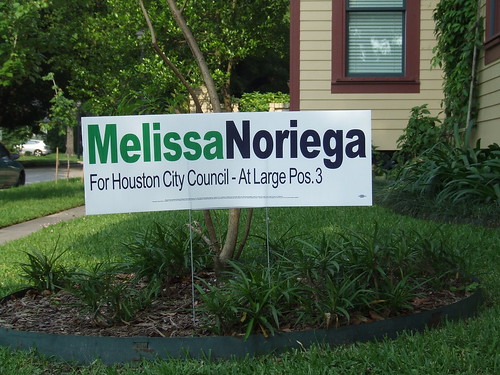

A closer look at the implements of destruction.
Get ready to say Good-bye...
UPDATE: Nothing different this morning. We'll see what the afternoon holds.
UPDATE: Matt Stiles has more.
Congratulations to Barry Bonds. I don't care what anybody else says. This was a hell of an achievement. I for one plan to celebrate it. Well done, Barry. Well done.
UPDATE: I agree with Matt Yglesias:
[T]he day when MLB invalidates all the other records from the Steroid Era -- rescinds the World Series titles and the division pennants, takes back the Cy Young awards and the Golden Gloves, etc., etc., etc. -- I suppose it would make sense to take Bonds' achievements away too. But until that happens, the records are the records and he played better than anyone else.
Indeed.
John Cornyn came to El Paso, and provided a new twist to his already convoluted stance on the border fence.
Cornyn, who is running for re-election in 2008, gave a legislative update to about 100 business leaders and local officials at the Greater El Paso Chamber of Commerce.The senator spoke about his support of the war in Iraq, the need for a bigger U.S. Army and Congress' low approval ratings, but the meeting quickly focused on border security.
"Fixing immigration is the single most important domestic challenge. But we've done it before. In 1986, amnesty came but enforcement didn't," Cornyn said. "We need to at least double the size of the Border Patrol. There are 10,000 Border Patrol agents. There are 40,000 police officers in New York City, but one fourth of that along a 2,000-mile border."
Such a stand is not overwhelmingly popular on the border where a daily cross-border back-and-forth is essential to business interests.
Indeed, the only room-wide applause during Cornyn's speech came after he said that increasing border security "would not entail a 2,000-mile wall on the border."
Last month, Cornyn voted for a $3 billion measure to build 700 miles of fence and 300 miles of vehicle barriers and to beef up the Border Patrol.
Cornyn, who had spoken against border fencing in the past, said in an interview Monday that he had not changed his mind, but that "in some places, urban areas where it's simply possible to come across and get lost in the city, some fencing is possible."
Got that? "Some" urban fencing makes sense, which is why Cornyn voted to build a 700-mile fence that will largely go through rural areas. Who could possibly argue with that logic?
Now hear this: Mikal Watts has a lot of money, and he's not afraid to use it.
Attorney Mikal Watts has the wealth to wage a Senate race in Texas, reporting in financial disclosure forms that he earned $40 million during the 18 months that ended in June.Watts, who hopes to challenge Texas' junior Sen. John Cornyn in 2008, also has several properties, two airplanes and earned more than $5 million from the sale of his cattle ranch.
[...]
Wealth is never a guarantee of victory, but by contributing millions of his own money, Watts was able to show potential contributors his seriousness in running and give himself a head start against candidates less well-funded.
Senate races are expensive in Texas. In his last race, Cornyn spent about $9.8 million, while his opponent, Ron Kirk, spent about $9 million. Cornyn already has had some fundraising help from Bush aide Karl Rove.
The Democratic trial lawyer has put $3.8 million toward his campaign for the March primary and pledged an additional $6.2 million for the November 2008 general election.
Money is necessary, but it's never sufficient. Having a good story to tell goes an awfully long way, and a little pizzazz doesn't hurt, either. It's fine that Mikal Watts has money to spend on this race, though the more of his own money he spends, the more John Cornyn can ask his donors to give. But it's what he ultimately does with it that will matter.
I had wondered before if there would be an organized constituency supporting Atlanta Falcons quarterback Michael Vick as he answers charges that he was a ringleader of a nasty dogfighting operation on his property. We know now that civil rights organizations like the NAACP have taken up the cause, with a plea for everyone to remember that the principle of "innocent until proven guilty" doesn't go away when the crime in question is vicious.
There's also, not surprisingly, a racial aspect to this. To understand where that's coming from, I highly recommend this ESPN story by Wright Thompson, which explores the history of race and justice in Atlanta. There's too much good stuff to really excerpt properly, so just go read the whole thing. Link via The Fanhouse.
Congratulations to Mr. and Mrs. Yao Ming.
Yao Ming, the supersize Houston Rocket, on today married his girlfriend of eight years in a private Shanghai ceremony that local media described as a melding of Chinese and Western traditions.The wedding of Yao, the 7-foot-6-inch NBA All-Star with a huge international following, and Ye Li, the 6-foot-2-inch former Chinese National Team basketball player who has been studying at the University of Houston, drew substantial media attention in China. The Web site sina.com dedicated a special section to the event, even though reporters clustered in the lobby of the five-star Pudong Shangri-La Hotel were excluded from the ceremony.
Far as I know, there's no truth to the rumor that their future offspring have already been offered basketball scholarships to at least three schools. But I wouldn't be surprised.
Anyway. Mazel tov and best wishes to the happy couple!
Back in May, several of Houston's topless clubs got a temporary stay from the Fifth Circuit Court of Appeals in New Orleans, which prevented the city of Houston from arresting their employees under the previously-upheld anti-SOB law. Today, the promised "expedited" appeal gets underway to determine if the 1500-foot regulation is too excessive.
The case before the 5th U.S. Circuit Court of Appeals in New Orleans on behalf of several topless clubs and bookstores is the latest legal skirmish between the industry and the city, which a decade ago adopted a strict new law regulating the businesses.Toughest among the new regulations, most of which have been upheld by the courts, was a provision prohibiting the businesses from operating within 1,500 feet of the sensitive sites.
This provision, if it survives the judicial review, would mean scores of topless clubs, adult bookstores and modeling studios would have to close or move -- a fate the businesses have fought vigorously.
"We're looking forward to (the) argument, with the hope that the court will find favor in our position," said John Weston, a Los Angeles-based lawyer representing the Colorado Bar & Grill and The Men's Club, two of the city's most popular topless clubs.
Courts have previously ruled that such location restrictions are constitutional, so long as there are enough alternative sites where the clubs could relocate.
The city considered that issue 10 years ago, when it adopted the ordinance under then-Mayor Bob Lanier. After years of litigation delayed enforcement of the ordinance, U.S. District Judge Nancy Atlas earlier this year ruled that the decade-old analysis was sufficient, in siding with the city after a two-week trial.
At issue today is whether an updated examination of alternative sites, now that Houston has grown more densely populated, should be used in determining whether the clubs still have room to relocate.
The city's position is that the previous analysis is sufficient.
"Our response is that the point of evaluating the sites is to know if the purpose of passing the ordinance was to eliminate these businesses," said Pat Zummo, the city's outside counsel who has worked on the issue for years. "That's something you could only judge at the time of the enactment of the ordinance."
I don't know how you could argue with a straight face that the number of potential alternate sites that comply with the new law is about the same now as it was back in 1997, but we'll see what the court thinks. I suppose it could conclude that the clubs had their chance to relocate back then instead of pursuing this lawsuit, and if the window of opportunity has closed in the meantime, that's just too bad. Who knows? A question that interests me but that may not be within the scope of the suit, is what happens if a club finds a place that meets the requirements of the law, then later on a church or school or day care center gets built within 1500 feet of it. Does that then put them in violation? I'm not sure how a law that allows you to be put in legal jeopardy by someone else's actions can be constitutional, but we live in strange times. The City Hall blog has more, including copies of the various filings.
Tonight is National Night out, which was conceived as a way of fighting crime by getting people to know their neighbors a little better.
Now in its 24th year, National Night Out is a nationwide event where people are encouraged to meet neighbors and police to help prevent crime and use of illegal drugs."Our mantra is 'neighbors being neighbors,' " said Mike Lauber, president of the Ashford Community Association in west Houston.
He said residents are encouraged to attend the event to know who lives in the neighborhood.
Many events are scheduled across Houston, Harris County and outlying suburbs this evening.
Marty Hajovsky has a list of the events going on in the Heights. Tiffany and the girls and I will be out there - I'm going to see about taking a few pictures. The sheer number of little kids at the NNO events in the Heights the past few years has been amazing. If nothing else, Olivia won't lack for playmates tonight.
Finally, via email from Dot Nelson-Turnier, here's an event in Montrose that you should know about:
What: Hate Crime Candlelight VigilWhen: National Night Out, Tuesday, August 7, at 8:30 p.m.
Where: In the parking lot at Montrose Counseling Center, 401 Branard Street, Houston, Texas 77006-5015
Who: All are welcome.
A limited number of candles will be available, so please feel free to bring your own.
Here's a map of the location, for those who need it. Dot's email is reproduced beneath the fold. Wherever you go, have a happy National Night Out.
In recent weeks, Hate Crimes have left their tragic mark on the Houston area, a mark that runs even deeper for two families who lost their loved ones.In one case, a young man from Spring took his own life because living with the pain, trauma and stigma of being a hate crime victim was unbearable.
In the other case, a Southwest Airlines employee from Pearland left a Montrose gay bar with another man who later admitted he planned to kill a gay man in order to send "him to hell."
The loss of both men and the impact their deaths will have on their loved ones, the loss also resonates with the greater community. A bias crime against one individual is a crime against an entire group of people. When David Ritcheson, a Mexican-American, was brutally assaulted, the attackers were self-proclaimed skinheads who used racial slurs while committing the crime. The language used by the attackers, proclaiming "White Power" lets others - especially those of Mexican-American descent - know that not only are they not welcome, but they, too, are at risk. Add to that recent debate about undocumented immigrants, and the result is communities living in fear.
When Ken Cummings went missing, his family and friends spent weeks trying to find his body, knowing only that he left a Montrose area bar with another man. It has recently come to light that man accused of his murder committed the crime after planning it out for several months. His motive was to hunt down a gay man and to kill him in the name of his religious beliefs. That this could have happened to any gay man who crossed paths with the attacker that evening threatens all members of the gay, lesbian, bisexual and transgender [GLBT] community. And so the GLBT community is sent the message to live in fear.
According to Melany Morrison, MA, LMFT-A, LPC-I, Hate Crimes Specialist at Montrose Counseling Center, "Hate Crimes are extremely personal. They impact a person's sense of identity." She adds that, "Most hate crime victims don't report their crimes or seek help for several years due to real or perceived fears. Many experience sleep disturbances, nightmares and flashbacks, a change in eating habits, anger, hatred, denial, frustration, fear, numbness and shock. A person may feel guilt, shame, withdrawal, and begin to isolate himself or herself from friends, family, and society." That is the impact of a hate crime.
Come join us for our candlelight vigil and lend your voice to those who want to put a stop to hate.
What: Hate Crime Candlelight Vigil
When: National Night Out, Tuesday, August 7, at 8:30 p.m.
Where: In the parking lot at Montrose Counseling Center, 401 Branard Street, Houston, Texas 77006-5015
Who: All are welcome.
A limited number of candles will be available, so please feel free to bring your own.
Montrose Counseling Center provides hate crimes services, including an advocate to accompany you to the hospital and/or to file a police report. They may help you file for Crime Victim's Compensation, and be with you through the judicial process if your attacker is arrested. These services are available to anyone who is the victim of a hate crime, not just those who are affected by anti-gay bias, whether or not the crime has been reported, and regardless of immigration status.
Please help us spread the word by forwarding this email to your personal contacts as well as any listservs, yahoogroups, employee groups or diversity programs you belong to. Gay, Lesbian, Bisexual, Transgender: Your quality of life matters.
For more information, please contact Sally A. Huffer, Community Projects Specialist, at 713.529.0037 x324.
The latest addition to the Blue America 08 PAC suite of candidates is none other than Rick Noriega. Blue America raised over $540,000 for the candidates it supported in 2006, and has already taken in another $56,000 for its 2008 endorsees, so this is a big deal. As part of the package, Noriega will be doing a liveblog/chat session on Firedoglake, Crooks & Liars, and Down With Tyranny this Saturday at 1 PM CDT. I'll have more information as we go, but for now mark your calendars for this Saturday, and get ready to join in the conversation.
Poor Senator Cornyn. It can't be fun to be blown with the prevailing winds like that.
Two years ago, Sen. John Cornyn said a border fence was a bad idea. Last month, he voted to build one.Critics accused Mr. Cornyn of pandering to his Republican base. The senator said he has been consistent in his goal of securing the border.
[...]
In recent years, Mr. Cornyn repeatedly said a wall would be impractical and a waste of money.
In 2004, he said that "we cannot and should not build a wall on the U.S. and Mexico border." In November 2005, he called "a fence or a wall at the border a 19th-century solution to a 21st-century problem. ... Can't people just go around it?"
Last month, he and fellow Republican Sen. Kay Bailey Hutchison of Texas, who has been more consistent in her public comments, voted for a $3 billion measure to build 700 miles of fence and 300 miles of vehicle barriers and to beef up the Border Patrol.
Brian Walsh, a Cornyn spokesman, said there was no inconsistency. He said Mr. Cornyn's past remarks referred to a 1,800-mile fence, not a shorter one.
There's a simple explanation for the flipflop. Cornyn represents one man in the Senate, and that one man wanted a fence. The President said "Jump!", and Cornyn said "How high?"
Laredo banker Dennis Nixon, a major Bush fundraiser, said the region's economic well-being as well as the party's political future is being jeopardized by "extreme elements of the country who have got this protectionist mentality.""It's a mistake for the Republican Party to allow Lou Dobbs, [Sean] Hannity, [Bill] O'Reilly and all these right-wing people to set the agenda," said Mr. Nixon, chairman of IBC Bank, the nation's largest Hispanic-owned bank.
"Candidates have been demonized by people who are interested in security only, who don't understand the river, who don't understand the border, have been sold a bill of goods that some simplistic thing like building a fence is going to solve the problem," he said.
I hate to tell you this, Mister Nixon, but they've set the agenda all along. It's just that now their agenda happens to be at odds with you and your neighbors.
But don't worry. There is something you can do about it:
State Rep. Rick Noriega of Houston and lawyer Mikal Watts of San Antonio, who are seeking the Democratic nomination to challenge Mr. Cornyn, have signaled they will make immigration an issue in the race.They both oppose building a fence on the border.
If you agree with Dennis Nixon, and you think Sen. Cornyn had it right the first time, before duty to his true constituency called, you can make a donation to the Noriega campaign and let them know it. South Texas Chisme, Houtopia, and Stop Cornyn have more.
And on we go with another Texas blog roundup, as once again conducted by Vince. Click on for the good stuff.
TxSharon at BlueDaze brings us an interesting story about drilling companies in Wise County getting caught lying about water usage. Sometimes, the truth just slips out as it did when an oil field worker told TXsharon the truth about water usage in Barnett Shale drilling: Depleting and polluting our water in Wise County, Texas.
Texas Toad at North Texas Liberal asks "Will There Be Mercy For Kenneth Foster?"
John C. at Bay Area Houston Blog tells us about the newest corporation and industry to exploit the Federal Arbitration Act– Comcast, in Another Consumer Scam: Comcast Arbitration.
If you want pictures of Rick Noriega at YearlyKos, Charles at Off The Kuff has them here.
McBlogger at McBlogger looks at the mortgage industry brouhaha and decides the sky isn't falling after all.
Easter Lemming does another of his Liberal News Digest's from progressive media. There really is a liberal news media, if you know where to look outside the mass media.
WCNews at Eye On Williamson posts regarding Williamson County County Attorney Jana Duty filing a brief with AG Greg Abbott regarding whether County Judge and Commissioners can use outside counsel without the County Attorney's consent in County Attorney Asks AG Abbott For Opinion On Hiring Of Outside Legal Counsel.
Hal at Half Empty points out that if you want quality education don't come to school bond issue meetings with box cutters.
Vince at Capitol Annex takes a look at the briefs filed before the Attorney General in the opinion request on the power of the Speaker of the House of Representatives.
Several Texas bloggers were also represented at Yearly Kos in Chicago, and did some great liveblogging. Here are some samples:
Burnt Orange Report; Muse from Musings was liveblogging all over the place, including at her blog where she bings us the ePluribus interview with Rick Noriega; Markos of DailyKos' special endorsement of Rick Noriega; a session on female bloggers; liveblogging of the the presidential forum; and at Capitol Annex where she blogged more on the female blogger session here, the MSN-blog panel (also here, here, and here); and on the Local Blogging Round-Table at Bay Area Houston.
The City Hall blog notes that proposed sale of the Center Serving Persons with Mental Retardation is on the agenda for City Council today. You can see it here as Item #27. I'm told that there are about 20 carryover items from last week, so it's not out of the question that this one may not happen today. We'll see how it goes.
By the way, two items up on the agenda is the abandonment of the one-block stretch of Bolsover in the Rice Village where the notorious Hippie Bohemian Attorney development is proposed to be. Last month, the city released a couple of appraisal figures for the site. The West U Examiner has an interesting story on how those figures were arrived at. Short answer: It's more art than science.
The Observer blog rounds up a few legislative scorecards from varying interest groups (and of varying degrees of quality and usefulness) for the 80th Lege, and notes that a few heavy hitters haven't been heard from yet.
Several organizations, most notably the Texas Association of Businesses, the League of Conservation Voters, NARAL-Pro Choice, and Equality Texas, compiled report cards for the 79th legislature but haven't yet released one for the 80th.
While I'm sure it's a time-consuming pain in the rear to compile these things, I'd think there would be more value to them if they were released closer to the end of the session, when what has gone on is still relatively fresh in people's minds. On the other hand, as these things are mostly used by campaigns, having them come out during or just before election season makes sense, too. It's probably just the junkie in me wanting the information sooner rather than later.
Kudos to the Observer for putting all these links in one place, too. I've done some searching for older report cards from some of these groups, and it can be a frustrating experience. I hope they'll do an update when more such reports get published.
At their August 1st meting, the Houston GLBT Caucus endorsed the following candidates in the November 6th elections:
Houston Controller Annise Parker
Houston City Council:
At-Large Position 2 Sue Lovell
At-Large Position 3 Melissa Noriega
At-Large Position 4 Ron Green
At-Large Position 5 Jolanda Jones
District B Jarvis Johnson
District C Anne Clutterbuck
District D Wanda Adams
District H Adrian Garcia
District I James Rodriguez
HISD School Board, District 4 Paula Harris
HCCS Trustee, District 1 Kevin Hoffman
"We had outstanding candidates seek our endorsement and very difficult decisions had to be made. I am very proud of the work the membership has done, and we look forward to making sure our endorsed candidates get elected this fall," said Jenifer Pool, president of the Caucus, which held its PAC meeting on Wednesday, August 1st.
Houstonist has the scoop.
Tuesday, August 7 at 2pm is the last chance for the public to speak about the pending historic landmark status of the River Oaks Shopping Center, River Oaks Theater, Alabama Shopping Center, and Alabama Theater in front of City Council. Members of the public must sign up to speak by 12pm Tuesday by calling the City Secretary (dial "311"), and people who have already spoken to City Council on this issue may not do so tomorrow. Those who are added to the list will only have one minute to speak.This preservation measure was tagged by Council Member Addie Wiseman last Wednesday which delayed the vote until tomorrow, August 8th, which is ironically the same day Weingarten can legally begin demolition of the northern, curved section. If the measure is passed, it looks like the River Oaks Shopping Center will be the martyr for Houston preservation since the (effectually meaningless) landmark status would be granted during or after demolition.
- Tuesday, August 7th, 2pm:
Public hearing at City Hall, 900 Bagby, 2nd floor
- Wednesday, August 8th:
Weingarten to begin demolition of northern curved part of River Oaks Shopping Center; City Council to vote on historic landmark designation.
- Wednesday, August 8th, 5pm:
River Oaks wake at River Oaks Theater upstairs bar, hosted by Save our Landmarks
As I drove by the shopping center this afternoon, I saw that the storefronts were now fenced off, and a smallish bulldozer sat in the parking lot, inside the fence. You could see the sands in its hourglass slipping away. I'll see if I can take another picture before the demolition starts.
After more than six years of the Bush Administration's Justice Department, can anyone honestly say they're surprised by this?
For four years, U.S. Justice Department attorneys heard the horror stories: Inmates in Texas juvenile prisons were being beaten and molested by the people who were supposed to protect them.Federal watchdogs discreetly collected information and discussed fine legal points as the assaults piled up. More than 2,000 allegations of staff abusing inmates were confirmed by the Texas Youth Commission from January 2003 to December 2006.
The Justice Department ultimately declined to prosecute anyone at TYC or do anything to compel agency-wide reforms.
Attorneys said they were constrained by narrowly drawn laws and insufficient evidence. But there was also a political climate at Justice that discouraged prosecution of official misconduct cases, former department attorneys said.
As Grits (who has more depressing news about the TYC) and Vince say, you really have to read the whole thing. Just one thing to add, which is a note about a couple of the players who appear in this story. One is Bradley Schlozman:
The tone set by the political leadership prodded career attorneys to think strategically about which cases they pushed, said Albert Moskowitz, chief of the Criminal Section from 1999 to 2005.He said his supervisor, Bradley Schlozman, left no doubt about his distaste for abuse of authority cases. Mr. Schlozman, a former deputy assistant attorney general, has emerged as a key figure in Congress' investigation of Justice Department politics.
"He sort of made that clear, and that had a sort of self-censoring effect on people," Mr. Moskowitz said. "People got awards not for doing police cases but for doing [human] trafficking cases."
Schlozman was one of the lead figures in pushing bogus "voter fraud" prosecutions at DoJ. Just exactly the kind of guy you want to be in charge of protecting civil rights, in other words.
And two, Jeff Blackburn:
However, Jeff Blackburn, a leading civil rights attorney from Amarillo, said federal civil rights prosecutions under Mr. Bush's two attorneys general, John Ashcroft and Mr. Gonzales, were "a complete joke.""On the surface, it just appears they're making case-by-case decisions, and they always have an excuse to not take one. But when you start piecing all those case-by-case decisions together, you see a sweeping decision," Mr. Blackburn said. "The decision to prosecute on these cases is totally political and always discretionary."
Blackburn was one of the attorneys who represented the wrongly incarcerated Tulia defendants in their successful civil suit.
Enough said. Read it and weep.
I confess, I didn't see this coming.
[A] coalition of bar, nightclub and cabaret owners last week challenged Houston's smoking ordinance in a federal lawsuit. They argue that city officials overstepped their authority last fall in passing the ordinance, scheduled to take effect next month, creating an unfair competitive environment for them to operate.The ordinance bans smoking in most public places, but exempts bars with significant tobacco sales or outdoor patios. The lawsuit claims the city does not have the authority under state law to regulate differently businesses licensed to sell alcohol for on-premises consumption.
"They're creating an unbalanced playing field by stating that certain types of operators, such as tobacco bars, who meet their arbitrary definition of what a tobacco bar is, can allow smoking while the guy across the street doesn't meet that definition cannot," said Houston attorney Al Van Huff, who represents Price and the other owners in the Houston Association of Alcoholic Beverage Permit Holders.
He is asking U.S. District Judge Gray Miller to enjoin the city from enforcing the ordinance and ultimately rule it invalid with respect to alcohol establishments licensed by the state..
The fairness argument isn't new to the council or other major Texas cities, such as Dallas and Austin, which have passed smoking bans in recent years.
Mayor Bill White and City Council members heard those complaints in a series of hearing last year, before passing the ban to prevent the negative health effects of second-hand smoke on bar patrons and employees.
City Attorney Arturo Michel said Houston is on firm legal ground.
"We're not really treating them differently, in terms of alcohol," he said. "We're actually not just regulating this industry in terms of smoking. We regulate a lot of other public places, in terms of smoking."
You can see a copy of the complaint here (PDF); link via the City Hall blog, which has more. I guess this is a surprise to me precisely because so many other cities have successfully enacted similar ordinances before. I'm not a lawyer, so I don't know if the city did something unusual in its attempt to carve out a limited set of exceptions, or if these bar owners are wasting their time. We'll see what the judge says.
This sign has been on the fence behind the soon-to-be-demolished River Oaks Shopping Center for a few weeks. One presumes that it's the new-and-supposedly-improved Center to come that is "for fun, for life, and for you", but there's no identifying information on the sign that I can see, so one must infer that. Given that demolition might begin as soon as this Wednesday, I figured I ought to take a picture of this now, while I still could. What do you think it means?
I have a couple of questions regarding this article on the proliferation of illegal slot machines in Houston.
Gaming rooms have proliferated throughout the Houston area in the past few years. They have become targets for crime, law enforcement say, because the operators handle large amounts of cash and most patrons are female or elderly.Everyone knows these places offer illegal gambling, police say. But savvy owners disguise them as "amusement rooms," taking advantage of weaknesses in Texas gambling law.
''Local law enforcement can't keep up with them," said Marc Brown, chief of the Harris County District Attorney's Office's misdemeanor division. "One shuts down, and another one opens up."
City Councilwoman Toni Lawrence is working on an ordinance that would force gaming rooms to put up signs, uncover their windows and allow unfettered access to law enforcement. Austin passed a similar law in March.
The proposal is tacit acknowledgment that game rooms are so numerous that more regulatory tools are needed. Lawrence said she hopes that forcing game rooms to be more visible will help police monitor their activities, and, perhaps, drive them away.
Capt. Steven Jett of the Houston Police Department estimates that Houston has 300 to 400 gaming rooms. Inside, one typically finds row after row of video gaming machines, often called ''eight-liners" because there are eight ways to win based on the combination of images on the screen. The machines also can be found tucked into convenience stores, coin-operated laundries, even dental offices.
''They're dangerous places to be hanging out in," said HPD Northeast Division Lt. D.R. ''Duke" Atkins. ''You're coming out of there with cash, and you're elderly, and you're going to get accosted violently."
So in terms of their threat to public safety, how do these gaming rooms compare to, say, The Men's Club?
In the past year, sheriff's deputies responded to 12 robberies and four shootings -- three of them fatal -- at gaming rooms in unincorporated Harris County, said sheriff's Sgt. Dennis Field.A 31-year-old woman was shot to death July 14, just outside a gaming room in the 2900 block of Gears, in northwest Harris County. The owner told investigators he was shooting at an armed man who was trying to force his way into the gaming room when Gloria Cruz stepped into the path of the bullet.
George, a west Harris County resident who did not want his last name published, said gaming rooms can be dangerous. Last year, he was gambling on a Sunday afternoon at a clandestine spot on the county's southwest side. Five armed men entered and corralled the 15 customers, many of them elderly women, and ordered them down on their knees, George said. After going through the players' wallets and purses, the robbers beat up the manager, George said.
[...]
HPD has four officers to conduct undercover gambling investigations.
"We do the best we can with what we have," said Capt. Glenn Yorek of the vice division. Since 2003, the department has made 219 gambling-related arrests and seized 2,771 video gaming machines.
And how many vice squad officers are assigned to undercover operations at sexually oriented businesses?
I agree that more needs to be done about this problem (assuming that statewide legalization, in which the big, glitzy, legal casinos would presumably squeeze out the backroom operators, is not on the table), and that HPD is going to be hard pressed to keep up no matter what. But given all the attention that's been paid to enforcing the recently-upheld anti-SOB ordinance, I think these are fair questions to ask.
UPDATE: Grits makes a good point about this.
The iPod is best known as an instrument of solitude -- unless the user ignores standards of etiquette by invading the eardrums of fellow commuters, office mates or other innocent bystanders. Then it starts to get annoying. Especially when you're stuck in close proximity.Amped to its highest volume, the iPod is not nearly as invasive as the classic loud cell phone conversation. But it can have its moments. Like when you're standing in an elevator at 9 a.m. and a co-worker cranks up Amy Winehouse's Rehab. (Too early for that song.) Or when an ear-budded subway rider belts what sounds like a Whitney Houston tune with careless abandon, causing other riders to inch away or flee into another car altogether. (True story.)
"I've heard that problem quite a lot, people singing along," said Leander Kahney, managing editor of Wired magazine's Web site. "And, of course, my kids -- when they have the iPod in, they shout. They don't realize with the headphones they're being too loud, so they'll conduct conversations without taking their ear buds out. And they're yelling."
I swear, every one of these stories could have been written 25 years ago about the Sony Walkman. All I can say is you can always console yourself with the thought that these goobers are ruining their hearing. For whatever that's worth.
I've expressed before my skepticism that Travis county DA Ronnie Earle's request that the Texas Court of Criminal Appeals reconsider its decision to let stand the dismissal of the conspiracy charge against Tom DeLay would come to anything, but Paul Burka just about has me convinced that there is a fighting chance.
Motions for rehearing are always longshots. But the Court's reasoning in the original Moore and Baker cases was so flawed, and the potential policy repercussions of tying the state's hands in conspiracy prosecutions are so serious, and the argument that the change of law in the Lomax case did not violate the defendant's right to fair notice is so sound, and the margin in the first case was so narrow, that the motion for rehearing has a better chance than most of being granted.
Read the whole thing and see if you don't think so, too. By the way, if you haven't seen it, the State Prosecuting Attorney's brief is here (PDF); thanks to RG Ratcliffe for the link.
Congratulations to Barry Bonds for his historic feat yesterday, putting him just one step away from the top spot on the all-time home run list. Forget what pompous windbags like Richard Justice think. What Barry Bonds has accomplished is amazing, and should be celebrated as such.
As far as the whole steroids "controversy" goes, I stand with Joe Sheehan:
While it's an unpopular viewpoint, I stand by my argument that Barry Bonds has not failed a test for PEDs in the four years that MLB has had a program. His testimony before a grand jury--subsequently leaked illegally, and to his detriment--was that he did take substances that were identified later as steroids, but he was told at the time that they were not. His testimony has been interpreted as parsing by some, perjury by others, although statements before the same grand jury by others have been granted full faith and credit. That grand jury inspired two reporters to write a book about Bonds, sourced largely by the illegally-obtained testimony, as well as the accounts of people around Bonds, at least one of whom, ex-mistress Kimberly Bell, can comfortably be described as "scorned."Baseball now has a small underclass of players--real players, not anonymous minor leaguers or fringe guys--who have tested positive for performance-enhancing substances, been suspended for that use, and returned to play. In virtually every case, those players go about their business without anyone caring. They're cheered at home for their good deeds, and ignored on the road. The Indians benefit from the bullpen work of Rafael Betancourt, by far their best reliever this season, and a big reason for their contending status. He's not reviled in Detroit or Minnesota as a steroid user, not booed and forced to endure the taunts of "Cheater!" or worse. No one cares. The same can be said for Juan Rincon, who is essentially the Twins' version of Betancourt.
Need more evidence that the game is more than willing to forgive and forget? Ryan Franklin tested positive in 2005, serving a 10-game suspension for his guilt. Last month, the Cardinals signed him to a two-year contract worth $5 million. Last winter, the Mets' Guillermo Mota was suspended for the first 50 games of 2007 off a positive test; a month later, the Mets signed him to a two-year contract for, again, $5 million.
Add it up, and baseball has lavished more than $30 million on players who have been found guilty of steroid use after their use has come to light. These players don't occupy some gray area, don't inspire "did he or didn't he?" discussions on sports radio or the talking-head TV shows. They cheated, they got caught, served their penalties, and went on to earn millions playing baseball without being held up as examples of all that is wrong with America.
The central truth about the "steroid issue" is this: average people don't care about PED use. They care about tearing down those who they do not like, protecting those they do, and making themselves feel superior in the process.
Amen. Very simply, sportswriters like Richard Justice hate Barry Bonds, for their own mostly petty reasons. It's just pathetic.
I'm not saying anybody needs to like Barry Bonds. I think he's a great player, one of the greatest ever, but I never cared one way or the other about his pursuit of the home run record. If he'd fallen short, that wouldn't have changed my opinion of him as a player. What I am saying is that I don't think he's gotten anywhere near a fair shake in the court of public opinion, as presided over by the likes of Justice. If anything has diminished his accomplishment, that's it.
As you know, Rick Noriega was in Chicago a few days ago to be at Yearly Kos. While I'm sure he'd have liked to stay there longer, given the enthusiastic response he got from everyone he met, he had an important reason to cut short his visit: Yesterday, in San Antonio, Lt. Col. Rick Noriega was sworn in as the Commander of the 1st Battalion, 141st Infantry Regiment. This was a public ceremony at the Alamo, and the Walker Report has pictures of the event. Check it out.
The next phase of the Universities line process has begun, as Metro has released the University Corridor Draft Environmental Impact Statement (DEIS) for the Universities corridor. It's a bunch of big honking PDFs full of all kinds of technical information - the Executive Summary (PDF) alone is 44 pages. (Thankfully, we have Christof reading and summarizing them for us.) Along with these documents are another round of public meetings to discuss the options and their impact on the area:
What: Public Meeting / Open House
Date: Monday, August 13, 2007
Time: 5:00 p.m. - 7:00 p.m.
Location: Holiday Inn Select - Greenway Plaza
Address: 2712 S.W. Freeway
What: Public Meeting / Open House
Date: Tuesday, August 14, 2007
Time: 5 p.m. - 7 p.m.
Location: Wheeler Avenue Baptist Church
Address: 3826 Wheeler AvenueWhat: Public Hearing and Open House
Date: Monday, August 27, 2007
Time: Open House, 1 p.m. - 2 p.m.
Public Hearing begins at 2 p.m.
Location: South Main Baptist Church
Address: 4100 Main Street Monday, August 27, 2007
Get ready for all this to be back in the news. And, of course, be sure to attend these public meetings if you have an opinion to express.
When I posted about the new Costco coming to the inner-Loop location of Richmond and Weslayan, I wondered if its potential proximity to a light rail stop might affect their offerings in some way. This West U Examiner story gives a little hint about that:
Muddying plans for a time was uncertainty over whether Metro's University rail line would run by the property.[Trammell Crow project manager Craig] Cheney lobbied U.S. Rep. John Culberson to oppose the project, which he said would have dictated a less profitable commercial concept and taken out oak trees along Richmond that the developers have committed to keep.
In the end, it didn't affect the project, Cheney said. "There's nothing suggested this far that would impact our plans," he said.
Doesn't sound too encouraging, does it? On the other hand, Trammell Crow is the builder, and I daresay he was doing that before the site was committed to being a Costco. So who knows?
In any event, none of the proposed alignments would place the route on Richmond west of Cummins, so it's now a moot issue. But it's still the case that this location may be very near a stop, and if so I still think it would be in Costco's interest to try to convince some of the thousand of people who'll pass it by every day to hop off and pay a visit as part of their trip. We'll see.
Why it can be so hard to make progress sometimes: It only takes one reactionary to screw things up.
In a move that could threaten a pilot syringe exchange program for drug addicts in Bexar County, District Attorney Susan Reed has warned local officials that the legislation authorizing it doesn't trump the state's narcotics laws."I'm telling them, and I'm telling the police chief, I don't think they have any kind of criminal immunity," Reed said. "That's the bottom line. It has nothing to do with whether they do it or don't do it -- other than if you do it you might find yourself in jail."
Reed said language in the statewide bill created a legal defense to prosecution under Texas laws prohibiting drug paraphernalia. The amendment authorizing the pilot program included no such defense.
[...]
[Rep. Ruth Jones] McClendon said she might seek an attorney general's opinion on the matter, which could take as long as six months. That would make it difficult for local authorities to gather enough evidence of the program's success -- should it prove successful -- to show the Legislature when it meets again in 2009. Supporters hope a successful local program will ease passage of a statewide bill next time.
Instead, McClendon said she is considering a meeting with the Texas District and County Attorneys Association for help in seeking a faster resolution.
"The Legislature had a purpose for this program, and the purpose for this legislation clearly was to allow a pilot program to proceed without prosecuting those who are managing the program and those who need the benefits of this," she said.
McClendon pointed to an exchange on the Senate floor between Sen. Jane Nelson, R-Lewisville, who introduced the Medicaid bill, and Sen. Bob Deuell, R-Greenville, who told her: "I did want to establish some legislative intent on the amendment regarding needle exchange. Is it your intent that, notwithstanding any other statutes, Bexar County will be allowed to legally operate a needle exchange program under the provisions of the bill?"
"That is correct," Nelson replied.
I think the intent is crystal clear, and DA Reed is falling back on a technicality that shouldn't materially affect the program. But if she insists on this stubborn interpretation of the statute, the effect will be to ensure that this pilot project, which has been shown to have many positive effects just about everywhere ir's been tried, doesn't have a chance to prove itself in San Antonio, even though that's quite plainly what the Lege intended. I'm with Grits on this: The police chief and sheriff would be well advised to ignore the DA and make enforcing the paraphernalia law a low priority, at least in this context. Let's hope they do that. Grits has more.
We've talked before about the proposed $900 million bond issue that Commissioners Court may put on the ballot this November. That price tag may be greater by the time all is said and done.
The court on Tuesday will consider whether to ask voters in November to approve a massive bond package that could range from $970 million to $1.5 billion.The Port of Houston Authority has requested up to $550 million of that for ongoing construction of its Bayport Container and Cruise terminal, and for security and environmental initiatives.
[...]
On Tuesday, the Commissioners Court will have before it five options outlined by the county's Office of Budget and Management Services.
The options include different amounts proposed for the port and other projects, such as roads, parks, an inmate processing center, juvenile facilities, a new family law center and a new forensic center.
"I think what we will end up doing is looking at what our tax base will allow us to do and work backward from there," Harris County Judge Ed Emmett said Friday.
"It will require us to set priorities, and that is something that the entire court gets to do."
[...]
The five outlined options would require property tax rate increases of 1.8 to 2.8 cents per $100 assessed value, according to the county budget office.
But Emmett and several commissioners said they do not want to seek a tax rate increase to pay for the bond package.
The county's ad valorem rate of 63.99 cents per $100 assessed value has remained unchanged for six years.
"For us, it's critical that we really look at making sure that we don't raise taxes and that we don't add any additional burdens to the property taxpayers," Commissioner Sylvia Garcia said.
The options outlined by the county budget office range from a total of $970 million to more than $1.5 billion.
The court could select any one of the options or craft its own.
"You have to look at how much you bite off and how much you can afford to put off," Commissioner El Franco Lee said. "All those considerations are wrapped into what we decide to do."
I'm sure most members of the Court would sooner chew off their own legs than be accused of raising taxes. You can already hear the Friends of Charles Bacarisse warming up in the bullpen, getting ready to lob all kinds of invective at Ed Emmett in that event. All I know is that either these projects are worth doing or they're not, and if they are worth doing, they've got to be paid for somehow. We saw a graphic and tragic demonstration this week of what the consequences can be for failing to face up to these kind of responsibilities. Make the case or don't, but don't pretend we can get by doing the same old thing forever.
Yesterday was the deadline for filing briefs with the Attorney General in regards to the Keffer request for a ruling on Speaker Craddick's claim of absolute power to recognize or not a motion to vacate the chair. Quite a few interested parties took him up on the offer.
As the deadline for arguing the case approached Friday, briefs poured into Abbott's office. Abbott has 180 days in which to rule.Those supporting Keffer included briefs from speaker candidates Reps. Jim Pitts, R-Waxahachie, and Brian McCall, R-Plano. Speaker candidates Reps. Fred Hill, R-Richardson, Delwin Jones, R-Lubbock, and Sylvester Turner and Senfronia Thompson, both D-Houston, did not file briefs.
Five other Republican legislators and the Texas Progressive Alliance, a group of liberal bloggers, also filed briefs in support of Keffer.
Yes, that's my blogging colleagues and me. The brief is here, and an executive summary of its contents is here.
Craddick's ultimate trump card in the legal battle, and an out for Abbott, may be an opinion that then-Attorney General John Hill issued in 1973 when asked a speaker's race question by then-state Rep. Fred Head, D-Troup, a candidate for speaker. Hill answered constitutional and state law questions but refused to give an opinion on House rules."Construction of the rules of the Texas House of Representatives is a responsibility, in the first place, of the speaker himself and secondarily, the parliamentarian," Hill wrote.
I'm not so sure that's a trump card for Craddick, as it just means the issue will be argued again when the 81st Lege convenes. It is, however, most definitely an out for Craddick, one that Burka thinks Abbott ought to take. He's got six months to make up his mind. Stay tuned.
A comprehensive study of electronic voting machines used in California has exposed some security weaknesses in machines used here in Houston.
The tests, administered by the University of California at Davis, found that absent tighter procedures, hackers could alter vote totals, violate the privacy of individual voters and delete audit trails.Harris County election officials called the test helpful, saying it identified places where the technology can be improved, but said the tested scenario was not relevant to live elections.
"The laboratory experiment, as conducted by the UC-Davis researchers, seems almost impossible to replicate outside that laboratory environment.
"Thus, voters in Harris County should be aware, but not be concerned by the results," said Hector DeLeon, a spokesman for Harris County Clerk Beverly Kaufman, whose office administers elections.
DeLeon called the test unrealistic because it is "premised on providing unfettered access to the voting equipment to a malicious individual with the technological savvy and ingenuity to violate the system."
It does not take into account controls and procedures designed to ensure accuracy, security and integrity of the voting system, he said.
It's true, in order to devise the attacks, researchers had unfettered access, said UC-Davis computer science professor Matt Bishop, who led the study.
But he said it didn't take long to devise attacks; some took five minutes, others took a few days.
"Relying on security through obscurity is a terrible thing to do," Bishop said. "(Attackers) can get the info, the only question is how hard do they have to work to get it. Any defense that relies on ignorance underestimates how ingenious attackers can be and overestimates how fallible people are."
I definitely agree with Bishop on this one. The problem as I see it is that county clerks don't think like hackers. I think they're too easily swayed by the promises made by vendors, who obviously have an interest in looking good.
Bishop could not say whether voters should be comfortable using the machines in place. He did, however, say that voters should "feel they can do a better job of building a better system."The vulnerability that the study uncovered speaks more to the vendors than the election officials, he said, because security should be part of the design and implementation of the system.
One of the members of the UC-Davis team was my friend Dan Wallach, with whom I've discussed electronic voting machine security before. The full set of reports is here. I'm going to try to make my way through the eSlate reports this weekend to see what I can learn. Read 'em for yourself as well if you're interested.
Midway through the hurricane season, things are looking a little better than before.
Hurricane researcher William Gray lowered his 2007 forecast slightly Friday, calling for 15 named storms, with eight becoming hurricanes and four becoming intense.On May 31, at the outset of hurricane season, Gray had called for 17 named storms and nine hurricanes, five of them intense.
"We've lowered our forecast from our May predictions because of slightly less favorable conditions in the tropical Atlantic," said Philip Klotzbach, a member of Gray's team at Colorado State University.
The new forecast calls for three named storms, two hurricanes and one intense hurricane in August; five named storms, four hurricanes and two intense hurricanes in September; and five named storms, two hurricanes and one intense hurricane in October and November combined.
I know it's been very quiet so far, but the potential for bad stuff is still out there. So don't get too confident.
I had the privilege of being with Rick Noriega all day yesterday at YearlyKos. Netroots rock star! I got the photos . . .
Rick liveblogs at Daily Kos during YKC07. He got on the recommended diary list FAST! He really did answer all of the comments himself and really enjoyed it. Watch out! I demystified blogging for him and now he is dangerous!
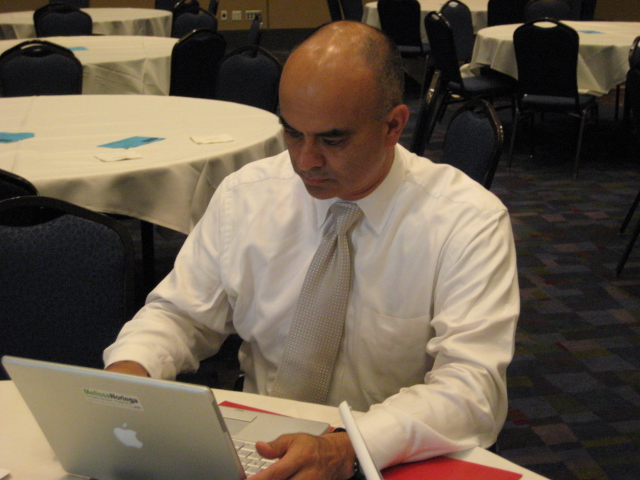
Thursday was caucus day and Rick visited a bunch of them and was well received at each one:
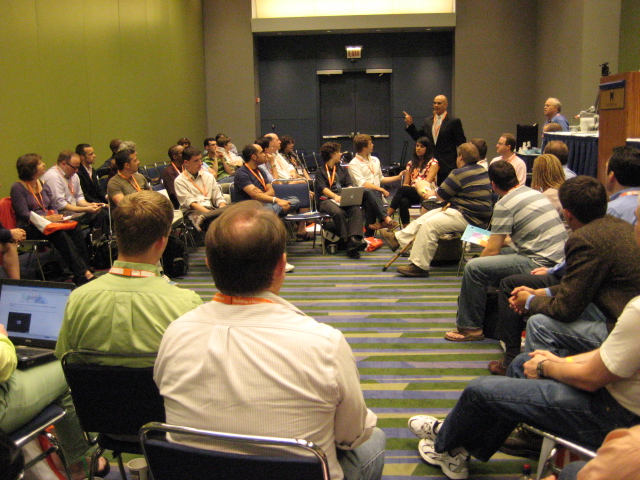
He interviewed with Kay Shepherd of epluribus. Podcast here!
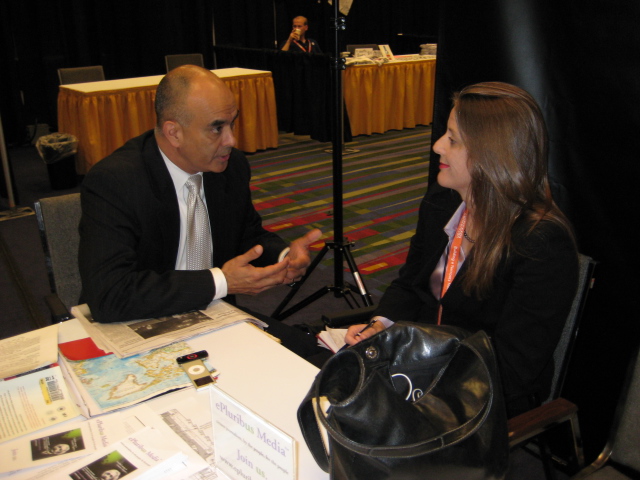
He met famous Kossak diarists. Here's Rick with teacherken. Waves to Georgia10! Her comment after meeting Rick, "Markos knows how to pick the netroots candidates and I can sure see why he likes Rick."
And, speaking of Markos, he came over to the blogger room while Rick was liveblogging. I pinned a Rick Noriega pin on him - like I was pinning a corsage on my prom date. Markos went straight from the blogger room to a press conference wiht about 75 MSM reporters. He wore his Rick Noriega button throughout and when asked if Democrats had a chance in the red states, he pointed to his Noriega pin and said here's a good example - Rick Noriega is here at YearlyKos and he's a great candidate who is taking on John Cornyn.
Rick with Lakoff, who I really enjoyed meeting:
We ended the day at the Howard Dean keynote. We put flyers on all the tables (about 1000 people) with information about Rick. Rick did a lot of that flyering, and everyone was crazy about him.
Just to wrap up, it was gratifying to find out that many, many people recognized Rick on site and those that didn't recognized his name when introduced. He received loud applause whenever he spoke. Here's Rick with someone from Texas, who walked past him, did a double take, then asked me to take her picture with Rick!
GREAT DAY!
UPDATE: Here's Houtopia's on the scene coverage of Rick at Yearly Kos.
All of a sudden, the news is full of primary challenges for various legislative seats in Texas. We'll start with SD11, where Sen. Mike Jackson now has more to worry about than just Joe Jaworski. From QR, via Vince:
Texas Medical Board member and former SREC member Tim Turner plans to challenge state Sen. Mike Jackson (R-Laporte) in next year's party primary.Turner said that he's a couple of weeks away from making an official announcement and that he still needs to talk to a few more key folks before making a final decision. However, he said he was "95 percent" certain that he would enter the race.
The Clear Lake business consultant said that he was approached by a group of party leaders last year who made it clear that they want change. Jackson's defense of the new business margins tax was what most rankled him, Turner said.
He referenced a June 29, 2006, article in the Pearland Journal where Jackson was quoted at a luncheon as saying, "Most people are OK with higher taxes. It's the Realtor businesses and big smoke stack industries that get upset."
"I don't know what world he's living in," Turner said. "Most people are not OK with higher taxes. I most certainly am not."
While I generally think that contested primaries for open seats, or for the right to take on an incumbent, are good things for a party, this is the kind of primary that often isn't so good, at least for a seat that's even remotely at risk. You can already see this shape up as a nasty battle over issues of orthodoxy. It's one thing for a safe seat - say, SD07 - but when you're staring at an attractive and well-funded candidate on the other side, with a modest but not mountainous partisan lean in the district, and you can see the potential for trouble on the horizon. Which, needless to say, is fine by me in this case. Bring it on, Tim!
For what it's worth, both Jackson and Turner were involved in the abortive DeLay ballot replacement selection process. What effect, if any, that may have in the primary, I couldn't say. But keep it in mind, since we know how factionalized the GOP got during that process.
Next, we hop over to SD10, where Todd Hill reports on some rumors.
Sources close to me here in Tarrant County all but confirm that we are likely to have two Democrats vying for the opportunity to take on liquor industry sponsored Republican Kim Brimer for the most Democrat leaning state senatorial district in all of Texas.Although I know the names of the individuals likely to step forward and run I will not reveal them at this time.
Todd thinks a contested primary here would be bad. I strongly disagree with that - this is exactly the kind of place where you want it, because it will prolong the media coverage cycle, and because it will force an early and sustained focus on identifying core supporters, whom the winner will be able to tap into for the remainder of the race. Sure, there's always a risk of a substance-free mudfest that turns people off, but them's the risks. Let 'em fight it out, I say. And while I'm at it, let me strongly endorse blank's comment about why this race matters. SD10 is very winnable. Whatever happens, let's not screw up the opportunity we'll have there next year. That's really all I ask.
Lastly, PDiddie excerpts from a Capitol Inside story that talks about a couple of State House primary possibilities here in Houston:
While Houston school board member Greg Meyers tests the waters for a race as a Republican against Democratic State Rep. Hubert Vo, Democrats are debating whether they should try to clear the deck for outgoing City Council member Carol Alvarado in the district that State Rep. Rick Noriega appears ready to give up in order to run for the U.S. Senate in 2008.The hottest potential primary race that appears to be shaping up in the state's largest city could pit State Rep. Kevin Bailey against Armando Walle in a litmus test of the Democratic incumbent's loyalty to Republican Speaker Tom Craddick. Walle is the community liaison for U.S. Rep. Gene Green and chairman of the Harris County Tejano Democrats.
Walle's interest in this race has been known, or at least talked about, for a few months now. I think he'd be a much stronger challenger to Bailey than John Reyes was last year. And as this is a safe Democratic seat, it's fine for there to be a challenge, especially on a crucial point such as support of Tom Craddick. I'm very interested in this race.
Alvarado supporters hoped she'd have a clear path to the Democratic nomination in HD 145. But the uncontested primary race that Alvarado forces envisioned has apparently run into some potential obstacles with State Reps. Jessica Farrar and Ana Hernandez reportedly resisting. While Alvarado has the baggage of an ongoing investigation into a scandal involving pay raises and bonuses for several employees when she was mayor pro tem, the problem that other Hispanic state lawmakers in nearby House districts appear to have with her possible candidacy for Noriega's seat seems to center more on her association with consultant Marc Campos.The longtime Democratic strategist supported Hernandez's main rival in a special election battle for a seat that opened when Joe Moreno died in a car wreck in 2005. Farrar was arguably Hernandez's most influential supporter in the special House race. Campos has also drawn the ire powerful Harris County Commissioner Sylvia Garcia for opposing her in a past race and backing Alvarado aide James Rodriguez against the candidate she favors for the open council seat. Alvarado has been a Campos client as well.
Make of that what you will - Campos himself wasn't terribly impressed. My best guess is that Alvarado can have that seat if she wants it. We'll see how it plays out.
Get ready for another long list of constitutional amendments on your ballot this November.
Texas voters will decide whether to approve as much as $3 billion in bonds for cancer research when they go to the polls in November to have their say on 16 proposed state constitutional amendments.The cancer research proposal will be 15th on the ballot, as determined Wednesday in a random drawing by Secretary of State Phil Wilson. He urged participation in the Nov. 6 election and said not enough Texans vote.
"This is something we must change," he said. "Constitutional amendment elections play an important role in shaping the future of our state, and I am committed to spreading that message to every region of Texas."
Well, if we really cared about making sure we got maximal turnout for these elections, we'd hold them in even-numbered years, when people normally expect to vote. Given that most municipal elections are held in May in odd years (Houston being the prime exception), what kind of turnout do you expect? And, not to put too fine a point on it, but as we know from the 2003 amendment election, which was scheduled in September so the expected high turnout in Houston due to the contested Mayor's race wouldn't make it easier to defeat the evil tort "reform" measure Prop 12, paeans to turnout should generally be taken with a sizeable grain of salt.
Anyway. For your reference, the full list of amendments is beneath the fold.
Proposition 1Provides for continuing the constitutional appropriation for facilities and other capital items at Angelo State University in a change of governance of the university.
Proposition 2Provides for issuing $500 million in general obligation bonds to finance student loans and authorizes bond enhancement agreements for general obligation bonds issued for that purpose.
Proposition 3Authorizes the Legislature to provide that the maximum appraised value of a residence homestead for ad valorem taxation is the lesser of these: the most recent market value of the home as determined by the appraisal entity or 110 percent -- or a greater percentage -- of the appraised value of the home for the preceding tax year.
Proposition 4Authorizes issuance of up to $1 billion in bonds for maintenance, improvement, repair and construction projects and for the purchase of equipment.
Proposition 5Authorizes the Legislature to permit the voters of a municipality with a population under 10,000 to authorize its governing body to enter an agreement with an owner of real property in or adjacent to the municipality that has been approved for funding under certain programs administered by the Texas Department of Agriculture. Would allow the parties to agree that all ad valorem taxes imposed on the owner's property may not be increased for the first five tax years after the tax year in which the agreement is entered into.
Proposition 6Authorizes the Legislature to exempt from ad valorem taxation one motor vehicle that the owner uses in his or her occupation or profession and for personal activities.
Proposition 7Allows governmental entities to sell property acquired through eminent domain back to the previous owners at the price the entities paid to acquire the property.
Proposition 8Clarifies certain provisions relating to the making of a home equity loan and use of home equity loan proceeds.
Proposition 9Authorizes the Legislature to exempt all or part of the residence homesteads of certain totally disabled veterans from ad valorem taxation and authorizes a change in the manner of determining the amount of the existing exemption from ad valorem taxation to which a disabled veteran is entitled.
Proposition 10Abolishes the constitutional authority for the office of inspector of hides and animals.
Proposition 11Requires that a recorded vote be taken by a house of the Legislature on final passage of any bill, other than certain local bills and ceremonial resolutions, and provides for public access on the Internet to those recorded votes.
Proposition 12Provides for the issuance of up to $5 billion in general obligation bonds by the Texas Transportation Commission for highway improvement projects.
Proposition 13Authorizes the denial of bail to someone who violates certain court orders or conditions of release in a felony or family violence case.
Proposition 14Permits a justice or judge who reaches the mandatory retirement age while in office to serve the remainder of his or her current term.
Proposition 15Requires the creation of the Cancer Prevention and Research Institute of Texas and authorizes issuance of up to $3 billion in bonds for research in Texas to find the causes of and cures for cancer.
Proposition 16Provides for issuance of additional general obligation bonds by the Texas Water Development Board up to $250 million to provide assistance to economically distressed areas.
You know about the $1 billion county bond proposal that will be on this November's ballot. Now it may be joined by an HISD bond proposal as well.
Houston Superintendent Abelardo Saavedra said today that he needs $805 million in a November bond election to repair HISD's aging schools.The proposal presented to the school board includes money to build 22 new schools and renovate 128 campuses. It also includes $90 million in safety upgrades and $27 million for new science labs at middle and high schools.
If approved, the bond would increase the property tax rate by 3 cents, Saavedra said.
"This program will mean new safety and security for every student on every campus, and new schools and repairs for children who have been waiting for them," Saavedra said. Included in the proposal is a new campus for Carnegie Vanguard High School.
[...]
While leaders of the urban district say they need the money to repair aging schools, some trustees worry that this abbreviated schedule won't give the public enough time to digest details of the plan. The board is expected to decide one week from today whether to put the issue on the ballot.
"I'm concerned about the timeline," board member Greg Meyers said Wednesday. "I'm just not sure this is going to give the voters adequate time to look at the plan."
Among potential obstacles for the proposal is the recent indictment of a secretary in the district's bond department on charges that she stole $150,000 in bond money.
In addition, Harris County commissioners already have announced a plan to put a nearly $1 billion bond package before voters on the November ballot.
But HISD leaders are confident in their plan, saying board members are well versed on the district's facility needs. They've always known that a third election would be needed to finish upgrading campuses, officials said.
In 1998 and 2002 elections, HISD voters approved a total of $1.5 billion to build 42 schools and renovate 114 others.
"It's not a fast turnaround," district spokesman Terry Abbott said. "We announced the details of the facilities report two months ago. This is just a question of identifying the election. It's been very public."
Here's the Chron story from before in which this plan was first floated. I spoke to my own trustee about this proposal, Natasha Kamrani, and she agreed this was a necessary thing to do. "I've visited a lot of campuses as part of this job," she told me. "There's a lot of them that need major work. Some haven't had any renovations in 40 years. I can't tell you there's a direct correlation between better facilities and improved test scores, but if you go to a school that's got a new physical plant, one that's open and airy, with new equipment and fresh paint, you can really tell the difference in the atmosphere. More importantly, so can the kids."
She also told me that part of this plan is to work on consolidating some underpopulated schools, so that funds can be spent more efficiently. We talked about the projection that HISD will continue to lose students over the next few years. She attributes that partly to rising housing prices in areas that HISD serves, which are pushing families out to cheaper areas. Apparently, there's enough new construction of lower-priced housing, which is already starting to attract young families, that this decline is expected to stop and level off in the next decade.
Anyway, I think the point about the difference between a new, well-maintained campus and an old one in disrepair makes a lot of sense. I know that from my perspective, the difference between the 80-year-old Stuyvesant High School that I attended and the brand-spanking-new building I toured on my 10th reunion was like the difference between living in the Middle Ages and the Internet Age. I have to believe that if HISD wants to remain a viable entity going forward, it has to have a modern fleet, so that it can offer parents a reason to send their kids to its schools. At the very least, it'll remove a disincentive for sending them elsewhere. Look for their decision about the bond proposal soon.
UPDATE: And Fort Bend wants $490 million in bonds.
When last we checked, Travis County District Attorney Ronnie Earle had asked the Court of Criminal Appeals to reconsider its ruling to uphold the dismissal of the conspiracy indictment against Tom DeLay. Yesterday, Earle got an assist from an unexpected source.
State Prosecuting Attorney Jeffrey Van Horn filed a friend of the court brief saying the court erred in not upholding a conspiracy indictment against DeLay. Van Horn is appointed by the Court of Criminal Appeals and usually represents the state in appeals brought from counties with understaffed district attorney's offices.But Van Horn said it is unusual for the appeals court to grant rehearings once it has decided a case.
"It's a matter that they've considered and made a record over, so it's naturally difficult to get the court to grant a rehearing," Van Horn said.
[...]
After considering the case for 13 months, the all-Republican Court of Criminal Appeals shot Earle down on the narrow vote. But two of the judges who ruled against Earle said they did so because the earlier case law was what existed at the time of DeLay's alleged crime.
Van Horn told the court that should not matter in this case because conspiracy requires the people involved to commit a felony, not just a conspiracy. If DeLay and two co-defendants knew their actions violated the felony code, Van Horn said, then the conspiracy statute should also apply.
In an interview, Van Horn said he gave the court a brief in support of Earle's request for a rehearing because the ruling would affect many areas of criminal law. He said under the court's ruling, the conspiracy statute will only apply to crimes that have been specifically designated by the Legislature as having a conspiracy element.
I don't know about you, but I hadn't known there was such a thing as the State Prosecuting Attorney. As noted, the duties of this office include representing the state in all proceedings before the CCA, so one presumes Van Horn's brief will carry some weight. Here's Van Horn's bio, in case you're curious. I still don't think this will have any effect, but you never know.
On Tuesday, Matt Stiles announced he was going to have the opportunity to ask the powers that be about the city's red light camera program. He's done his thing, and you can listen to the answers he got here (MP3). It's only about four minutes long, so give it a listen. The main thing I got out of it was a statement by Executive Assistant Chief Martha Montalvo that she is meeting this month with a Rice U engineer and a representative from the Texas Transportation Institute to talk about the impact of the cameras on safety at these intersections. I hope that means that their finding will be made public shortly thereafter. Take a listen and see what you think. Or just read this City Hall blog post, which has some stats about the cameras.
In case you haven't seen it yet, the just-unveiled updated Texas Democratic Party website is worth a look. It's more community-oriented, got more up-to-date content, and it just looks nicer. Check it out.
Rick Noriega paid a visit to Yearly Kos today and blogged about it here. Lots of positive responses to him there, which is no surprise to anyone who's met Rick. You sometimes hear about candidates who have Elvis in them, with that being an integral part of their success. I can't speak for Mikal Watts, having never met the man, but Rick Noriega has Elvis to spare. It's one of many reasons we supporters are excited about him.
Muse has some pictures, with more surely to come. As always, if you like what you're seeing or hearing about Rick Noriega, there's an easy way to show it.
Rick's stay in Chicago will be short, because tomorrow he'll be in San Antonio for this. That's quite a week he's having, wouldn't you say?
UPDATE: Here's a podcast interview with Rick from YK for your listening enjoyment.
At long last, City Council has finally approved the much anticipated historic district ordinance for the Old Sixth Ward.
Preservationists hailed the 12-1 vote as a new era in Houston's cultural consciousness.The 33-acre protected district contains the highest concentration of historic homes in Houston, many dating back to the late 19th century. The neighborhood has been listed in the National Register of Historic Places since 1978.
"We're very happy," said Jane Cahill of the Old Sixth Ward Neighborhood Association. "We were afraid the trend of abolishing the neighborhood's historic construction would continue."
I'm very happy about this. This has been a long time coming, and the folks in the Old Sixth have worked their keisters off to get to this point. My hat is off to them for their accomplishment. To add to what Jane Cahill said, here's a statement I got from Larissa Lindsay, also of the OSWNA:
What does this mean? Two primary things 1)"No Means No" when it comes to demolitions and inappropriate development of historic properties; and 2) that additions and new construction will need to follow design guidelines in a recently developed Pattern Book that addresses scale, mass and height, but not architectural style.
Special thanks goes to the current crew leading the charge - Jane Cahill, Leigh Hollins, Brett Mize, JD Bartell, Chuck Stava, and Claude Anello - and to all those who came before them who made great strides in laying the groundwork for protecting the OSW. There are too many to list (and I would miss people) of folks who have been going to City Council over many years, advocating for the Old Sixth Ward. Your efforts have paid off, we have a victory!
And here's more from the story about what this actually means:
Construction and restoration in the district now will be guided by design regulations -- some mandatory, some suggested.For example, overhanging roof eaves are suggested, while flat roofs are forbidden on residential buildings.
The protections represent ''a huge turning point," said Lynn Edmundson, executive director of Historic Houston.
''Now that it's been established once, it could, in fact, be asked for by the other historic districts," Edmondson said.
But city officials cautioned that no precedent was being set.
"The mayor did not intend Old Sixth Ward to be a road map for other neighborhoods to follow," said Jill Jewett, White's assistant for cultural affairs. "It warranted special treatment."
Individual property owners can request designation of their buildings as protected landmarks, Jewett said. The designation triggers tax benefits and remains even after the property is sold.
While I agree that this action shouldn't set a precedent, I do think that there are other neighborhoods (some of which are mentioned later in the story) that should be considered for similar protections if enough of the residents there want them. Rather than make such folks reinvent the wheel, I think it would make sense to create some guidelines for what would allow a neighborhood to qualify for a Sixth Ward-style preservation ordinance, much like we now have one for historic commercial structures and the tax break for which they can get. These guidelines can be restrictive as needed (at least 100 years old, two-thirds majority of residents approving, blah blah blah), but it's got to be better to have something known and consistent that can be used when appropriate rather than coming up with a unique set of hurdles to be cleared each time.
Houstonist and the City Hall blog have more, including the following reminder from the latter that what happened yesterday wasn't all good:
The council, however, delayed for a week a vote to grant landmark status to the River Oaks Theatre, River Oaks Shopping Center, Shepherd Alabama Shopping Center and the Alabama Theatre.Unlike the new protections for the Old Sixth Ward, this landmark designation wouldn't stop the property owner, Weingarten Realty Investors, from demolishing or altering the buildings. Under the city's current preservation ordinance, the owner only has to wait 90 days after the Houston Archaeological and Historical Commission ruled against it.
The planned demolition of the northeast section of the River Oaks Shopping Center at West Gray and Shepherd could begin August 8 -- the date the council is expected to consider the landmark designation.
As one preservationist noted today, that could make the panel appear "impotent" in protecting historic structures in Houston.
It's always something, isn't it? I can see why Council might be reluctant to step in at this last minute to bar Weingarten from bulldozing the shopping center. It's hard to imagine Weingarten not fighting back vigorously. That shouldn't stop them from taking a stand on the part of the center that includes the River Oaks Theater, or the nearby Alabama BookStop, however. We'll see if Council has the stones for that next week.
Rich Connelly has an update on the sudden shutdown of Infernal Bridegroom Productions, which unfortunately appears to substantiate my speculation about the possibility of malfeasance.
"Insurmountable financial difficulties" was the official word, and IBP employees, ex-employees and board members were tight-lipped about adding any details.But everyone's favorite bogeyman is at least partly to blame: the Internal Revenue Service.
In reality, that's not true: The blame should go to IBP management, who somehow thought it was okay not to pay payroll taxes to Uncle Sam. Sam, it appears, thinks otherwise.
No one is talking for publication still, but people who know the situation confirm that an ongoing tussle with the IRS helped to trigger the seemingly out-of-the-blue announcement. (There are other rumors about finances, but no one's willing to go anywhere near confirming those.)
That's the bad news, and it sounds like there may be more to come. But there is some good news as well:
The company is expected to declare bankruptcy, and its key members hope to re-form as a completely unrelated entity.But won't the private donors and arts organizations who gave them grants be a little pissed that the money was mismanaged?
"I think people know the artistic staff had nothing to do with any of this," one former IBPer said. "So if we started a new organization, I don't think it would be held against us."
I sure hope so. I for one am rooting for IBP to ride again.
The Lancaster ISD, which had petitioned the Texas Education Agency for a waiver to allow a four day school week, has backed off that request, at least for now.
Superintendent Larry Lewis said Tuesday he withdrew the waiver application because school starts in less than a month and the four-day schedule would conflict with existing employee contracts.Robert Scott, acting Texas Education Agency commissioner, said he didn't have enough information from Lancaster to say whether he would have approved the one-year pilot program. He said he has directed his staff to review the district's finances, which have come under scrutiny since the proposal was announced.
While some parents said they might support the schedule if given time to digest it, many parents who had vehemently opposed it said Tuesday that they were thrilled the waiver was withdrawn.
Dr. Lewis said that complaints from parents did not contribute to his decision and that he believes that with another year to review his proposal, the community and the TEA would support it.
"I think we're going to get great community buy-in...," Dr. Lewis said. "We would have never brought it if we thought [TEA] wasn't going to approve it. We are almost 100 percent certain that they're going to approve it."
[...]
Some parents said they would consider supporting the plan - which called for longer school days Monday through Thursday, and Fridays off - if the district took more time to review it.
The school board voted 5-1 to seek the TEA waiver two weeks ago, just four days after the plan was proposed by a staff member. Dr. Lewis presented the public with three articles about four-day school weeks that he found online. Four-day schedules are extremely rare, but most commonly found in small, rural districts.
"I don't think that it's a bad plan, just poorly timed," said Kim Dotson, whose son will be a senior this year.
But others said they doubted that the community would ever support it. Many parents were upset about having to pay for day care on Fridays; others feared their unsupervised teenagers would get into trouble.
"The Friday day-care situation is really going to be a major player in this," said Maria Esparza, president of the Lancaster Council of PTAs. "There are just going to be too many things playing into it. I honestly just don't see the parents going for it."
Dr. Lewis said he plans to survey the community on the proposal. He said he would solicit volunteers from community groups, the school board and schools for a "blue ribbon" committee to study the plan.
"We haven't fleshed it out yet, but all segments of the community will be represented - those who had issues with it vs. those who supported it," Dr. Lewis said.
I was skeptical when I first heard about this, and I remain so now. That said, if the school district can put together a plan that has community support and addresses the obvious questions about effectiveness and child care on Fridays, then I think they at least deserve a full hearing from the TEA. I have my doubts, but let's give them a chance to prove me wrong.
I noted before that the unfunny duo of Walton and Johnson was to move from rock station 103.7 KIOL to talk radio station 950 AM KPRC. They make their debut next week.
They'll host the morning talk show 5:30-10 a.m. Mondays through Fridays.The two began their new show Monday. They left KIOL on July 20.
At KIOL the duo provided talk programming in the midst of a hard-rock format. At KPRC, they join an all-talk format.
That makes them the second Wacky Morning DJ to make such a transition in recent days here, following in the footsteps of Sam Malone, who did double duty on KHMX and KTRH after he jumped ship at KRBE. Interestingly, Malone's turn as a KTRH yakker appears to be at an end, since he's not on their revamped lineup. I have to wonder how successful this kind of change is likely to be for the Wacky Morning DJ types. Will this be basically the same old schtick - with sidekicks and recurring characters and whatnot but without the occasional need to play music - or will they fully transition to Serious Talkers talking about Serious Topics in Serious Tones of Voice? Because if it's the latter, it seems to me you're taking a winning formula and throwing out much of what made it a winner. (If it's the former, then I guess KPRC is taking a bit of a chance with the talk radio format.) Will the yokels who used to listen to W&J on KIOL follow them to KPRC regardless? Will they fit in with KPRC's existing listener base? I guess we'll find out.
Not that I really care - I'd rather undergo root canal sans novocaine than listen to those morons - but I am curious about the result. I don't understand the logic behind the move, but you never know. HouStoned has more.
Dwight Silverman has a reading list of novels for geeks that you might like. The criteria for making the list is a bit elastic - from affecting the geek culture and language (the Hitchhiker's Guide trilogy) to being about a geek in some fashion (The Catcher In The Rye) to being about technology and its effects on society (Neuromancer), among other things - but they all fit. As with most lists of Books You Should Have Read, I haven't read most of them (though I have read the four-(should have been five)-book Asimov trilogy that descends from I, Robot); maybe this one time I'll try to do something about that. I draw the line at the Tolkien stuff, however - I tried, I really did, to read The Hobbit a few years ago, and failed miserably before the end of chapter two.
Anyway, if nothing else, this should be some good debate fodder. And if you want more, check out his earlier list of 15 geek movies to see before you die, which has more stuff I've watched than the book list has stuff I've read. Check 'em out.
More money for another year of SafeClear is on the agenda for City Council today.
Council approval would authorize $1,869,474 for the program during the fiscal year that began July 1. The money would be used to reimburse 11 companies contracted to tow disabled cars off freeways.The program's annual price tag -- including the cost of police assistance on tows -- comes to more than $3.2 million, according to the city budget.
Councilwoman Addie Wiseman said the program, originally meant to be revenue neutral, is not worth the money.
"They can talk it up, but they have not been able to truly prove the program is worth the money spent," Wiseman said. "People would rather have the money spent on police in their neighborhoods."
Houston police data shows that freeway accidents declined by almost 20 percent, or 2,500 crashes, between 2004 and 2006. The White administration credits Safe Clear, but Wiseman said the decrease could just as well be from fewer construction projects.
Safe Clear met with opposition when it began in 2005. Critics said the poor could not afford the fees, and that drivers with flat tires should be allowed a chance to fix it themselves if they weren't blocking traffic. The program was changed later so flat fixes and short-distance tows are subsidized by the city.
"We have begun to change behavior, get people to get off the roadway sooner," said Councilman Adrian Garcia, a supporter of Safe Clear. "We've seen two years of double-digit reductions in crashes. I can't see where it has not proven itself to this point."
Council Member Wiseman's "agin" vote is pretty much a given these days. Even still, I find her argument to be weak. I'll be surprised if the program isn't easily renewed, with hers being the sole dissenting vote.
Okay, so back in 2004 there were two competing revenue cap proposals for the city of Houston on the ballot. One only limited property and sales tax revenues plus water/sewer service fees, while the other affected those plus revenue generated by the airports and convention facilities. Both were passed, with the former getting a higher percentage and the city claiming that it therefore took precedence. Supporters of the more stringent cap filed a lawsuit, which ruled in their favor at first go-round; the city is currently appealing. In the meantime, City Proposition G from last November explicitly removed the airport and convention caps; it passed easily. Opponents of Prop G, who were among the initiators of the original strict caps from 2004, sued even before the vote, saying that Prop G was illegal.
That's the two-minute-drill outline, which will save me a boatload of copying and pasting from this article, which is about that lawsuit being dismissed. More background is here and here. On to today's piece:
In the latest court decision affecting the city's finances, a state district judge has dismissed a lawsuit challenging two ballot measures Houston voters approved last fall.The suit, brought by local businessman and limited-government activist Bruce Hotze, sought to invalidate Propositions G and H. He claimed the measures, which loosened restrictions on how much revenue the city can raise from taxes and other sources, were not lawfully drafted or proposed.
But the city's outside counsel, Scott Atlas of Weil, Gotshal & Manges law firm, successfully argued that Hotze didn't have the right to sue.
"The city followed the letter in the law in every respect in putting Propositions G and H on the ballot," said Atlas, who also represents the city in another Hotze lawsuit in support of a city revenue cap, known as Proposition 2, that voters approved in 2004.
[...]
Hotze, who campaigned against Propositions G and H, said Tuesday that he might appeal State District Judge P.K. Reiter's decision in the most recent case.
"I'm disappointed that the court hasn't upheld in favor of the people," he said. "I filed this on behalf of the people."
Reiter's order doesn't explain the decision, which was handed down Friday. But the city's legal team asked for the dismissal, claiming that Hotze had filed the suit too late -- and that he didn't have "standing," a legal term referring to people who have the right to sue because they were somehow injured by another's party's actions. Atlas argued that Hotze wasn't affected by the ballot measures more than the average voter, and therefore couldn't sue.
I confess, I don't quite get the argument about standing. Much as I'm gratified by this ruling, it's not clear to this non-lawyer why exactly Bruce Hotze could not file that suit. It feels to me that if the city's logic is followed, no one could file suit, and that doesn't make sense to me. I'm also not sure what the deadline to have sued should have been - as noted, it was filed on November 3, 2006, which was the Friday before Election Day. I'm sure Hotze and friends will appeal the dismissal - it's what these guys do. In the meantime, if anyone who knows more about this stuff than I do wants to chime in about why the suit got tossed, I'd appreciate it.
Thanks to McBlogger for the link. More videos will be here if you want to subscribe. And of course, if you like what you see, you know what to do.
At last report, the Center Serving Persons with Mental Retardation had signed a letter of intent to buy the land they now lease from the city. That agreement was contingent on City Council approval of the deal, which should be forthcoming soon.
The Houston City Council is expected to vote as early as next week to sell the 6.7-acre tract where the center is to the facility's Foundation for the Retarded. The center offers an array of services to about 600 mentally retarded people, including 200 who live in a six-story dormitory.The vote would all but cap the center's hard-fought battle to remain on the land it has occupied for more than 40 years under a 99-year lease that city attorneys recently declared invalid.
Officials with the center said they are looking forward to closing on the property, which could occur within weeks.
"Everybody at the center will be thrilled to be focusing on our clients and adding value to our services instead of worrying about our survival," said David Baldwin, president of the Foundation for the Retarded.
[...]
Under the agreement, the center's foundation will buy the land near Shepherd, West Dallas and Allen Parkway for $6 million, due in 15 years.
The city has agreed to finance the purchase at a 5 percent annual interest rate after three years interest-free. The center will pay $300,000 annually in interest for the remaining 12 years, with the principal.
"I think it's fair terms by the city to allow them to get their fundraising efforts off the ground," City Attorney Arturo Michel said.
Baldwin said the structure of the loan gives center officials the flexibility to raise money initially for operations and much-needed building improvements before worrying about the $6 million. Many of the buildings, constructed soon after the center began leasing the land in 1963, are seriously outdated.
[...]
Eva Aguirre, its executive director, said that for the first time the center is in a position to make plans for growth.
"Because it will be our land, we can actually do something with it," she said. "It is a good time for the center."
That was one of the main reasons why the folks at the Center were so happy with this deal - it meant they had control over their destiny. I've got a call in to David Baldwin to ask him a few questions about where they stand right now. I'll post an update after I've had a chance to talk to him.
The probation officer responsible for monitoring how Harris County juveniles are treated at Texas Youth Commission facilities said Monday that some youths have been waiting as long as 18 months to get into a sex offender program or have been released without taking part in it.She also said that about a third of Harris County youths who have been prescribed drugs to curb hyperactivity or treat mental illness have not been receiving proper medication at TYC facilities.
Susan Moynahan cited her findings Monday in defense of her job as the county's TYC review officer.
Harris County officials are considering whether to make her post permanent and assign two more employees to work with her.
Dick Raycraft, county budget officer and director of management services, said Commissioners Court may raise questions about whether Moynahan's services duplicate the efforts of the TYC ombudsman, a newly created post whose duties include investigating complaints from detainees and their families.
That seems like an odd reaction to someone who's apparently doing her job competently, isn't it? Let's see what the TYC ombudsman has to say about Raycraft's suggestion:
Reform efforts included appointing Will Harrell, a longtime prisoner-rights champion who led the American Civil Liberties Union's chapter in Texas for seven years, to serve as TYC ombudsman. He said he does not want to see Moynahan go."Her role is very important and will be for some time," he said. "It will take awhile to implement some of the legislative reforms."
State district Judge Pat Shelton, one of the county's three juvenile court jurists, said Moynahan is needed to ensure that county youths sent to TYC lockups are not mistreated.
"Sometimes you need redundancy in the process. It may not meet an accounting standard," he said. "Raycraft sounds like an insurance adjuster who's reluctant to write a check. But we need somebody who can get their nose under the tent at TYC."
Moynahan spends more than half her time traveling to TYC facilities, where she said she tries to meet with each Harris County detainee.
Until Moynahan visited facilities, Shelton said he and other juvenile court judges were unaware that many youths sentenced to Giddings were not getting needed sex offender treatment, Shelton said.
"Given what's happened in the past, how can we trust TYC to do its job?" he said.
Good question, wouldn't you say? Let's hope Commissioners Court keeps that in mind when they do their budget in September.
On a related note, you may recall that the TYC apparently started a process to outsource care of 10 to 13 year old inmates, without any real public notice of their intent. According to Grits, who confirmed this via email with the reporter, the Dallas Morning News says that RFP has been cancelled, at least for now. Let's hope that if it ever does come up again, there will be an opportunity for some actual input from the public about it.
You might have seen RG Ratcliffe's report on how various legislators and statewide officeholders have been spending their campaign cash, which is something which my colleagues JohnCoby and Muse have been doing tirelessly for months now. Possibly the most interesting tidbit buried in the individual reports was in that of Speaker Craddick. As Eye on Williamson puts it:
Speaker Craddick spent $22,976.10 at H-E-B during the January-to-June reporting cycle.To be fair, the regular session of the 80th Legislature occurred during this reporting period; however that still works out to $128 for each day of the 140-day session. That's a lot of Rice Krispies. So much that the groceries were running 5 percent of the $455,023 spent out of Craddick's campaign cash.
Now, I don't know what kind of tastes Tom Craddick has, or how many mouths he's feeding these days, but here's two things to keep in mind. One, legislators get a per diem that's supposed to pay for things like food. And two, all of the listed expenditures for "HEB Credit Receivables" are, as I understand it, in violation of the rules. He's supposed to list individual receipts on the day of the purchase, not monthly payments presumably made for credit card transactions (note that there's six of these, one per month; contrast to the two "HEB 382" and "HEB-Austin" items).
Like I say, I don't know what Mr. Craddick is spending all that money on - maybe he just likes buying a lot of chips and beer for Survivor-watching parties at his place - but I think he's gonna need to tell the TEC a little bit more about it. And he may have to budget a few extra dollars to pay a fine to the TEC when he does.